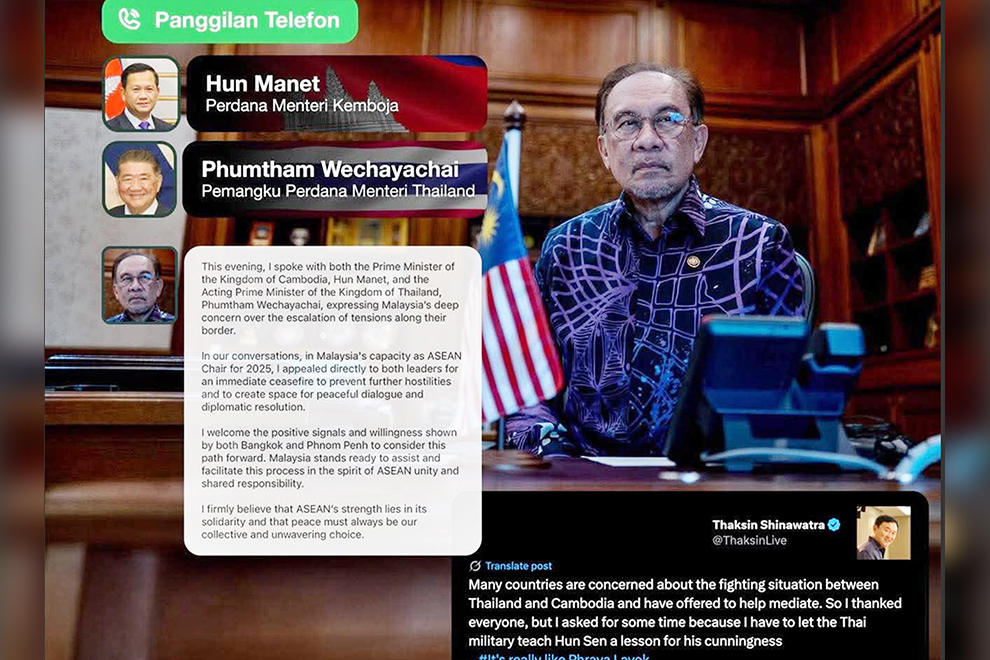
A controversial post by former Thai prime minister Thaksin Shinawatra has been interpreted by many as a call for Thai military aggression against Cambodia, with no consideration for the role of the ASEAN chair.
Tensions between Thailand and Cambodia sharply escalated yesterday, with intense border clashes taking place in multiple locations.
As the situation grows more dire, the international community remains on edge.
ASEAN’s commitment to peace and unity is being put to the test, as it grapples with the challenge of mediating a resolution to the conflict.
Malaysian Prime Minister Anwar Ibrahim, who serves as ASEAN chair, reiterated Malaysia’s readiness to assist in facilitating dialogue, emphasising that ASEAN’s strength lies in its collective pursuit of peace.
Anwar stated that he expressed Malaysia’s concerns over escalating border tensions to the prime ministers of Cambodian and Thailand. As ASEAN chair, he urged both leaders to implement a ceasefire to prevent further conflict and facilitate peaceful dialogue.

“I welcome the positive signals and willingness shown by Bangkok and Phnom Penh in considering this matter. Malaysia stands ready to assist and facilitate this process in the spirit of ASEAN unity and shared responsibility,” Anwar said, via a July 24 social media post.
“I firmly believe that ASEAN’s strength lies in its solidarity, and peace must always be our collective and unwavering choice,” he added.
However, just an hour later, Thaksin, currently awaiting the verdict of a lese majeste charge, posted a disturbing message.
“I asked for some time because I have to let the Thai army teach Hun Sen a lesson for his cunningness,” he said.
Thaksin’s remark sent shockwaves throughout Southeast Asia, as it directly contradicted ongoing diplomatic efforts led by ASEAN to resolve the dispute peacefully.
His inflammatory statement seemed to dismiss ASEAN’s call for peace and signal an alarming shift towards military force.
The post was interpreted by many as a clear indication of Thailand’s readiness to escalate the conflict, despite the international community’s efforts to mediate a peaceful solution.
Senate president Hun Sen responded strongly to Thaksin’s comments.
He expressed no surprise at the aggressive rhetoric, citing Thaksin’s controversial history, including his alleged betrayal of the Thai monarchy and his involvement in the deaths of hundreds of Thai Muslims in southern Thailand in 2004.
“What is worse is that he was involved in the killing of hundreds of Thai Muslims in the southern provinces in 2004,” Hun Sen said.
He also noted that Thaksin’s actions were not only a personal vendetta against him, but would lead to the suffering of innocent civilians, as the people of Thailand and Cambodia would bear the brunt of any military escalation.
“Under the pretext of taking revenge on me, he is resorting to war, the ultimate consequence of which will be the suffering of the people,” he added.
On July 24, Thai F-16 fighter jets reportedly launched airstrikes on the Ta Mone Senchey pagoda and a nearby health centre in Oddar Meanchey province, resulting in significant civilian casualties and destruction.
One airstrike, at around 5.30pm, killed a 70-year-old Buddhist clergyman at the pagoda. Local authorities reported that one civilian was killed and five injured.
The Ministry of Culture and Fine Arts condemned Thai attacks, highlighting damage to the UNESCO-listed Preah Vihear Temple.
The Cambodian government has evacuated approximately 5,000 citizens from the affected border areas, providing them with shelter and humanitarian aid.
Hun Many, Minister of Civil Service, also pointed out the concerning timing of Thaksin’s post, which seemed to directly defy ASEAN’s diplomatic intervention.
“Is this his answer to the appeal of Prime Minister Anwar Ibrahim?” Many asked.
He warned that Thaksin’s comments exposed Thailand’s true intent to resolve the issue through military means rather than peaceful negotiations.
“The post demonstrates to the rest of the world the real intent all along of Thai side to resolve the dispute through the use of military force,” he said.