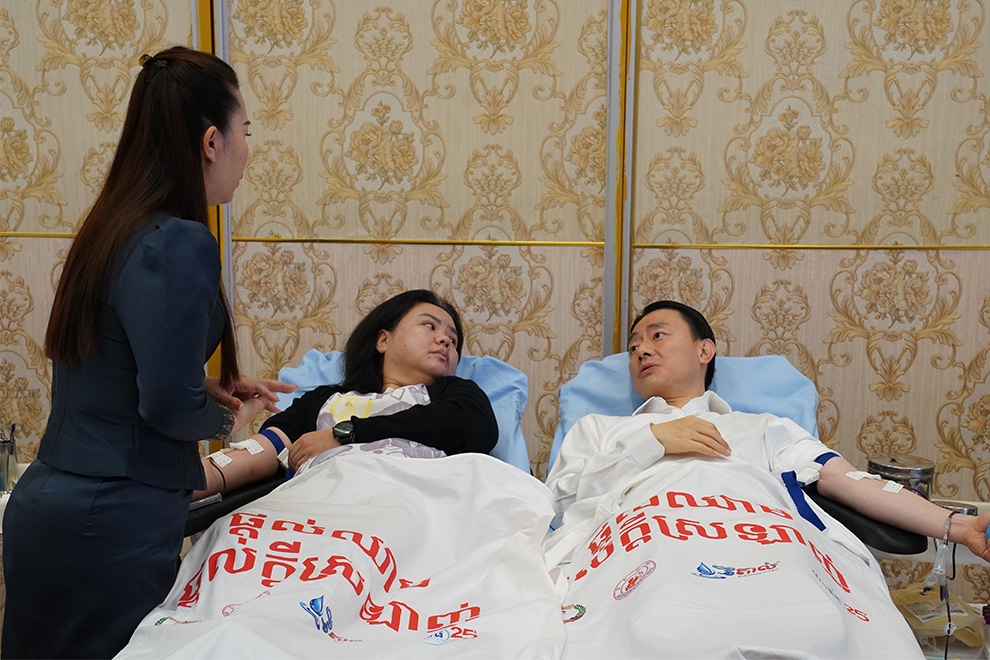
Blood drips slowly from a vein at the bend of the arm, flowing through a clear tube before resting quietly inside a blood bag. There is no sound and no spectacle, yet inside that small bag lies what hospitals can never afford to lack: life.
For doctors, blood is an emergency life-saving tool. For patients, it is a chance to survive once more. For voluntary donors, it is a quiet act of sacrifice that connects one human life to another without ever knowing each other’s names.
Originally conceived as an initiative to mobilise employees to donate blood for frontline soldiers during Cambodia’s efforts to safeguard its territorial integrity from Thai encroachment in December 2025, a large-scale blood donation activity was postponed and eventually held today January 21, with its mission broadened to serve all patients in need.
The event was organised for the first time by The Premier Land under the campaign “Save Lives, by Donating Blood Together”.
Mean Som Ol, chief executive officer of The Premier Land, said the affiliated companies plan to continue organising blood donation drives annually as part of their long-term contribution to society.
He said that this year, 380 employees from affiliated companies — out of more than 1,000 staff — voluntarily donated blood.
“Our volunteer staff initially wanted to donate blood at Koh Pich following a nationwide call to support frontline soldiers,” Som Ol said. “But there were too many people, with donors waiting until late at night.”
With an available venue and coordination with the National Blood Transfusion Centre (NBTC), the company decided to organise the donation drive at Première Centre Sen Sok to ensure accessibility and efficiency for staff.
Among the donors was Chea Phalla, 40, an employee at Garden City Water Park, who donated blood for the second time after her first donation in 2019.
She said her original intention was to donate blood for frontline soldiers who were carrying out missions to protect Cambodia’s territory.
Speaking to The Post while enjoying refreshments after the donation, Phalla said she felt only pride and emotion.
“I feel deeply moved to be able to donate blood for life-saving needs, especially for our heroic soldiers who once shed their own blood to protect our land from invaders,” she said.
Phalla noted that although her plan to donate blood had been delayed since December, her determination never weakened.
“We cannot give them much from here,” she said. “All we can offer is blood and small support. They protect the land, and we protect them — and others — through blood when it is needed.”
She added that frontline soldiers face immense hardship, from personal safety risks to food and rest shortages, and that civilian blood donation is only a small sacrifice compared with what soldiers have endured.
Phalla said she remains ready to participate in other humanitarian causes within her capacity.
At the event, Dr. Heng Sokchamroeun, deputy-director of the National Blood Transfusion Centre of Cambodia under the Ministry of Health, said voluntary blood donation is a deeply meaningful humanitarian act that not only saves patients’ lives but also fosters a culture of sharing and sacrifice in society.
She said Phnom Penh requires between 350 and 400 units of blood per day, while voluntary donations average only 100 to 150 units daily — a shortfall that remains a serious concern.
Nationwide, annual blood demand stands at nearly 212,428 units, she said, while voluntary donations have yet to meet international standards.
“Blood cannot be manufactured,” Sokchamroeun said. “There is only one source — human beings.”
She explained that the campaign “Save Lives, by Donate Blood Together” carries two key objectives: first, to build habits and a culture of voluntary blood donation among youth and the general public to ensure sufficient blood supply for patients in all hospitals without discrimination; and second, to link voluntary blood donation with broader humanitarian action in society.
Sokchamroen stressed that blood donation does not harm health and, in fact, offers multiple benefits.
Donors receive health screenings, reduce risks of certain cancers, lower excess iron levels that can affect the liver and pancreas, and improve heart health while reducing risks of stroke and excessive weight gain.
“Blood donation does not only help others,” she said. “It can save members of our own families and protect people across society from preventable death.”
She urged the public not to delay acts of compassion.
“Do not wait until the moment you want to help but can no longer do so because of age, illness or circumstances,” she said, adding that red blood cells naturally die after 120 days if they are not donated.
According to the NBTC, only 33.2 percent of Cambodia’s blood demand is currently met through voluntary, unpaid donations.
The World Health Organization recommends that at least 90 percent of the national blood supply should come from voluntary donors to meet international standards.
Sokchamroen emphasised that participation from the private sector and organisations remains critical.
“Companies, organisations and ministries with large workforces can contribute up to 500 units per campaign, with usable blood rates reaching as high as 80 percent,” she said.
As blood continues to drip quietly from donors’ veins into waiting bags, the act stands as a reminder that even in times of peace, sacrifice endures — no longer on the battlefield, but in donation rooms where lives are saved, one bag at a time.