Twenty indigenous communities have so far received nearly $2 million in direct funding from the Keo Seima REDD+ Project. The capital has supported improvements in health, education, infrastructure and income generation — efforts that are helping reduce their dependence on natural resources.
The funding is provided through the Cash for Communities programme (C4C) under the Keo Seima REDD+ Project, which began in 2010, owned by the Ministry of Environment, with implementation by the Wildlife Conservation Society (WCS) Cambodia, in Mondulkiri province.
The C4C programme is a benefit-sharing mechanism that distributes revenue from carbon credit sales, and is at the core of the Keo Seima Wildlife Sanctuary’s conservation strategy.
“This is the first and only such benefit-sharing system in Cambodia, providing direct cash payments to local communities, empowering them to initiate more projects — more than 350 projects have already been implemented,” stated WCS Cambodia.
The environment ministry and WCS Cambodia organised a three-day field visit for journalists last weekend to showcase key project outcomes in promoting sustainable community development.
One such success story is Leng Kao Waterfall, located in Andoung Kraloeng village, Sen Monorom commune, O’Raing district, which has become a community-run ecotourism site for the Banong indigenous people.
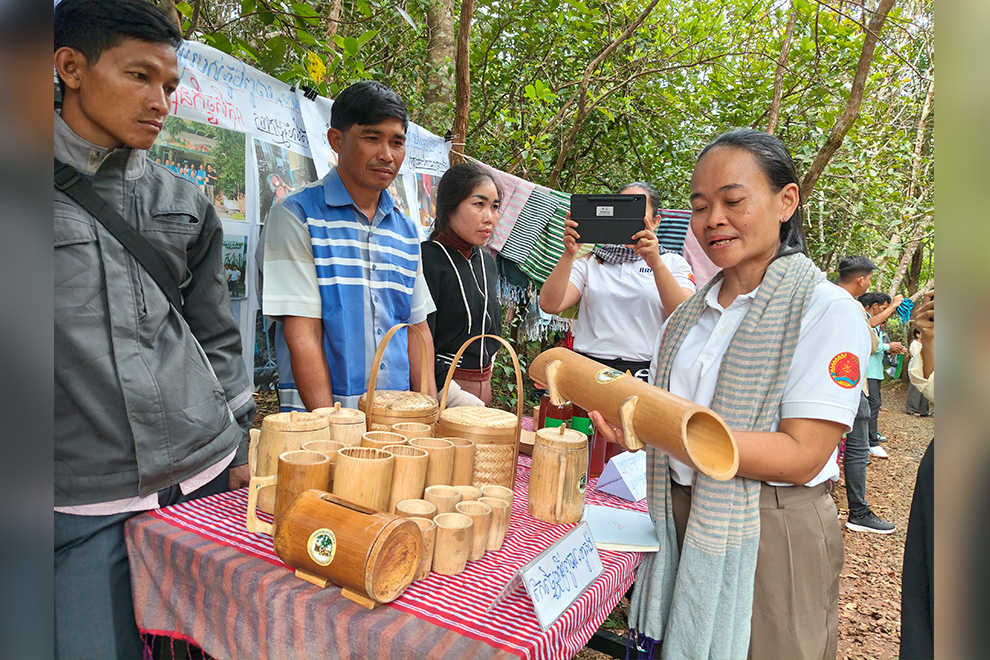
During the visit, community members staged an exhibition of local products — including woven scarves (krama), honey, materials made from bamboo, vegetables, soap, drinks, cakes and IBIS rice.
Pleng Seiha, 21 said her community in Pou Rang village has been weaving krama scarves to earn extra income since May 2023. Eleven women have been trained in weaving, helping reduce the community’s reliance on forest resources.
“We earn a modest but steady income from weaving. The more we weave, the more buyers we get. Instead of going to the forest, we spend our free time weaving. We’re helping conserve the forest. The project’s support has had a very positive impact,” she explained, while showcasing her kramas to the visitors.
The handwoven scarves are sold locally in Mondulkiri, as well as in Phnom Penh, and several other provinces. Seiha hopes that future support will further expand their weaving activities.
Under the Keo Seima REDD+ Project, the International Institute of Rural Reconstruction (IIRR) has also trained communities to produce bamboo crafts and dish soap.
Moeu Sokchea from IIRR explained that the bamboo products are made from old or fallen bamboo, rather than freshly cut ones — thus avoiding environmental harm while creating new income opportunities.
“When these products are sold, they help improve household livelihoods. When families have income, they don’t have to destroy the forest. Many people used to log trees because they had no money,” she said.
Khieu Samnang, a WCS Cambodia community livelihoods officer, said that aside from income from tourism, the project’s support in developing new occupations has helped communities earn sustainably without harming the forest.
“This is a new alternative for our communities. Before, they depended on forest exploitation; now, they can benefit from forest resources through new, sustainable livelihoods,” he said.
Khvay Atitya, undersecretary of state at the environment ministry, led the tour.
He noted that beyond reducing greenhouse gas emissions through forest protection and reforestation, the REDD+ project is also improving community livelihoods and promoting local development in which the communities are the owners and direct beneficiaries.
“This aligns with the ministry’s Circular Strategy on Environment to enhance community livelihoods… This is their income, derived from the green development goals of the government,” he said.
He added that there are 193 community protected areas nationwide, with over 50 having strong potential for eco-tourism, which the ministry is further developing — especially in Mondulkiri, through the REDD+ Project — to attract domestic and international tourists for longer stays and generate higher local incomes.
The nearly $2 million in funding provided directly to communities under the Keo Seima REDD+ Project was disbursed in four phases: Phase 1 (2017–2018) with $238,554; Phase 2 (2021) with $200,000; Phase 3 (2022): with $600,000 and Phase 4 (2024) with $800,000.
In the first two phases, all communities received equal funding. In the third and fourth phases, allocations varied depending on each community’s efforts to reduce deforestation, as measured by three key indicators: forest cover, participation in forest protection and community development activities.
The Keo Seima REDD+ Project covers 166,983 hectares of forest within the Keo Seima Wildlife Sanctuary, which spans more than 300,000 hectares across Mondulkiri and Kratie provinces.