The border tensions that continue to trouble mainland Southeast Asia are often mischaracterised as products of modern nationalism or regional rivalry. This explanation is convenient — but incomplete. In truth, many of today’s disputes are the direct consequence of borders created, administered and ultimately left unfinished during the colonial era, particularly under French Indochina.
During the late nineteenth and early twentieth centuries, France governed Cambodia, Vietnam and Laos as a single colonial entity. These territories were not treated as fully separate nations with clearly defined international borders. Instead, internal boundaries were drawn primarily for administrative control — taxation, labour management and provincial governance — within a unified imperial system.
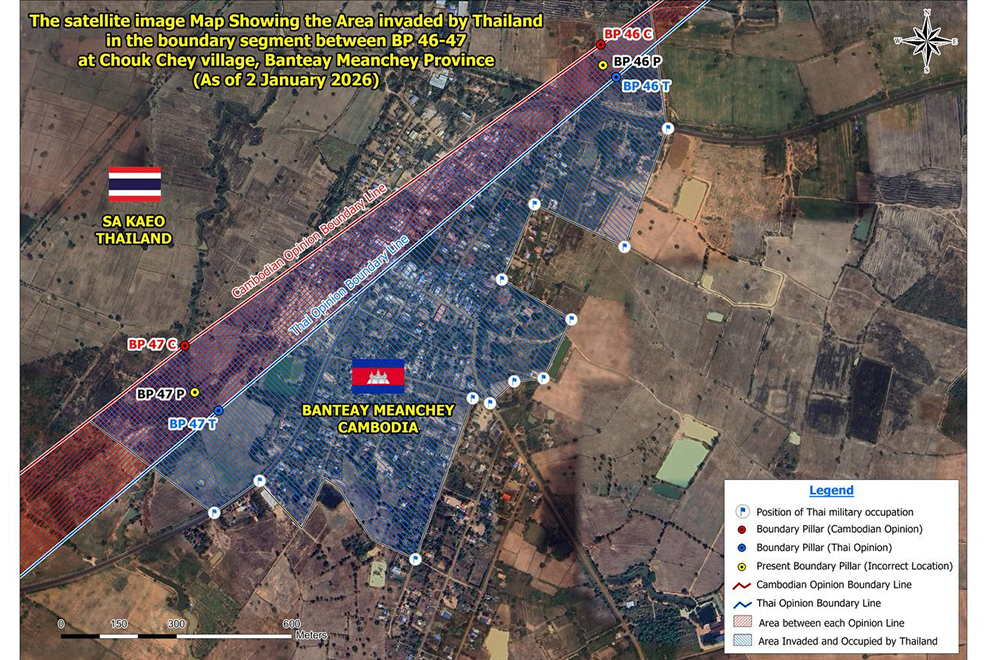
These lines were never intended to become the foundations of future sovereign states. They were often approximate, based on rivers, mountain ranges or administrative convenience, and frequently revised. In many frontier regions, full field surveys, permanent markers and legally finalised demarcations were never completed. What was left behind were maps that carried authority, but not finality.
To understand why France entered Cambodia at all, one must return to the harsh geopolitical realities of the mid-nineteenth century. At that time, Cambodia stood on the brink of disappearance. Pressured relentlessly by Siam (Thailand) and Vietnam, the Kingdom endured repeated wars, forced tribute, territorial loss and deep political interference. Cambodian sovereignty was steadily eroded, and its kings were often installed or removed under foreign influence.
Facing the real possibility that Cambodia would be absorbed entirely by its neighbours, King Ang Duong made a strategic and existential decision. He sought French protection not as an invitation to colonisation, but as a last means of survival — to preserve Cambodia as a distinct kingdom rather than allow it to vanish from history.
French protection, later formalised under King Norodom, did succeed in preventing Cambodia from being annexed. Yet it also placed Cambodia within a colonial framework whose borders were never fully clarified before independence. Protection saved the nation — but unfinished borders burdened its future.
Within this framework, the Franco–Siamese Treaties of 1904 and 1907 were signed. These agreements returned significant areas of historically Cambodian territory and produced maps defining the frontier between French Indochina and Siam. These maps later became central legal instruments in international law.
When France withdrew from Indochina in the 1950s, independence was granted to Cambodia, Vietnam and Laos. However, the crucial task of transforming colonial administrative lines into fully surveyed, mutually agreed international borders was left incomplete. Multiple maps, surveys and interpretations remained, silently planting the seeds of future conflict.
This is what scholars now call “heritage border disputes” — conflicts inherited from colonial administration rather than created by modern governments. Entire villages, forests and sacred heritage sites were left in legal ambiguity.
The case of Preah Vihear exposes this reality with undeniable clarity. In 1962, and again in 2013, the International Court of Justice ruled that the temple and its surrounding area belong to Cambodia, based on the very maps produced under the Franco–Siamese agreements. These rulings demonstrate a hard truth: colonial-era documents still decide modern sovereignty.
Because these borders were created under French administration, France today holds much of the original authority — archival records, maps and survey materials. This fact carries not blame, but responsibility.
If the French government were willing now to openly share, clarify and help reconcile these historical records, it could make a decisive contribution to regional peace. Such action would not reopen colonial wounds. On the contrary, it would close them.
France is a nation that speaks proudly of universal values, international law and historical responsibility. This is an opportunity to demonstrate those values in action — not through words, but through constructive engagement. By helping Cambodia and its neighbours complete the unfinished work of border clarification, France could help prevent future conflict and replace inherited uncertainty with lasting stability.
For the Cambodian people, this would not be remembered as a reminder of colonisation, but as an act of historical integrity and friendship. It would show that a great nation does not turn away from the consequences of history — but has the courage to help resolve them.
The world should understand this clearly: today’s border tensions in Southeast Asia are not failures of goodwill between neighbouring peoples. They are the delayed consequences of an unfinished colonial transition. Completing that transition peacefully is not only possible — it is overdue.
Tesh Chanthorn is a Cambodian citizen who longs for peace. The views and opinions expressed are his own.