At moments when rhetoric rises and statements from across the border suggest escalation, clarity must prevail over provocation.
Cambodia’s position is unequivocal: sovereignty is non-negotiable. Territorial integrity is not subject to pressure, intimidation or unilateral interpretation. Peace is preferable — but peace cannot be sustained through threats, nor preserved through coercive language.
Border matters are sensitive because they touch history, law and national identity. When inflammatory rhetoric enters the conversation, public concern is justified. But national strength is not measured by reactionary language. It is measured by resolve, discipline and readiness.
Cambodia does not seek confrontation. Yet Cambodia will not be pressured into silence, nor drawn into rhetorical escalation designed to destabilise confidence. Firmness anchors sovereignty. But firmness must be intelligent, not impulsive.
Strength Through Discipline — Not Volume
A confident state does not compete in rhetoric. It competes in credibility. Cambodia’s strength rests on three foundations.
Legal clarity.
Cambodia’s territorial position is grounded in historical documentation and recognised legal principles. Assertions must be matched by facts. Interpretation must be anchored in law — not volume.
Defensive preparedness.
The Cambodian armed forces stand ready to safeguard territorial integrity. Readiness is not aggression. It is responsibility. Stability is best preserved when deterrence is clear.
Strategic composure.
Escalatory language may seek to create urgency or political leverage. But urgency manufactured through rhetoric does not alter legal reality. Calm firmness protects long-term national interest.
True strength is disciplined. Yet sovereignty cannot rely on posture alone. It must be reinforced by structure.
Beyond Rhetoric: Building the Architecture of Stability
If rhetoric increases, the risk of miscalculation increases. And miscalculation is the real danger along any contested border.
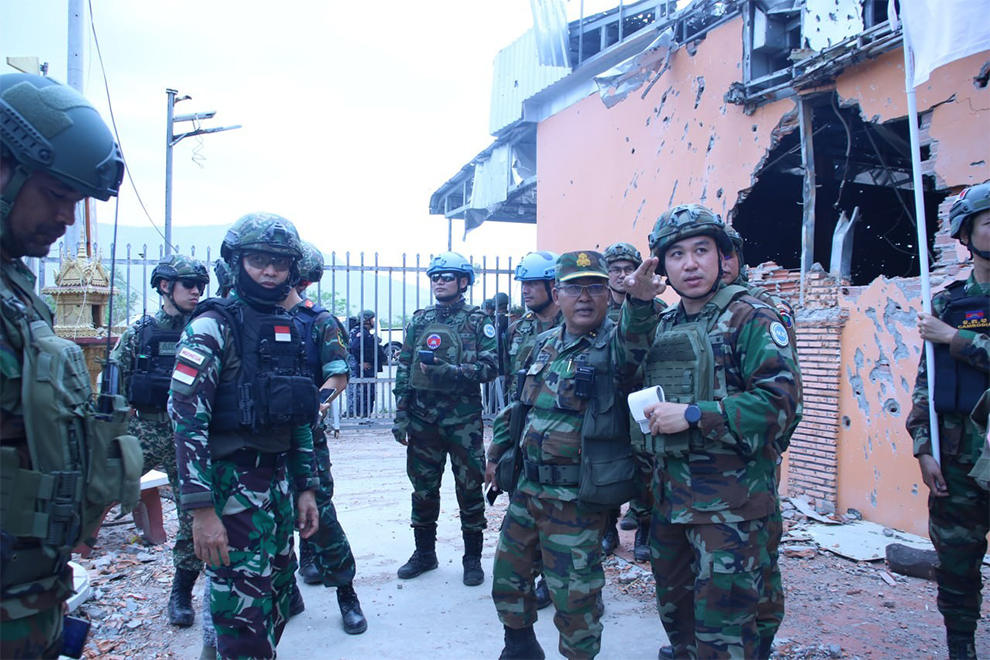
Southeast Asia has avoided many crises not because tensions never emerge, but because mechanisms exist to prevent escalation. The ASEAN Observer Teams (AOT) are part of that stabilising architecture.
The AOT carries a dual mandate:
- Monitoring ceasefire compliance and military posture.
- Assessing humanitarian and political realities on the ground.
These roles must not be symbolic. They must be operational.
If monitoring is mandated, it must be systematic:
- Clear verification benchmarks.
- Regular and predictable engagement.
- Documented observation of deployments.
- Timely incident verification.
- Structured follow-up that informs practice.
Observation without consequence invites repetition. Verification without follow-through weakens deterrence. When monitoring is credible, exaggerated claims lose credibility. When facts are verified, escalation narratives lose force.
Civilian Stability Is National Stability
Border tensions do not affect only military units. They affect farmers, traders, schools and communities.
If the AOT’s humanitarian and political assessment mandate is to mean anything, then civilian displacement must be documented, trade disruptions must be tracked, infrastructure impacts must be assessed and community stability must be evaluated.
Peace cannot be measured only in troop numbers. It must be measured in normal life.
Mechanisms must not operate in vain. Their findings must shape stabilisation measures.
Transparency Counters Escalation
In today’s environment, silence can be misinterpreted. Rumour spreads faster than verification. Calibrated transparency strengthens stability.
The AOT does not need confrontational press conferences. But structured public summaries confirming verified realities would counter misinformation and reduce speculative escalation.
Strong states are not threatened by facts. Facts reinforce credibility.
Institutional Strength Is Strategic Strength
Strengthening regional mechanisms does not weaken sovereignty. It strengthens Southeast Asia’s ability to manage disputes internally — without external intrusion.
If ASEAN mechanisms remain credible, disputes remain contained. If they erode, outside narratives fill the vacuum.
Institutionalisation means:
- Building institutional memory.
- Tracking incident patterns.
- Professionalizing observer practices.
- Linking findings to ASEAN deliberations.
- Ensuring monitoring translates into measurable practice.
This is not dependence. It is strategic insurance.
Firmness Without Recklessness
Cambodia will defend its sovereignty. That is clear. But Cambodia will not be provoked into instability through rhetoric alone.
Firmness protects borders. Institutional strength protects stability.
These are not competing paths. They are complementary pillars of national security.
Escalation may generate attention. Stability generates security.
Cambodia’s advantage lies in disciplined resolve, legal clarity, defensive readiness, and institutional foresight.
Strong nations defend their sovereignty. Strategic nations prevent crisis before it begins. In times of rising rhetoric, maturity is strength. And strength, exercised wisely, endures.
Panhavuth Long is founder and an attorney-at-law at Pan & Associates Lawfirm. The views and opinions expressed are his own.