When the guns fell silent on the night of July 28, 2025, many hoped it marked a turning point at the border. After days of clashes that left soldiers dead, civilians displaced and historic cultural heritage sites severely damaged, Cambodia and Thailand finally agreed to a ceasefire, brokered through urgent regional diplomacy led by Malaysia, with support from the US and China.
But behind this fragile momentum, Thailand is playing the long game. They are manipulating the story to project an image of peace, while quietly reversing the truth on the ground. At the recent General Border Committee (GBC) meeting in Malaysia, the Thai delegation laid out eight well-prepared proposals, strategically timed to frame Thailand as the party seeking dialogue and resolution. In conflicts like this, the first to frame the story often defines it, and Thailand has seized that advantage. Cambodia now faces the difficult task to catch up Thailand’s narrative chessboard.
Then we ask: Is Thailand really seeking peace or simply buying time for its desired outcome?
Abduction as a Tool of Foreign Policy
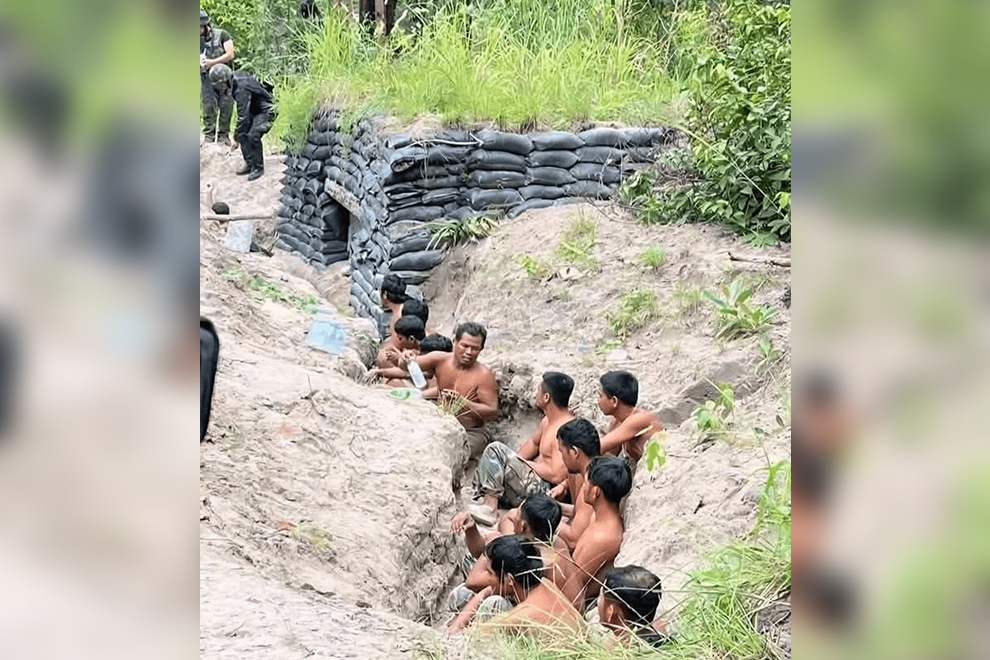
Let us begin with the unlawful abduction of 20 Cambodian soldiers just hours after the ceasefire was declared. According to Major General Chanth Sopheaktra, Commander of the Preah Vihear Operational Area, Thai forces invited Cambodian troops to pose for a symbolic group photo to commemorate the ceasefire. What was meant to be a gesture of goodwill turned into an alarming act of deception: Thai soldiers suddenly emerged from a nearby forest and apprehended the Cambodian troops at gunpoint.
How could such an abduction occur after a declared halt in fighting?
Thailand defended their actions by accusing the Cambodian soldiers of crossing into their territory. They further reframed the incident as an immigration and border security issue, conveniently distancing it from being recognised as a violation of the ceasefire.
That act echoes Colonel Walton K. Richardson’s analysis in “Prisoners of War as Instruments of Foreign Policy”. Though in this case, Thailand clearly abducted hostages. He argued that captives were not simply wartime casualties, but were deliberately used to delay peace, manipulate negotiations and serve broader diplomatic objectives.
In that sense, Cambodian soldiers are now being selectively released, not as a gesture of reconciliation, but seemingly as political currency to gain leverage in political talks and extract diplomatic concessions at the GBC Meetings. Only two soldiers were returned: one with a broken arm and one suffering psychiatric illness, despite the Thai Second Army Regional Commander initially agreeing to release all hostages by August 1.
One could say Thailand is sweeping up soldiers when it can’t control the land or win fairly. It uses abducted troops as leverage or bargaining chips. Negotiations now unfold with this reality in mind.
Manufacturing Legitimacy through Prolonged Conflict
At the heart of Thailand’s strategy lies the deliberate prolongation of conflict. Why prolong the fighting, either militarily or diplomatically? Because extended conflict helps normalise aggression that creates a context in which extraordinary measures can become justified. It allowed power maintenance for the Thai military and its foreign officials to manufacture multiple narratives that bolster domestic legitimacy while persuading the international community to overlook the true source of the bloodshed.
On one hand, coordinated or not, it is the Thai defence ministry that is on a killing spree. On the other, the Thai foreign ministry is working to contain the political damage, shaping a positive portrayal of the government’s role. This dual-track approach fits what political scientist John Mearsheimer describes in “Why Leaders Lie”. They lied strategically to cover up uncomfortable truths. Their deception is not only aimed at foreign adversaries but also at concealing illegal or unpopular acts from their own public and institutions.
Apparently, the Thai military has downplayed civilian casualties and masked troop movements to avoid losing legitimacy and to rally nationalist sentiment. It leads to another element of the strategy: Fearmongering. Leaders exaggerate external threats to strengthen their domestic standing and to defer accountability until they achieve their desired political outcome.
Perhaps, what they really want is the procedural silence; it is to calm things down just enough so they can continue their actions without being questioned. Thai leaders often try to make themselves look strong and shift attention away from domestic issues. Once they have done that, they may suddenly change their tone. The same leaders who pushed the conflict will now speak softly in peace talks.
Implications for Cambodia and the Region
Regardless of Thailand’s attempts to twist the narrative, Cambodia firmly rejects its claims and stands by the truth with multilateralism and legal channels against time and control. Cambodia must now ask: how many more violations must we suffer before the truth is finally acknowledged?
Thailand’s framing risks reducing this serious conflict to a mere misunderstanding or miscommunication. If this narrative is accepted, Cambodia risks losing its moral and emotional appeal as a peace-loving nation caught in unjust aggression. The suffering of displaced civilians and the destruction of historic sites could be overlooked or minimised.
Cambodia’s challenge is to keep the truth up front and centre, and avoid falling into Thailand’s checkers game, where symbolic gestures and packaged agreements replace genuine accountability and resolution.
Perhaps, we must clarify that the 20 Cambodian soldiers are not Prisoners of War (POW), at least if we oblige with the Third Geneva Convention. Their detention took place after a ceasefire was declared, not during ongoing hostilities, and not in a combat zone. In that case, Thailand’s action violates multiple international treaties including the Universal Declaration of Human Rights (UDHR), the International Covenant on Civil and Political Rights (ICCPR) and the UN Convention Against Torture (UNCAT), all of which guarantee protection against arbitrary detention, torture and unlawful treatment.
On a regional posture, Thailand’s narrative exposes the political complexity behind its actions and its readiness to manipulate facts to rally domestic support and gain diplomatic advantage. The international community watches and understands that Thailand’s political strategy is calculated and that it will frame events to maintain nationalist support at home.
Neighbouring countries and global partners must remain vigilant and insist on transparent, multilateral processes that uphold justice and lasting peace, rather than allowing opportunistic narratives to dictate outcomes.
Conclusion
Thailand’s carefully crafted narrative serves as a strategic tool to buy time, control perceptions and avoid full accountability. Nevertheless, Cambodia is by no means left powerless.
Cambodia and the region must see through this calculated playbook and demand that peace be based on truth, justice and mutual respect, not on manipulation and procedural silences. Only through upholding the rule of law and embracing dialogue in good faith can we hope to transform this difficult chapter into a foundation for lasting peace.
Pheng Thean is a research associate at the Asian Vision Institute (AVI) and an international relations student at the Institute for International Studies and Public Policy (IISPP). The views and opinions expressed are his own.