The recent armed clashes along the Cambodia–Thailand border were sparked by the events of May 28, 2025. The five-day conflict was far from a desirable outcome for either nation. In fact, it was an unwelcome development, considering that both sides have repeatedly affirmed their commitment to resolving border disputes through international law and existing bilateral mechanisms, particularly those outlined in the 2000 Memorandum of Understanding (MoU 2000).
This raises the critical question: Why do these two countries continue to fall into armed conflict?
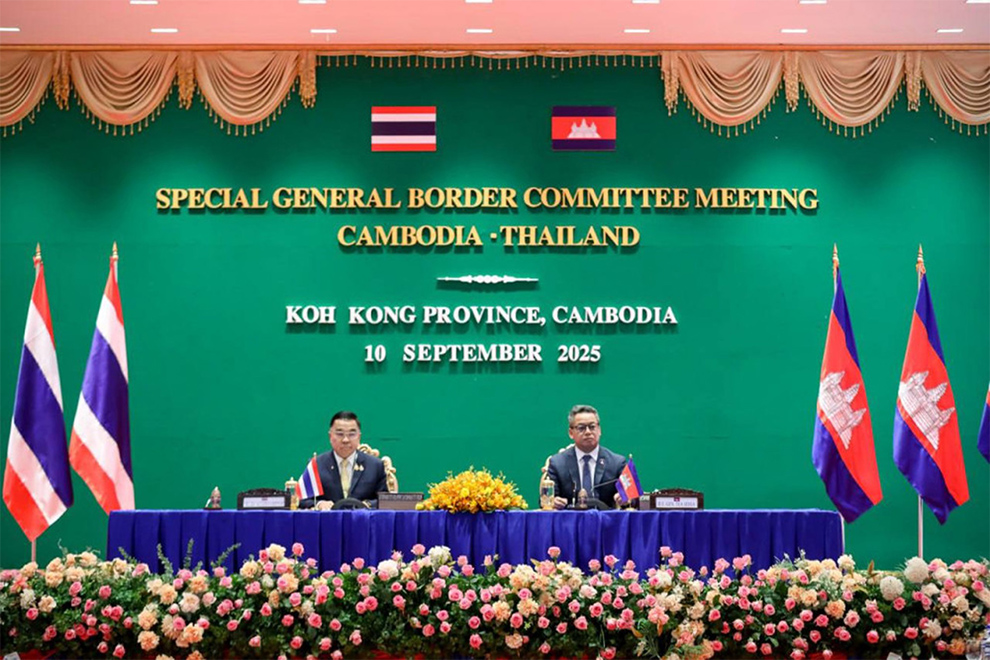
The outcome of the latest General Border Committee (GBC) meeting offers a glimmer of hope. It is a positive sign that Cambodia and Thailand are capable of managing their disputes peacefully in the near future. The people of both nations are eagerly waiting for political normalisation to take hold.
One of the root causes of continued tension is the lingering, unresolved border demarcation — compounded by strong waves of nationalism. Such sentiment is often exploited by political actors on both sides for domestic political gain.
The complex and often turbulent history between Cambodia and Thailand dates back centuries. Despite sharing a rich cultural heritage and many social and linguistic similarities, the relationship has also been marked by territorial disputes and periodic conflict.
Nevertheless, in recent years, the two nations have made genuine efforts to deepen their ties. Cooperation has expanded in areas such as trade, tourism, security and cultural exchange. This progress culminated in the establishment of a Strategic Partnership in 2024, aimed at further strengthening long-standing relations and exploring new avenues for mutual development.
History reminds both nations of a time before modern borders — when cultural exchange and inter-civilisational influence were fluid and rich. Today, Cambodians and Thais continue to share similar linguistic roots, traditional music and dance forms, while also retaining their distinct national symbols and customs.
In 2024, the elevation of Cambodia–Thailand relations to a Strategic Partnership marked a milestone in bilateral cooperation. Trade and investment have seen significant growth, with Thailand emerging as a major investor in Cambodia. Meanwhile, Cambodian labour continues to play an important role in Thailand’s economy. Infrastructure and connectivity efforts, such as the Thailand–Cambodia Friendship Bridge and the revival of railway services, are also helping to facilitate trade and people-to-people ties.
However, border demarcation remains a highly sensitive and complex issue. Disputes — especially over the Preah Vihear Temple — have periodically escalated into military confrontations. More recently, clashes have extended to other contested sites, including the temples of Ta Mone Thom, Ta Mone Touch, Ta Krabey and the Emerald Triangle area.
Several recent flashpoints were exacerbated by the spread of fake news, tit-for-tat narratives and competing historical interpretations — all of which inflamed nationalist sentiment on both sides. These factors played a significant role in sparking the most recent hostilities.
Nevertheless, the results of the GBC meeting held in Koh Kong in 2025 are widely viewed as a new and positive turning point. Both sides expressed a clear willingness to rebuild mutual trust and return to what they referred to as the “status quo ante May 28, 2025”. The goal is to transform the border from a zone of tension into a space of peace, security and prosperity for the people of both countries.
As ASEAN member states, Cambodia and Thailand are committed to living in a shared community — politically, economically and culturally. The hope remains that both nations will not only restore peace, but also raise the living standards of border communities and fully embrace the opportunities of globalisation and interdependence.
Long Sokun is a former researcher on the 1962 Preah Vihear case and the 2007-2008 Task Force. The views and opinions expressed are his own.