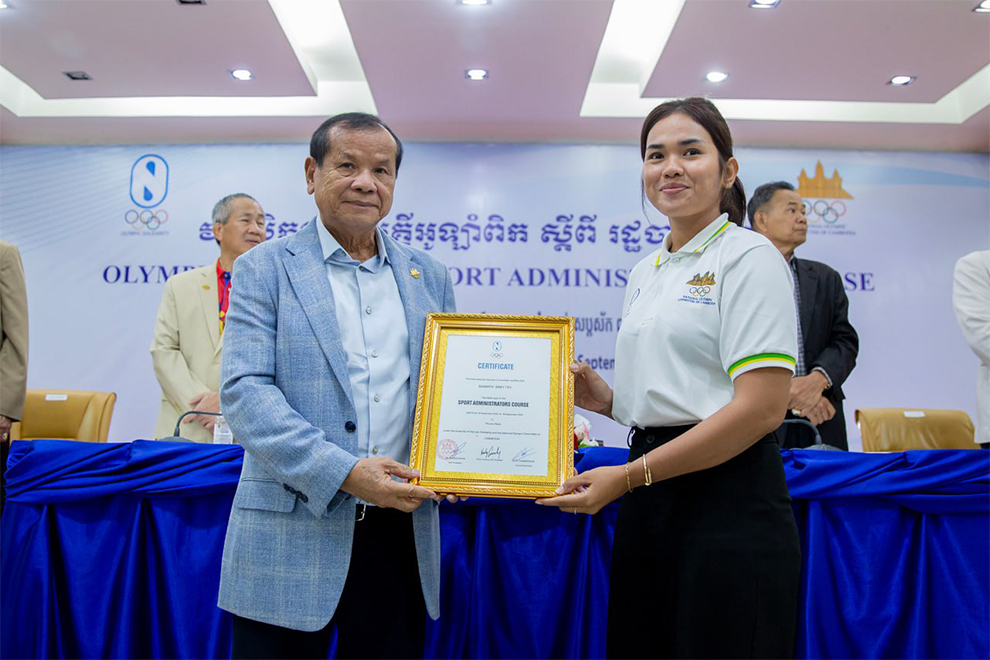
Thong Khon, president of the National Olympic Committee of Cambodia (NOCC), has lauded the progress of the Kingdom’s sports administrators, as he congratulated the graduates of the Olympic Solidarity Sports Administration course.
He explained that the course will support the development of all sporting codes, so that Cambodian athletes can reach competitive parity at the regional, continental and global levels in the future.
He delivered his remarks as he addressed the closing ceremony for the course at the NOCC headquarters on September 18.
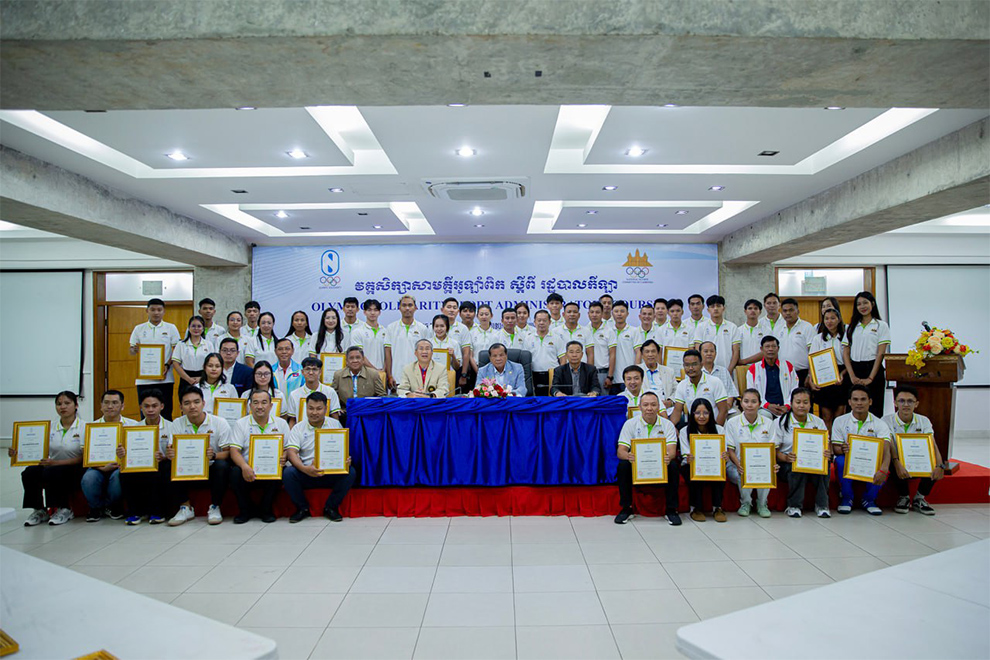
The course was attended by 56 coaches and sporting officials, including 18 women. They trained under six expert instructors from September 15–18.
“The Olympic Solidarity sports administration course provided essential fundamentals in the process of leading and managing sports organisations with transparency, integrity, good governance and strong leadership,” said Khon.
“It ensures effective work and contributes to the development of each specialised sport, enabling Cambodia to achieve competitiveness at regional, continental and global levels in the future,” he added.
He noted that all participants gained a deeper understanding of the Olympic Movement’s good governance principles — essential values which all members, including national sports federations, must implement to comply with the Olympic Charter.

He explained that sports administrators must understand both national and international sporting regulations. Cambodia has a national sports policy, strategy and development framework, but their implementation must be carefully examined to ensure compliance with international sports principles and the Olympic Charter in order to achieve sustainable sports development.
Khon believed the course provided participants with new knowledge in sports administration, sports science and theory, which they can use to serve their national federations effectively.
“The most important thing is to apply this expertise correctly and share it further with the sports community to achieve tangible results in building and developing each sport within its own federation,” he said.
According to evaluation reports from the six instructors and the organising committee, the results were excellent. Among the 56 participants, 40 (71%) received “very good” grades, 7 (13%) “good”, and 9 (16%) “average”.
To build on this success, the NOCC plans to organize the first Advanced Sports Management Course later this year for senior officials and sporting leaders. This second-level course will strengthen their ability and knowledge in managing sports institutions effectively, in line with the Olympic Movement’s leadership principles.
Khon called on the graduates of this course, as well as other sporting leaders, to participate in the upcoming advanced management training:
“Sports are professional disciplines governed by international technical codes, regulations, and ethical standards. No country or state can act outside or against these standards,” he stated.
“The implementation of national sports development policies in all countries must ensure compliance with the Olympic Charter, respecting the partnership and autonomy of national Olympic movements, balancing relations between civil sports organisations and state sports authorities, and recognising each other’s independence, rights and responsibilities. This partnership is essential for the cooperative promotion of sports development,” he added.