



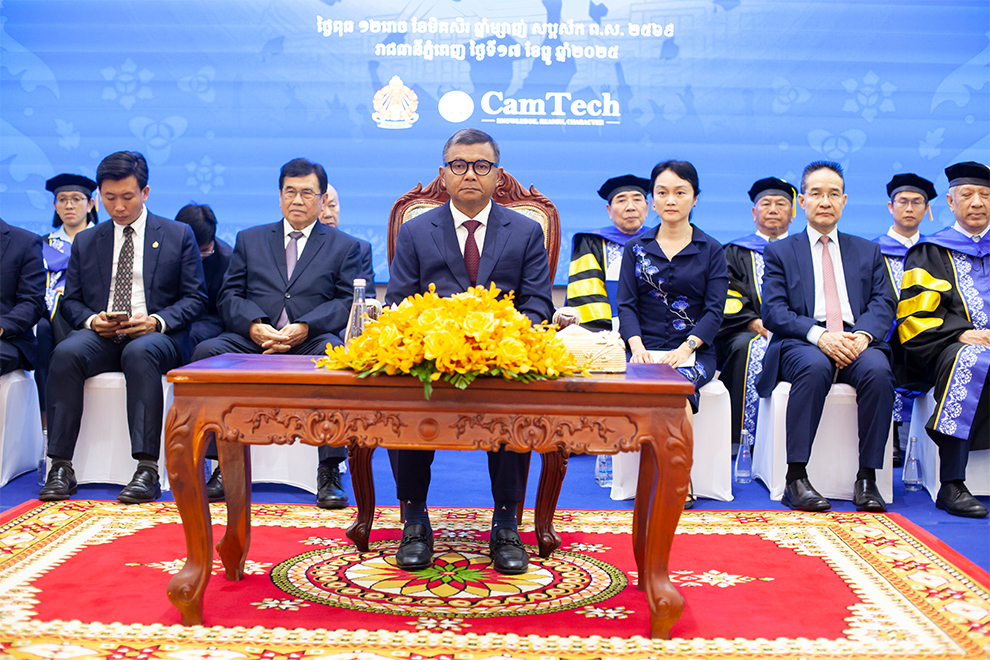
Minister of Education, Youth and Sport Hang Chuon Naron has warned that Cambodia could fall further behind developed nations if it fails to embrace artificial intelligence (AI). He urged universities to adopt the technology quickly but responsibly to safeguard genuine learning and national competitiveness.
Speaking at the December 17 graduation ceremony of CamTech University, Naron said AI is already transforming how students learn, how economies grow and how societies function, but warned that delays in adoption would widen the gap between developed and developing countries.
“AI helps students learn faster, gain more knowledge and also contributes to economic growth, accelerating the digital revolution,” he said.
“But if Cambodia does not yet embrace AI technology, it will create a wider gap between developed and developing countries,” he added.
The minister acknowledged that AI is reshaping multiple sectors, including education, agriculture, industry and the economy, citing future applications such as drones being used to study soil conditions and apply fertilisers around the clock.
At the same time, he said the technology is disrupting labour markets, with some jobs declining while others emerge.
“Some writing-related careers have been replaced by AI, but other careers are on the rise,” Naron said.
“AI helps students’ research and helps them study more effectively,” he continued.
However, he drew a clear line on academic integrity, warning against overreliance on AI in higher education.
“Relying on AI to write dissertations is not learning, because the idea was created by AI,” he noted.
To address these risks, he explained that the education ministry is encouraging universities to adopt AI responsibly by developing codes of ethics and rethinking teaching and assessment methods.
He stressed that educators must adapt to the AI era by prioritizing critical thinking, problem-solving and leadership over rote learning.
“In this AI era, teachers need to improve their teaching methods to encourage students to do their own research, solve problems, think critically, be leaders, and use AI as a help,” Naron said, adding that oral examinations should be promoted to reflect real knowledge rather than work generated by artificial intelligence.
Despite his cautions, he said all forms of learning, including learning supported by AI, can be beneficial when used appropriately.
Addressing the graduating class, Naron said their degrees marked more than an academic milestone, calling on them to become active contributors to national development under Cambodia’s Vision 2050.
“Today, you are not only receiving your degrees, but are also taking steps forward as future leaders, engineers, researchers, policymakers, entrepreneurs and innovators,” he said.
“I would like to inspire all people to increase their ideals and love for learning as a capital to change our destiny and our nation for the better from one generation to the next,” he added.
He urged Cambodian youth to channel frustration into self-improvement, saying: “May Cambodian youth turn anger into hard work to learn, strengthen their capabilities and defeat our enemies in the long run.”
At the same event, Lim Lina, a representative of CamTech University’s Board of Directors, said education and human resource development are central to Cambodia’s long-term growth.
She highlighted the university’s alignment with the government’s Pentagon Strategic Plan and Vision 2050.
“In close cooperation with the education ministry, CamTech successfully established the Artificial Intelligence Laboratory for Education to strengthen capacity in education, research and the practical application of AI technology,” she said.
Professor Sothy Khieng, founding president of the Cambodia University of Technology and Science, said CamTech aims to support Cambodia’s transition toward a digital economy and middle-income status by 2030 through applied research and innovation-focused education.
“As an innovation-focused and entrepreneurial institution, we strive to rebrand Cambodia as a hub of knowledge, technology and startups,” he said.
He noted the university’s commitment to producing graduates in architecture, software engineering, data science, AI and robotics.
He also announced the official launch of the CamTech Alumni Association to strengthen professional networks and long-term contributions to national development.
Graduates echoed the message of resilience and adaptation. Kry Sorachna, who earned a bachelor’s degree in data science and artificial intelligence, encouraged peers to embrace discomfort.
“Even if it feels uncomfortable or awkward, give it a try. It’s better to do it now than never,” she said.
Voun Chhorvan, a bachelor’s graduate in architecture, said the challenges behind the degree had prepared him for the future.
“Behind this degree were long nights, heavy pressure and the strength to keep going. These challenges shaped my character, and now I’m ready to build the future I envision,” he said.
The ceremony underscored a clear message from the education minister: AI is no longer optional for Cambodia, but without clear rules, ethical use and stronger teaching methods, it risks undermining the very learning it promises to enhance.
