



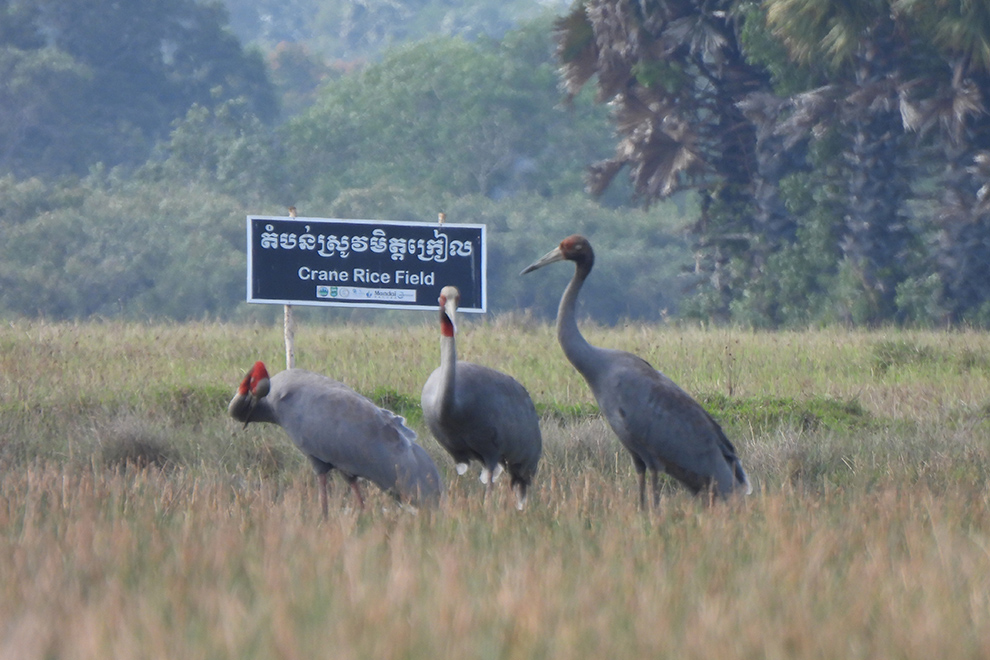
Some 20 national and regional conservation institutions met in Cambodia to discuss conservation efforts and share experiences on protecting the sarus crane. The Cambodian population of the species — one of the world’s most critically endangered — has shown the highest global increase of the past three years.
The Mekong Sub-regional Sarus Crane Conservation Workshop was held on December 2. It was organised by the General Department of Nature Conservation of the Ministry of Environment, NatureLife Cambodia (NLC) and the Cambodia Sarus Crane Working Group.
Organisers explained that the main purpose of the forum was to discuss conservation efforts and recent research among participants from Cambodia, Myanmar and Nepal, and share challenges and results, with a focus on conservation and restoration.
In addition, the workshop aimed to strengthen cooperation among participating institutions and encourage public involvement and support — especially from students — for sarus crane conservation activities.
The sarus crane population in the lower Mekong basin has declined alarmingly over the past decade. Annual monitoring results show a drop from 869 individuals in 2011 to just 156 in 2022. However, since 2022, the population has begun to increase.
The 2025 Sarus Crane census recorded 214 individuals in Cambodia, the highest number since 2020 — an increase of up to 37 per cent compared to 2022. Nevertheless, the species continues to face numerous threats.
NLC director Bou Vorsak noted that in recent years one major threat has been the excessive use of chemical fertilisers.
“In 2017, nearly 10 sarus cranes died in the Anlong Pring Protected Landscape in Kampot province. Laboratory tests found that they died from poisoning while foraging in local rice fields,” he said.
He added that natural aging also contributes to a high mortality rate, along with habitat loss, nest poaching and other disturbances. He explained that although the species can fly, it cannot perch in trees, which is why it nests on grassland.
Five key topics were presented and discussed at the workshop: updates on the conservation status of the cranes in Cambodia, Myanmar and Nepal, research and habitat restoration efforts, rescue operations and nest protection, crane-friendly agricultural initiatives and the broader status of sarus crane conservation in the Mekong Sub-region and across Asia.
The event was chaired by Srey Sunleang, director-general of the General Directorate of Natural Protected Areas, and brought together 73 participants, including experts from Cambodia, Myanmar and Nepal, park rangers, students and forestry officials, as well as representatives from conservation organisations. These included BirdLife International–Asia, NatureLife Cambodia, ICF, WWT, WCS, WWF, CBC, FFI, WEA, SVC, CBGA, CI and IUCN.
