



The Ministry of Environment has requested that capital and provincial administrations across the country strengthen the implementation of measures to prevent public air pollution, as part of efforts to protect the environment and address air-pollution issues in Cambodia.
In a November 27 notice, environment minister Eang Sophalleth sought enhanced cooperation with the governors of capital and provincial administrations to guide municipal, district and commune authorities to promote air-pollution prevention and reduction measures. These include educating and advising the public not to burn grass fields, agricultural waste, forest debris, trash, or plastic waste in open areas — along with the burning of landfill sites.
They should also prevent dust pollution at construction sites and during the transport of construction materials, regularly clean along roads and public spaces, and prepare equipment and tools to suppress or extinguish fires should the burning of grass, agricultural waste or other materials occur.
The ministry requested that sub-national administrations take immediate action, in line with the Environmental and Natural Resources Code, with no exceptions. This includes action against company owners, factories, enterprises and handicraft operations that burn textile scraps or industrial waste of any kind in boilers, furnaces or brick kilns that are not equipped with air-pollution control and filtration systems.
Further, they must halt the burning of all types of waste inside or outside factory compounds, enterprises or public areas, and must install smoke-filtration systems to ensure emissions comply with air-quality standards.
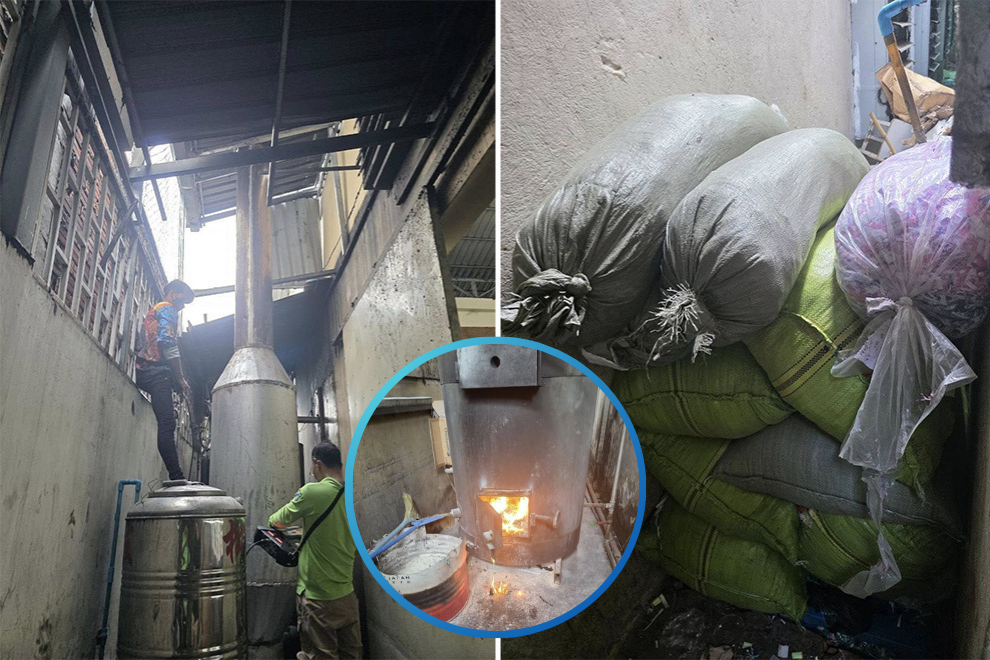
A November 17 inspection by a team from the ministry determined that Xing Xi Wang (Cambodia), a garment-cutting service located in Chom Chao I, Por Senchey district, Phnom Penh, was polluting the environment. The team — joined by officials from the district administration and the Phnom Penh Department of Environment — found that the company was burning approximately 3–4 bags of textile scraps (each weighing about 20 kg) in a steam boiler each day.
“The boiler is of a basic type and is not equipped with a filtration system. The air quality measured at the primary exhaust point exceeded standard limits. The company has been operating without an environmental protection contract or the required waste-emission permits,” the ministry stated.
The ministry ordered the company to immediately cease burning scraps in its boiler and install a filtration system. The company must also prepare an environmental protection contract for submission to the ministry for review and approval, and request a waste-emission permit.
In addition, the company faces administrative penalties under Articles 161, 173, and 668 of the Environmental and Natural Resources Code, as well as Sub-Decree No. 42 on air-pollution control. The company will also be required to compensate for public-health impacts and environmental damage based on official assessments by technical officers.
