



More than 120,000 Cambodians were affected by flooding in the first nine months of year, according to the National Committee for Disaster Management (NCDM). Tragically, 20 people lost their lives to flash floods and rising river levels, 12 of them children.
Committee spokesperson Soth Kimkolmony announced today, October 23, that from January to September, flooding affected 20 provinces, impacting the entire country, bar Phnom Penh, Kampot, Kep, Takeo and Kampong Speu.
The disasters affected 41,513 households, or 124,676 people, with 1,782 families (around 5,900 people) evacuated from their homes. 23,489 houses were flooded, along with 62 school buildings, 13 pagodas, 28 health centres and 5 government offices.
“There were 20 fatalities, including 7 women and 12 children,” said Kimkolmony.
Four Tompuon indigenous villagers, including two small boys, have been missing since September, when floodwaters swept away their homes in Samaki commune, O’Chum district, Ratanakkiri province.
Floodwaters also inundated 30,702 hectares of rice fields and 8,118 hectares of other crops. Of them, 8,621 hectares of rice and 3,756 hectares of other crops were damaged or destroyed. The flooding also forced the evacuation of 1,871 livestock animals, of which 50 died.
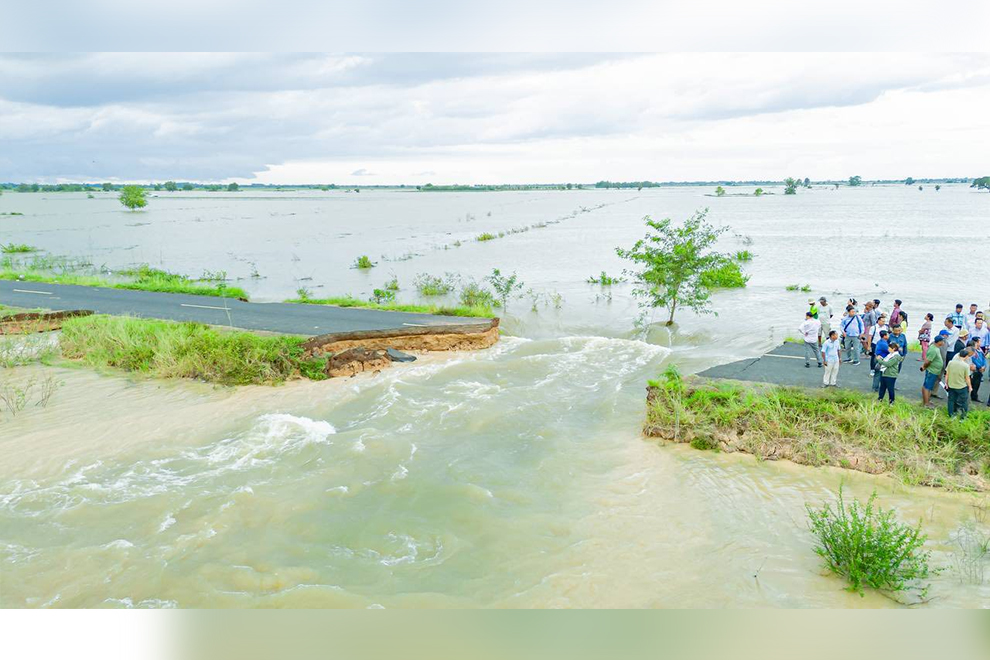
Infrastructure damage was extensive, with 35,939 metres of national, provincial and asphalt roads, and 539,044 meters of rural (laterite, concrete, gravel and dirt) roads flooded or damaged. 78 bridges — concrete, wooden and Bailey types — were affected, and riverbanks and stream embankments eroded over a combined 5,743 metres.
As of Wednesday, October 22, flooding continued in four provinces: Prey Veng, Kandal, Battambang and Banteay Meanchey.
The NCDM observed that rainfall across Cambodia has persisted at moderate to heavy levels since the second week of May, with widespread and variable precipitation nationwide.
This was compounded by regional storms and the southwest monsoon system, which caused heavy rainfall in several parts of northern, highland and northeastern Cambodia, leading to widespread flooding of villages, farmlands and rural infrastructure.
In several areas, canals and streams overflowed beyond warning levels, worsening the inundation. The Mekong River experienced three flood surges since July due to heavy rainfall in the upper Mekong Basin and its tributaries, causing the river to rise rapidly between late July and late September.
