



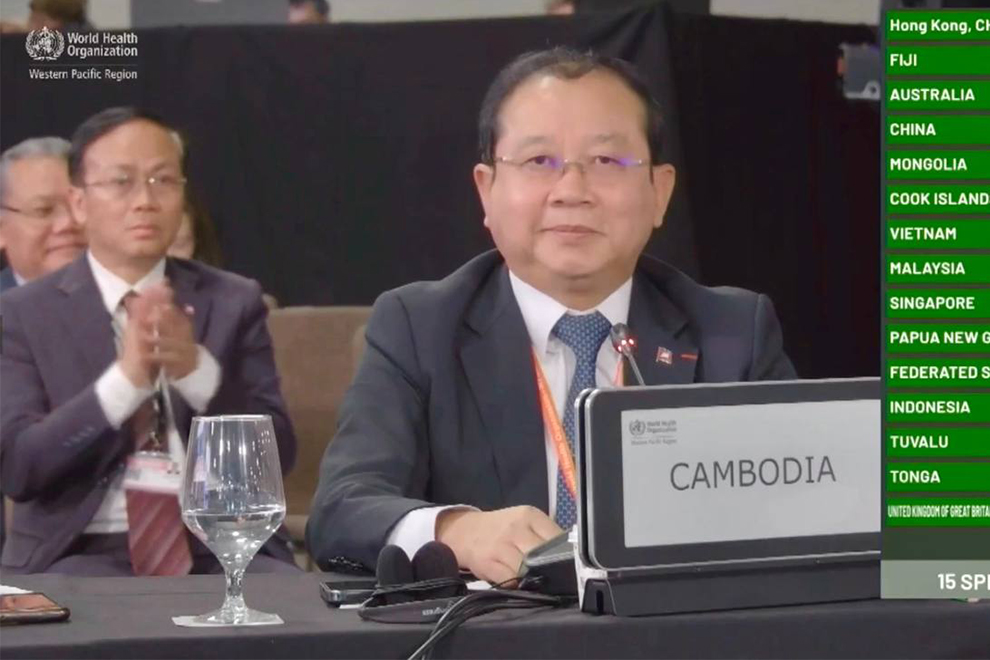
Minister of Health Chheang Ra has emphasised the Royal Government’s firm commitment to addressing non-communicable diseases (NCDs) and health issues caused by climate change during his address at the 76th Session of the World Health Organization (WHO) Regional Committee for the Western Pacific, held in Nadi, Fiji, from October 20-24.
The meeting, themed “Weaving Health for All”, focused on regional strategies for inclusive and resilient healthcare systems.
“In his address, the minister highlighted key health priorities and commitments of the Royal Government of Cambodia, including the fight against non-communicable diseases, human resource development, health security, climate change-related health challenges and efforts to strengthen the resilience of the health system through sustainability and innovation,” the ministry stated.
These priorities are being implemented through the Cambodia–WHO Country Cooperation Strategy (2024–2028), aligned with the National Health Strategic Plan (2025–2034), aimed at improving public health and achieving Universal Health Coverage (UHC).
The minister described how Cambodia is modernising its health system through digital health innovation, which supports the management of chronic diseases, mental health issues, and the regulation of tobacco and alcohol products. These efforts are part of broader initiatives to enhance collaboration, solidarity, equity and access to quality, effective, and safe healthcare services — ensuring that no one is left behind.
He stressed the importance of joint participation by all member states in promoting peace, socio-economic development and human dignity, to build a resilient and sustainable region.
“Through our collective efforts to understand and address global health challenges, solidarity and cooperation must guide us toward achieving our shared health priorities,” Ra said.
The WHO Western Pacific Regional Committee Meeting is an annual regional forum that gathers health ministers and delegates from 38 countries and territories. The forum serves to formulate health policies, review regional programs, evaluate progress reports and endorse new initiatives.
In addition, the participants sought to identify and approve solutions and resolutions to guide the work of both regional and country offices in the coming years. Key topics included combating non-communicable diseases, promoting mental health, addressing climate change and health system safety, strengthening epidemic surveillance and utilising emerging technologies in healthcare.
During the meeting, Ra delivered a keynote speech on Cambodia’s health achievements and strategic priorities toward realising UHC. His remarks underscored the government’s strong commitment to improving the nation’s health and maintaining Cambodia’s partnership with the WHO, noted the ministry.
The ministry is currently intensifying public health education on NCDs, particularly diabetes and hypertension, as their prevalence continues to rise across Asia, including in Cambodia — where 4–6% of the population is estimated to have diabetes.
Ministry spokesperson Koy Vanny told The Post that the ministry is running numerous campaigns to raise public awareness about NCDs such as cardiovascular diseases, cancer, chronic respiratory illnesses and diabetes.
“We continue to strengthen and expand our efforts to help reduce the impact of non-communicable diseases, especially diabetes and hypertension, which are taking lives across the world — including in Cambodia, where we are not exempt,” he said.
