



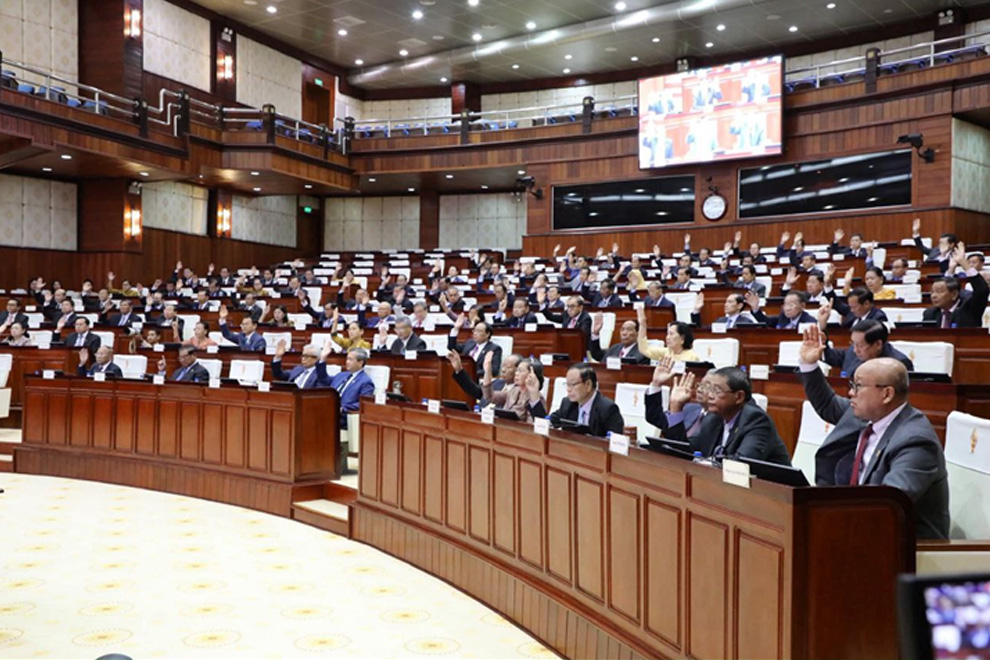
The National Assembly (NA) has adopted a draft law on the ratification of the Agreement on the Conservation and Sustainable Use of Marine Biodiversity beyond National Jurisdiction, under the UN Convention on the Law of the Sea.
Of the 120 lawmakers present at the session on Monday, August 25, 119 voted in favour. The vote followed a detailed debate, in accordance with parliamentary procedure.
“The agreement aims to ensure the conservation and sustainable use of marine biodiversity, beyond national jurisdiction for both the present and the future,” said an NA statement.
The draft law is expected to enhance Cambodia’s international prestige, while expanding equal cooperation in the management and conservation of marine resources. It also covers the equitable sharing of benefits from marine genetic resources and digital sequence information found in international waters, supporting scientific research, economic benefit, environmental protection and marine conservation, it explained.
Before adoption, Minister of Environment Eang Sophalleth presented the three-article draft law on behalf of the government.
During prior discussions on August 18, the minister highlighted how the law aligns with Cambodia’s strong national policy framework and phase one of the government’s Pentagonal Strategy, under which the ministry issued its Circular Strategy on Environment 2023–2028.
The strategy prioritises sustainability, climate change response and the promotion of a green economy, with the ultimate goal of achieving carbon neutrality by 2050.
The government is working to strengthen international partnerships to enhance Cambodia’s global standing and attract foreign resources for national benefit.
On May 13, the government authorised the environment ministry to sign the treaty, during the Third UN Ocean Conference in Nice, France.
As a state party, Cambodia will be required to contribute to the treaty’s financial mechanism, though its contribution will be relatively small as a developing country.
In addition, Cambodia pledged its active participation in biodiversity conservation beyond its national jurisdiction, reinforcing national-level actions and promoting legal and institutional cooperation at the global, regional and sectoral levels.
