




Officials from the Ministry of Environment, Battambang provincial authorities, Fauna & Flora International (FFI) and development partners are currently assessing the possibility of beginning the process of listing two limestone mountain areas — Phnom Sampov and Phnom Banan — in Battambang as natural heritage sites.
On July 9, ministry spokesperson Khvay Atitya explained that several stakeholders are working to to evaluate these areas for their historical significance and natural resource value, with the aim of designating them as green ecotourism destinations.
Heng Hong, director of the Department of Natural Heritage Sites under the ministry’s General Directorate of Local Communities, is heading the working group. He joined researchers from FFI and officials from the provincial environment department on July 7–8 to present findings from a 2024 biodiversity study conducted at the two sites. The group also surveyed potential locations and met with local communities.
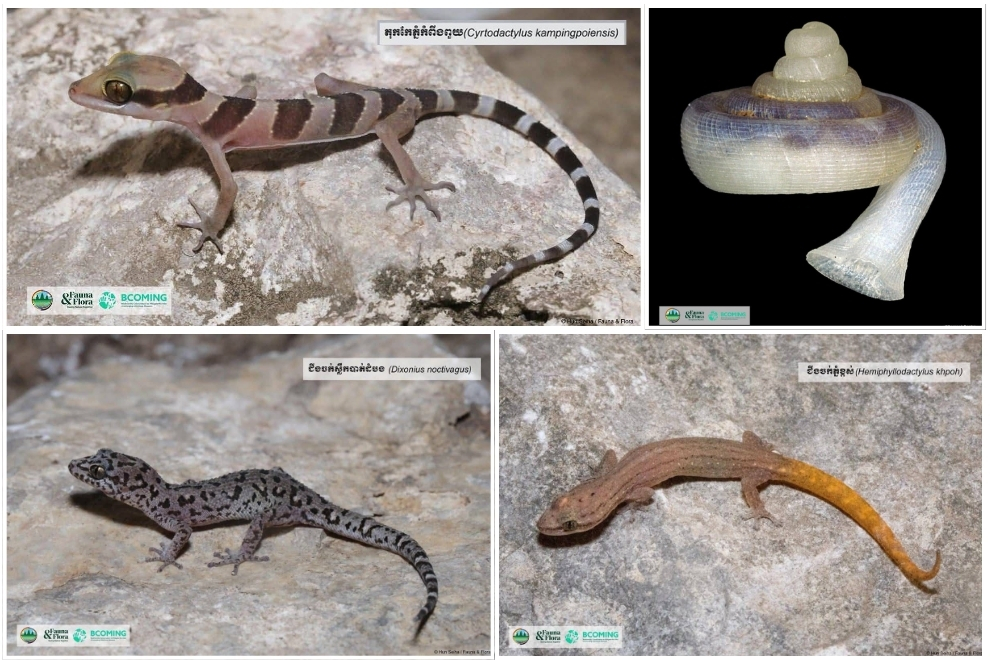
According to the ministry, camera trap surveys revealed that these areas are home to many species classified as globally threatened, including pangolins, hornbills, civets, silvered langurs and pig-tailed macaques. They also found a wide range of lesser-known species. Notably, they discovered previously unknown species, including geckos, skinks and snails.
Phnom Banan and Phnom Sampov also feature ancient Khmer heritage sites from the Angkorian era. They contain numerous temples, in addition to limestone formations that were once part of a marine environment dating back to the Permian period (251–299 million years ago) of the Paleozoic era.
In addition to their biodiversity and historical-cultural value, both Phnom Banan and Phnom Sampov are major tourist attractions for religious pilgrims and forest visitors, especially for witnessing a daily bat exodus which takes place at sunset. Locals call this phenomenon the “bat army”, and the colony is estimated to number around 5 million bats.
The bats provide economic benefits to local communities through guano harvesting. On average, community members earn about $30,000 per year from Phnom Banan and $20,000 from Phnom Sampov.
Recently, researchers discovered a new species of “prehistoric land snail” in the limestone areas of Battambang, including Phnom Banan — a species now recognised as new to science.
Experts confirmed that the snails, described as “living fossils”, exist in significant numbers throughout the limestone formations of Battambang, especially at Phnom Banan.
In March 2024, several new species of geckos were also discovered by researchers from the Ministry of Environment, FFI and La Sierra University (USA). They have also been recognised as new to science.
The three newly reorded species are the Striped Kamping Poi Bent-Toed Gecko (Cyrtodactylus kampingpoiensis), the Battambang Leaf-Toed Gecko (Dixonius noctivagus) and the Khpoh Gecko (Hemiphyllodactus khpoh).
