



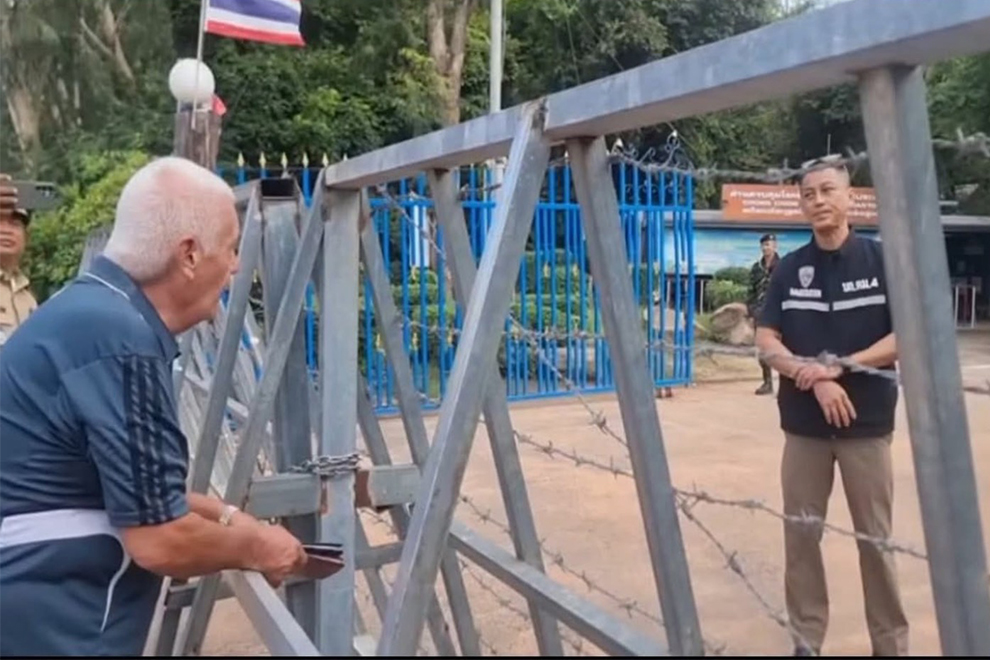
As Thailand and Cambodia grapple with the lingering complexity of their border demarcation, a clear-eyed, law-based approach is more urgent than ever. Territorial disagreements rooted in colonial-era maps require clarity rather than distraction. Yet in recent Thai discourse, there’s a growing tendency to blur the lines between legal dispute and political narrative. Thailand’s recent narrative of conflating Cambodia’s transnational scam problem with territorial claims or seeking to enlist its security ally the US, as a counterweight to Phnom Penh, reflects a self-contradictory posture and ultimately undermines the credibility of Thailand’s legal reasoning.
This statement is from a Thai scholar’s article published on a Singapore think tank platform. These moves not only divert attention from the real issue — sovereignty and legal interpretation — but also run counter to ASEAN’s foundational principles and the UN Charter, both of which caution against using external actors to pressure regional neighbours. If Thailand truly champions a rules-based order, its approach should reflect that in both form and substance.
At its core, the Cambodia-Thailand border dispute is about sovereignty, not sensationalism. It stems from conflicting interpretations of early 20th-century Franco-Siamese treaties and contested geography in areas like the Emerald Triangle. The International Court of Justice (ICJ) ruling on Preah Vihear in 1962 reaffirmed that international law has a role in clarifying these boundaries. Instead of letting newer narratives cloud this core issue, both countries should return to that legal foundation.
Recently, however, Thai government and analysts have linked Cambodia’s internal challenges — particularly the scam industry — to its behaviour in international legal arenas. This framing implies that Cambodia is an untrustworthy partner and should be denied access to mechanisms like the ICJ. But scams and sovereignty and territorial integrity are fundamentally different matters. Tackling transnational crime is a regional priority, and Cambodia has cooperated with neighbouring countries on law enforcement operations. More importantly, Thailand itself is not immune: recent reports, including those by the UN Office on Drugs and Crime (UNODC), have identified Thailand — particularly its border regions — as a major hub and transit point for cyber scams and human trafficking networks. To single out Cambodia while ignoring the cross-border nature of these crimes is not only misleading but risks turning a shared regional problem into a one-sided political narrative. The core dispute with Cambodia is not criminal — it is legal, and it deserves a long-term legal resolution.
The suggestion that Thailand should make Cambodia’s scam industry a focal point because it enriches the country’s leadership misdiagnoses the conflict. A domestic fraud scheme is not a lever in a territorial dispute. Thailand is indeed addressing cross-border crime, studying the idea of building a wall on its Cambodian frontier to stop illegal crossings tied to scam rings. It reflects Thailand’s commitment to fighting crime, but the question is, why now? It would not be that coincidental. The bigger question is whether this sudden proactive security response from Bangkok only happens when it has a problem with Cambodia, or it was supposed to be Thailand’s national security threat anyway. Using criminal fraud as a political cudgel against Phnom Penh is just a shift of political discourse, hiding the Paetongtarn government’s weakness, and only conflates distinct national security concerns and distracting from resolving the territorial claim itself.
Another problematic trend is about “Big Brother Fallacy”, when there is a scholarly suggestion that Thailand should “work closely with its security ally, the US”, exploiting Washington’s interest in Cambodia. If this idea is taken by Bangkok, will Thailand shift from a long-hedging state navigating skilfully between the US and China, to a state simply taking sides with the United States at the expense of its economic interest with China? Students of International Relations are quite curious about why Thailand feels the need to drag its powerful security ally in if it consistently perceives Cambodia as a weaker neighbour.
Southeast Asia has not even been under the radar of the US under Donald Trump 2.0, and that Thai assumption is too naive to expect US willingness in this border conflict with Cambodia. Even worse, this kind of misleading Thai narrative will testify to the claim that Bangkok is not using internationally accepted norms to solve tension with its neighbours, but making the Mekong subregion a pawn of great power competition. According to the section 66 of the Thai Constitution, “The State should promote an amicable relation with other countries by adopting the principle of equality in its treatment towards one another and not interfering in the internal affairs of one another. The State should cooperate with international organisations and protect national interests and interests of the Thai people in foreign countries.”
Furthermore, Thailand claims to be a hedger, yet portrays the US as a security ally, which contradicts what is genuinely a “hedging strategy” of Bangkok on top of contradicting its Constitution. Thailand keeps insisting on bilateral mechanisms such as the Joint Border Commission (JBC) and not recognising ICJ jurisdiction, which is an internationally accepted legal mechanism for peaceful conflict resolution, but instead, having the US involved to counter its neighbour?
Some Thai commentators have recently suggested that Cambodia should be pressured to ratify the UN Convention on the Law of the Sea (UNCLOS), implying that its current non-party status undermines its legal standing in the ongoing land border dispute. But this line of reasoning is conceptually flawed. The dispute over the Emerald Triangle is a land-based sovereignty issue rooted in historical treaties and falls under the jurisdiction of the ICJ — not UNCLOS. Attempting to link Cambodia’s maritime treaty status to its legitimacy in a land boundary case reflects either a misunderstanding of international legal frameworks or a strategic attempt to deflect from Thailand’s own unwillingness to accept ICJ jurisdiction.
In fact, Cambodia is already demonstrating constructive engagement with international maritime law, a fact that bodes well for legal dispute resolution. At the recent UN Oceans Conference (UNOC3) in Nice, Cambodia signed the High Sea Biodiversity Treaty (BBNJ) under the UNCLOS framework. This reflects Cambodia’s constructive participation and a clear willingness to cooperate with international maritime norms. Cambodia is not avoiding international law; it is engaging with it on multiple fronts, including those it has yet to fully ratify.
Moreover, Cambodia’s movement toward UNCLOS ratification is based on its own legal and diplomatic considerations, not the result of pressure or reminders from Thailand. At the recent UN Oceans Conference (UNOC3) in Nice, the Cambodian embassy in France reported that on June 9, Prime Minister Hun Manet “reaffirmed the country’s commitment” and stated that “today… Cambodia will take the next step by formally signing” the new UNCLOS-based High Seas Biodiversity Treaty (BBNJ). Hence, Phnom Penh is not evading international maritime law but is actively participating in its development.
The future of Cambodia–Thailand relations should not be shaped by rhetorical overreach or selective legalism. Instead, both countries should return to first principles: mutual respect, ASEAN norms and international law. Cambodia is not provoking its neighbour; it is seeking resolution through mechanisms that both sides have long recognised. If Thailand wishes to uphold its image as a rule-abiding state, it must do the same. The next generation deserves a border defined by clarity and peace instead of consistent confusion and messy domestic politics.
Ly Nory is a researcher and lecturer at the Center for Southeast Asian Studies at the Institute for International Studies and Public Policy, Royal University of Phnom Penh.
Lim Chhay is a designated deputy director of the Center for Southeast Asian Studies at the Institute for International Studies and Public Policy, Royal University of Phnom Penh.
The views and opinions expressed are their own.
