



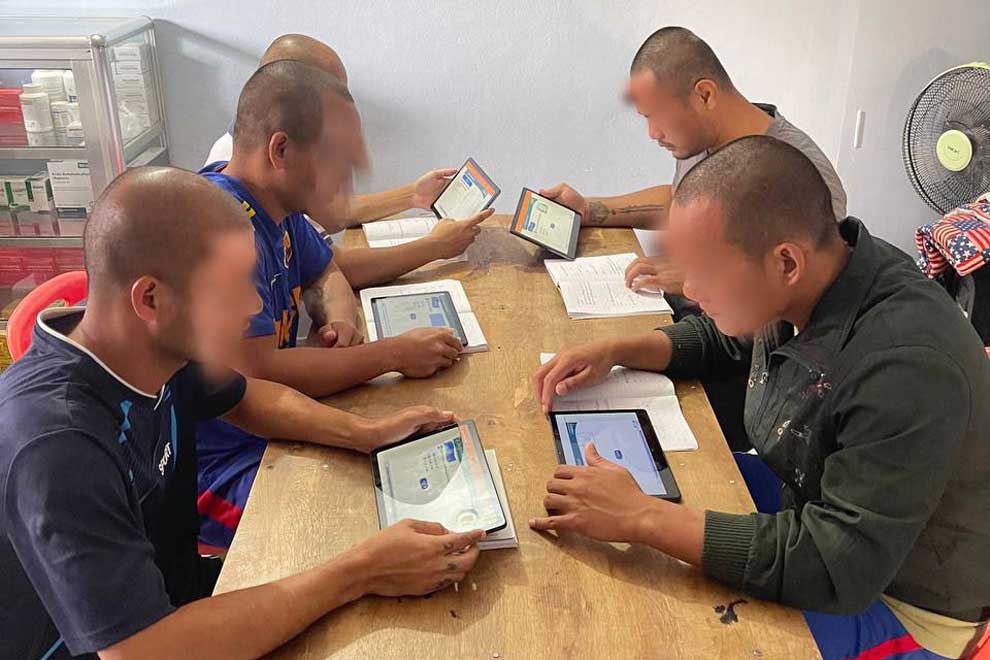
The Ministry of Education, Youth and Sport and the Ministry of Labour and Vocational Training, with the support of UNESCO, are expanding the Basic Education Equivalency Programme (BEEP) to ensure it reaches more young people, especially in prisons and correctional centres, and among migrants.
A new learning centre has been established at the Banteay Meanchey Provincial Rehabilitation Centre. It is helping young people to develop skills, find suitable employment opportunities and empower them to reintegrate into society.
Since the opening of its first learning centre in 2019, the BEEP has expanded and now operates 26 centers in 14 provinces across Cambodia. A total of more than 1,700 students, including dropouts, low-skilled youth and the unemployed, have benefited from the programme.
Nearly two-thirds of BEEP graduates went on to continue their professional development at Technical and Vocational Education and Training (TVET) schools.
“Often young people from disadvantaged groups due to poverty, gender, disability and geographical location are most at risk of dropping out of school, thus lacking the qualifications and skills needed to get an appropriate job,” said UNESCO Cambodia.
With access to basic education through BEEP, youth in correctional centers and prisons, as well as migrant youth, are supported to continue to develop additional skills that empower them to access job opportunities and support their full integration into society.
In addition, UNESCO continues to work closely with relevant institutions – especially the education ministry – to expand the scope of BEEP and reach more target groups. With financial support from Switzerland and contributions from private partners, new learning centres with on-demand support services will be established in the Kingdom’s rehabilitation and correction centers, as students in these locations often require additional support.
UNESCO will continue to provide technical support to ensure that the BEEP coordinators working at these centres can form curriculums and provide guidance to students in accordance with the centre’s internal regulations.
Chhean Sothearith, deputy director of the labour ministry’s training department, said BEEP is very important for young people who have dropped out of school and those who are vulnerable.
“It gives them the opportunity to study for free and learn skills that will help them to find decent jobs, which helps them and their families,” he added.
“This is especially important for the target groups, including vulnerable youth, indigenous peoples and people with disabilities. Through the programme, they have new opportunities to study, re-enroll and continue to learn additional skills for free at technical training institutions under the labour ministry and general education institutions under the education ministry,” he continued.
Ros Phearak, secretary of the education ministry’s General Department of Youth, said there was a downward trend in the school year 2021-2022, with more than 150,000 primary school students dropping out of school. Citing the ministry’s latest report, he said 110,000 high school students also dropped out.
“BEEP provides a second opportunity for young people who drop out of secondary school, giving them basic knowledge [equivalent to the secondary level] and soft skills, and encouraging them to graduate,” he said.
“When they enroll, they get the chance to continue on and acquire skills at TVET institutions, in line with the government’s policy of providing all young people with at least one employable skill,” he added.
BEEP is a collaborative initiative between UNESCO and the ministries of labour and education to address high dropout rates at the secondary level.
Since its inception in 2019, BEEP has been helping out-of-school youth in Cambodia complete basic education through flexible online learning, enabling them to obtain ninth-grade certification which is recognised by both ministries.
With certificates from BEEP, students can return to formal education and pursue further skills development at TVET institutions or general high schools.
