When Dalila Belaza arrives in Battambang on a Wednesday afternoon, she spends the entire day leading workshops with young dance students at Phare Ponleu Selpak, the city’s renowned arts NGO. The commitment is immediate, physical, present – the kind that defines her practice.
There is an energy and curiosity that brought the French choreographer to Cambodia for her first major engagement in Southeast Asia. A meeting point – between contemporary expression and ancient ritual, between her language and the Kingdom’s own deep traditions of sacred movement.
From folklore to form
To understand Figures, you have to start with lore. Or rather, with the friction between lore and the abstract, a tension that drives Belaza’s creative process.
“For me, abstraction begins with folklore,” she explains. “Folklore is something recognisable – you know the time, the space, the costumes. Everything tells you it’s from a particular place. For me, abstraction is like taking one component inside that ecosystem – say, the human being – and enlarging it infinitely, to study it from different points of view. That transformation opens borders and helps transcend reality as we know it.”
This philosophical approach has roots in her own biography. Born in France to an Algerian family, Belaza grew up travelling between two worlds, absorbing something essential about rhythm, celebration and collective memory.
“Even before starting to dance with my sister, I went to Algeria every year with my family,” she recalls. “I witnessed many celebrations there, and I think I absorbed something about music, dance and singing – because those things are very alive in family circles there.”
The oral storytelling traditions passed down through her family infused her imagination with a taste for narrative, for the mysteries that could be transmitted through voice and forms of motion. These stories became the cradle of her practice, eventually coming to life on stage through her body.
Dalila’s path into dance was unconventional, shaped by collaboration with her older sister, the acclaimed choreographer Nacera Belaza.
“We have a self-taught path,” she says. “We started dancing in our room at the beginning – no school, just genuine intuition. This language feels part of me because it helps materialise invisible dimensions, and it doesn’t have to be a style. That’s what I like about it.”
For years, she performed within Nacera’s company, developing an austere, trance-like movement vocabulary that explored repetition and the sacred in everyday action. But five years ago came a turning point.
The birth of Figures
“I met a folk-dance group in France, in Aveyron – it’s a rural area,” Belaza remembers. “I was already thinking about creating a solo, and meeting them showed me that I was really connected to ritual expression. By ritual, I mean something that has roots – you feel it comes from far away, yet it’s still alive in the present moment.”
She created a piece with the group called O Kur, a dialogue between their traditional movement and her abstract language. The experience clarified something crucial: she wanted to explore how dance could transcend the limits of identity, how it could speak universally without belonging to any single culture.
“In Figures, I wanted to create a kind of ritual that does not belong to any territory – totally abstract, but with its own language,” she says. “When you see it, you can connect to it as if it were a ritual you somehow knew.”
The piece investigates the possibility of what she calls a universal rite – an imaginary traditional dance “without origin” that somehow connects the present to eternity. It’s a bold ambition, the kind that could easily collapse into empty universalism or cultural appropriation. But Belaza’s approach is more subtle, rooted not in borrowing from specific traditions but in excavating something deeper: the impulse toward ritual itself, the human need to mark time and space through repeated gesture.
Composing in three dimensions
When Belaza creates, she doesn’t just choreograph movement. She composes the entire sensory experience.
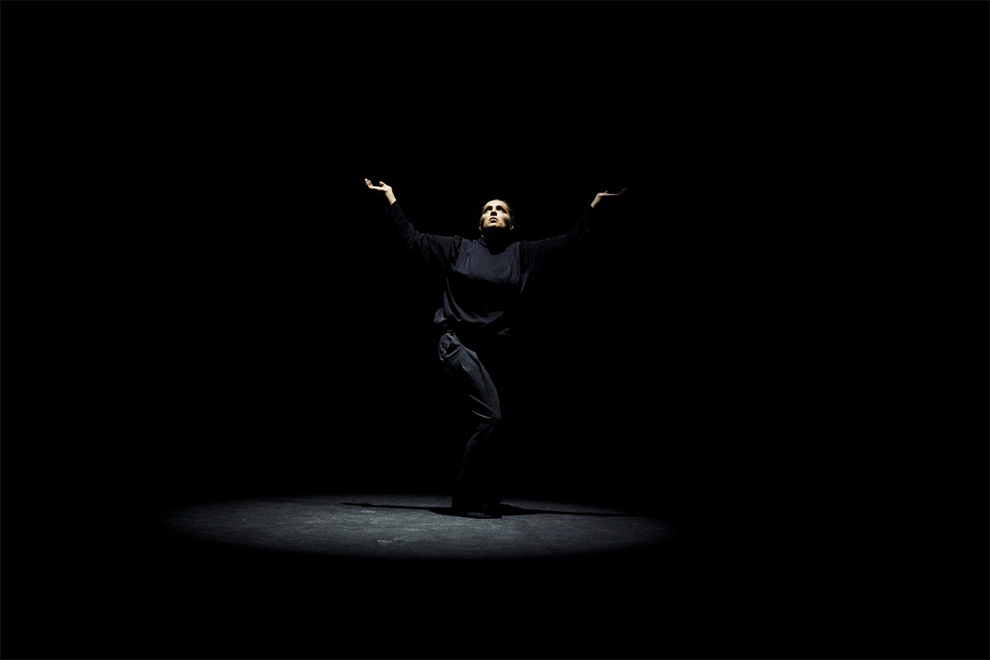
“It’s not only choreography because I do the lighting and sound as well. I create it all,” she explains. “For me, it’s a whole process – I use lights and sound as a partition and choreography as a melodic line. I consider all three as music, actually. It helps me create a specific universe, like with Figures.”
This integrated approach stems from her fundamental interest in musicality – the way sound transforms depending on the space it occupies and the moments in which it resonates.
“Whenever I start a creation, this, in a very large sense, interests me, because it’s not only the music but also the silence around it,” she says. “It has a kind of dynamic that depends on the present setting. When you change the environment, the music doesn’t sound the same. It has to assimilate the new parameters, and that musicality leads me little by little to create a story.”
But the creative process itself remains mysterious, even to her. When asked whether music starts the process, whether concept precedes form, she pauses.
“It’s a bit paradoxical, because yes, I know the music leads me toward a kind of story, but I don’t know exactly where it starts,” she admits. “I don’t know if it comes from the choreography – gestures that unfold at a certain moment – or from sounds I hear, here and there. It’s actually a combination of several trajectories: the place I’m in, the music I choose because I know by intuition it will work, and the movements that emerge from that combination.”
The result is what she describes as “states of light” – ephemeral moments where the visible and invisible merge, where the body surrendered to the unconscious seems to belong to all the communities of humanity. In Figures, fluid and seemingly enigmatic movement is carried by subliminal lights and soundscapes, creating a dialogue between body and illumination that guides the audience between the concrete and the dreamlike.
Not dance, but human
Despite being a choreographer, Belaza insists she’s not really interested in dance as such.
“It’s strange because I’m a choreographer, but I’m not focusing on dance – I’m focusing on where it comes from inside,” she says. “When you do this kind of work, you learn quickly that it comes from an intimate place, from a very precise consciousness, but at the same time you have to stay open to let information come through – temporal, spatial information – and it melts dimensions like past and present. So for me, choreography is about creating landscapes and stories that talk about the human being.”
The study of being drives her work – not dance as spectacle or technical achievement, but as a tool for excavating something essential about consciousness, memory and presence.
“When you study the human being, you try to make it an objective thing to look at,” she explains. “That naturally opens to other dimensions – philosophical, political, societal – because you’re questioning the human being in relationship to everything. It’s not just a person enclosed in a box.”
This investigation isn’t solitary or self-contained. Through her travels and collaborations, Belaza continuously expands her inquiry beyond her own experience.
“By studying personal and intimate spaces, it’s not only my own that I study,” she says. “I travel a lot, I give workshops, I meet many people – so I’m always digging into the same subject, but it’s not me as the subject. It’s always expanding. Each creation opens a new dimension of what it means to be human. So I’m not doing my study in a small room, ignoring the world as it is. I’m really looking for deep connection.”
Meeting in movement
In Battambang, those principles were tested in real time. Her three-day workshop brought together dance students ranging from sixteen to twenty-five years old, most of whom had only studied Khmer classical movements.
“It was very interesting because they usually practice only traditional dance,” Belaza says. “It was about creating a connection – finding a meeting point – to understand that learning this is like learning a new language for them.”
She asked the students to share their traditional forms, then proposed something: to inhabit those same movements while working with her principles of spatial perception and deep listening.
“I worked on perception of space and how to create space by listening to it,” she explains. “Then I asked them to try this state in their own dance. We made them move very slowly, and it gave something very interesting because it was still their dance but already something new.”
The encounter was mutual. Belaza watched carefully, absorbing what the students shared, looking for those meeting points where different expressions might touch without erasing each other’s specificity. It’s the same instinct that brought her to Cambodia in the first place.
An invitation to travel
When Figures is performed, Belaza isn’t asking the audience to understand anything in particular. She offers something different: an invitation to surrender to the unknown.
“I hope they will travel through the piece as if it were a mystery and a story I’m sharing with them,” she says. “I hope they will be in a state of availability – ready to go on a journey and be part of the experience, not looking for something to understand intellectually. It’s about opening themselves to something they may not know or understand at first, but somehow they’ll travel through it. I hope it’s not about liking or not liking it – it’s about how long the piece will stay with them, the memory of it as an experience.”
When asked if there’s a sequence in Figures that still gives her goosebumps, she pauses.
“I don’t know if there’s a specific moment. From the minute I start, I feel like I’m back in an ancient world, and sometimes almost a cosmic world.”
Belaza sees herself fundamentally as a storyteller, just one who uses the body’s language instead of words. A return to those oral traditions she absorbed as a child, those family gatherings in Algeria where music, dance and narrative were all part of a single living practice.
“I’m looking for the intimate, mysterious and unchanging story that lies dormant within us, that speaks to us in an essential sense and that can bring us together,” she has said. “To do this, I create the conditions that allow us to open up and question our intimacy, as if to extract from it a reinvented human story.”
To create a ritual that belongs to no single culture but somehow speaks to all of them, to find the universal in the most intimate gestures – this is the work. A French choreographer travelling through a story that has no origin and therefore might belong to everyone.
And in the end, her work returns to that simple act of meeting – one body, one tradition, reaching toward another.
“I can’t know before the meeting where it’s going to go, but I have the intuition that the people of Cambodia will understand my language because of their own history, because of their traditions,” she says. “I have the feeling that, yes, we can meet somewhere…”.
Belaza will perform Figures on Friday, October 24 at 7pm at the John Crawford Theatre, Canadian International School of Phnom Penh (CIS). Tickets are available at ifcambodge.com. The performance is part of an artistic residency organised by the French Institute of Cambodia (IFC) in partnership with OCIC Group, as part of La Nuit des Idées 2025 and the Olympe de Gouges cycle: Women of Power and Women of Action.