The prices of paddy rice grown in Battambang and Banteay Meanchey provinces have experienced significant declines, driven by a notable deterioration in new orders from overseas buyers. And without a clear, viable replacement as the year’s main harvest season progresses, farmers’ livelihoods could be at stake, industry insiders have warned.
Kim Sreyroth, vice-president of the Cambodia Rice Federation (CRF) – the Kingdom’s apex rice industry body – blamed the price drops witnessed in the two northwestern border provinces on a dull market reflected by foreign buyers tightening their wallets and holding off on purchases.
“After Covid-19, and subsequently the Russia-Ukraine war, Cambodia and the rest of the world began to experience an inflationary crisis and a decrease in consumer spending – consumers are not in such a hurry to buy things anymore, and only do so when they need to, … waiting for the ideal price. Buyers of our milled rice are no different.
“Take for instance, jasmine rice: they’re high-end varieties that command high prices in milled form. Most importers have yet to place orders, and are waiting for rates to go down. Moreover, milled Cambodian jasmine rice is sold at prices based on those of its Thai analogues,” she said.
Cambodia lacks a wide variety of export channels to countries with large market potential for rice, and has historically relied on Vietnam and Thailand as intermediaries for processing of the grain and re-export to third nations.
Although acknowledging that the per-tonne price of milled Thai jasmine rice has risen to a still-relatively-low $740 this harvest season versus $640 a year earlier, Sreyroth affirmed that the selling price of the Cambodian equivalent is under pressure, which could also adversely affect the rates for certain paddy varieties.
“If importers cannot buy milled rice at the current rates and Thai jasmine prices fail to increase, this could hurt the profits of all players in the rice sector, from farmers to exporters,” she said, adding that, as a general rule, eroded purchasing power keeps buyers away from top-of-the-line products.
On the other hand, marine shipping rates are now considerably below their Covid-era peak, and this could persuade buyers to accept a $730-750 price tag for milled Cambodian jasmine rice, similar to that of Thailand, or varying rates deemed proportional to international fluctuations.
“The immediate-term solution is for paddy to be bought at reasonable prices, not too high, not too low, and not sold in a hurry all at once, but rather step-by-step.
“Banks can provide working capital in the form of six-month term loans with low interest rates, to prevent milled rice from being sold too quickly, since some millers are facing interest rate stress and a lack of cash flows,” she said.
The Ministry of Agriculture, Forestry and Fisheries remarked in a November 15 notice that the post-monsoon harvest season generally falls between November and mid-December each year, and that mills are now teeming with activity and influencing paddy prices, much like last year.
The ministry called on growers in Battambang and Banteay Meanchey provinces not to be coerced by the prospect of declining prices into sacrificing the quality of their paddy by cutting the crop too early and saturating the market with inferior product, thereby – perhaps ironically – further driving down prices.
It also specifically mentioned Phka Rumduol as one of the varieties harvested during this period.
Phka Rumduol is one type of long-grain jasmine rice that has emerged as a top choice of international buyers, and is one of the varieties exported under the “Angkor Malys” certification mark. The Cambodian Agricultural Research and Development Institute says it released the variety for farmer use only in 1999, after 10 years of development and testing.
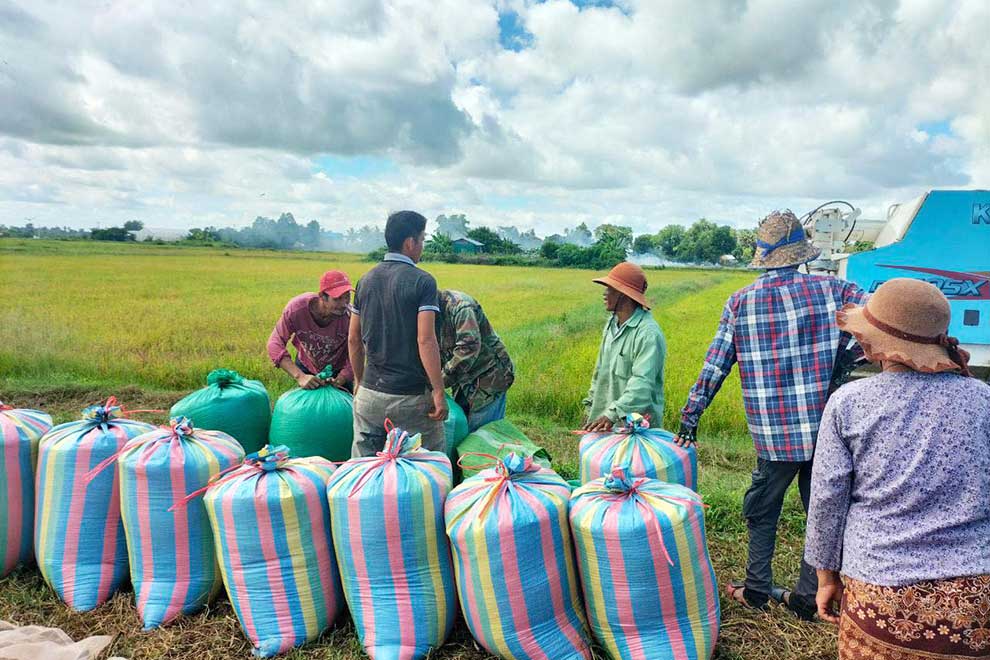
Oy Sirisatya, a farmer in Banteay Meanchey’s Svay Chek district, which borders Sa Kaeo province’s Khok Sung and Ta Phraya districts in Thailand, shared that his household recently sold a batch of 10 typical 50kg sacks of Phka Rumduol paddy at around 10 baht ($0.28) per kilogramme, which he stressed was not commensurate with current production costs.
Worse still, Sirisatya said, prices have since fallen by 20-30 per cent, which he blamed on inconsistent pricing from traders who resell the paddy to mills.
“Getting 10 baht out of [one kilogramme] may be okay enough, but at less than that, we’d be in a real pickle since fertilisers are costing a pretty penny this year, unlike last year,” he said.
Sirisatya underscored that this year’s sky-high costs of fertilisers make all the difference when analysing the severity of the drops in paddy prices in 2022 versus those in 2021. “[Last year] it was not a big problem due to the low prices of fertilisers,” he added.
“And another dilemma, we don’t have the technology-oriented irrigation systems to ensure high yields. [We] want the agriculture ministry to provide farmers with agricultural and technical training.
“In Thailand, paddy prices are set by the ministry each year – they have their documents. But here, prices are at the discretion of traders and the people.”
But not all hope may be lost. In a social media post late on November 16, agriculture minister Dith Tina communicated prominent local businessman Phou Puy’s pledge that Phka Rumduol paddy would not sell for less than 9,000 baht per tonne or 1.044 million riel in Khnach Romeas commune of northwestern Battambang’s Bavel district, basing the vow on collaboration between a ministry working group and millers.
The declaration has been met with great enthusiasm, and the minister is expected to make similar announcements for additional localities, lifting the spirits of farmers and other stakeholders.