



Cambodia will host its largest-ever agricultural event next month, with the Ministry of Agriculture, Forestry and Fisheries (MAFF) positioning the Cambodia Agriculture Forum & Exhibition 2025 (CAFE25) as a turning point in the country’s agrifood sector.
Scheduled for November 13–16 at the Diamond Island Convention & Exhibition Centre, CAFE25 combines a two-day high-level forum with a four-day exhibition, aiming to attract over 20,000 participants to its more than 400 booths.
The event, an initiative of agriculture minister Dith Tina, will be officially opened by Prime Minister Hun Manet or a designated Deputy Prime Minister, underscoring strong government commitment to agricultural modernisation.
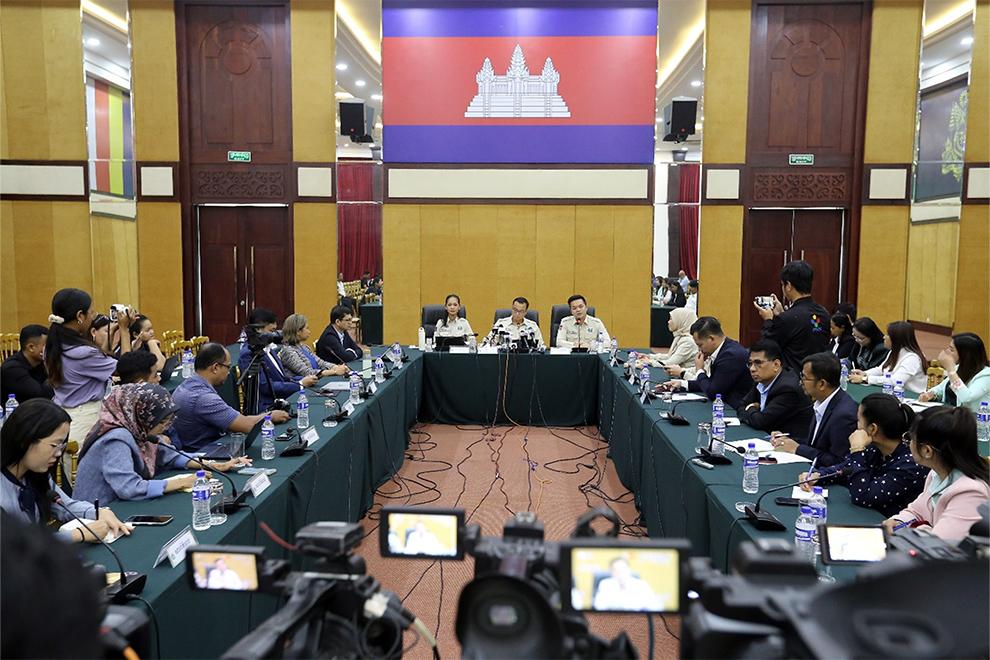
“This is the largest event the ministry has organised. It is a discussion forum, as well as an agricultural exhibition,” said Prak David, ministry secretary of state, during an October 3 pres conference.
“The forum will bring together leaders of ministries and institutions to discuss agriculture, marketing, finance, logistics systems and highlight the successes of the private sector,” he explained.
At the core of CAFE25 are nine commodities deemed Cambodia’s “strategic agricultural products”: rice, cashew, mango, vegetables, cassava, pepper, rubber, fish and sustainable timber.
They represent both the backbone of rural livelihoods and the foundation for future agribusiness investment.
“Please note that these nine agricultural products, in terms of cash value, amount to millions of dollars,” said Khim Finan, ministry spokesman.
“This is what we call Cambodia’s strategic agricultural products, which we want to promote by focusing on more agribusiness that is both processed and exported,” he added.
For decades, Cambodia’s agriculture has relied heavily on exporting raw goods with limited processing at home.
Finan acknowledged that the country still exports millions of tonnes of unprocessed rice and other crops annually, with only a fraction entering higher-value markets.
“In addition to domestic demand, Cambodia produces 7 to 8 million tonnes of paddy rice annually, but exports only about 650,000 tonnes of milled rice (equivalent to roughly 2 million tonnes of paddy). It is similar to other crops, including cassava and cashews,” he told The Post.
“There is nothing to be ashamed of to hide! Processing is low,” he said.
“CAFÉ 2025 is a bridge to promote the agricultural sector as a processing industry, especially the creation of modern agricultural communities,” he noted.
The exhibition will not only highlight Cambodia’s strengths but also expose gaps in the sector, showcasing technologies, drones, processing solutions and advanced machinery that could help farmers move beyond subsistence.
Through a “Farmer Tour Programme”, more than 8,000 farmers from across the country will be brought directly to the venue to see firsthand how their crops can be transformed into finished products.
“Farmers will get to experience firsthand how their original products are processed into finished products, and what their appearance and taste will be,” said ministry spokeswoman Im Rachna.
Beyond national stakeholders, CAFE25 is being organised in collaboration with development partners, including the Food and Agriculture Organization of the UN (FAO) through its Hand-in-Hand Initiative, as well as the private sector.
The event is designed to create a collaborative environment for farmers, investors, processors and policymakers to forge partnerships, promote trade and position Cambodia as an attractive destination for agrifood investment in the region.
“CAFE25 is more than just an exhibition,” Finan said, adding, “It’s a bridge to the future of Cambodian agriculture”.
Finan explained that “CAFE25” is not an acronym but a figurative term, likening it to a café — a place where stakeholders gather to discuss opportunities and challenges, while policymakers join to listen and seek solutions.
Cambodia is positioning itself as a hub for sustainable agribusiness in Southeast Asia, with vast opportunities in value-added processing, export growth and agri-tech innovation.
Backed by enabling government policies and rising investor interest, the sector is increasingly seen as a driver of economic transformation.
