



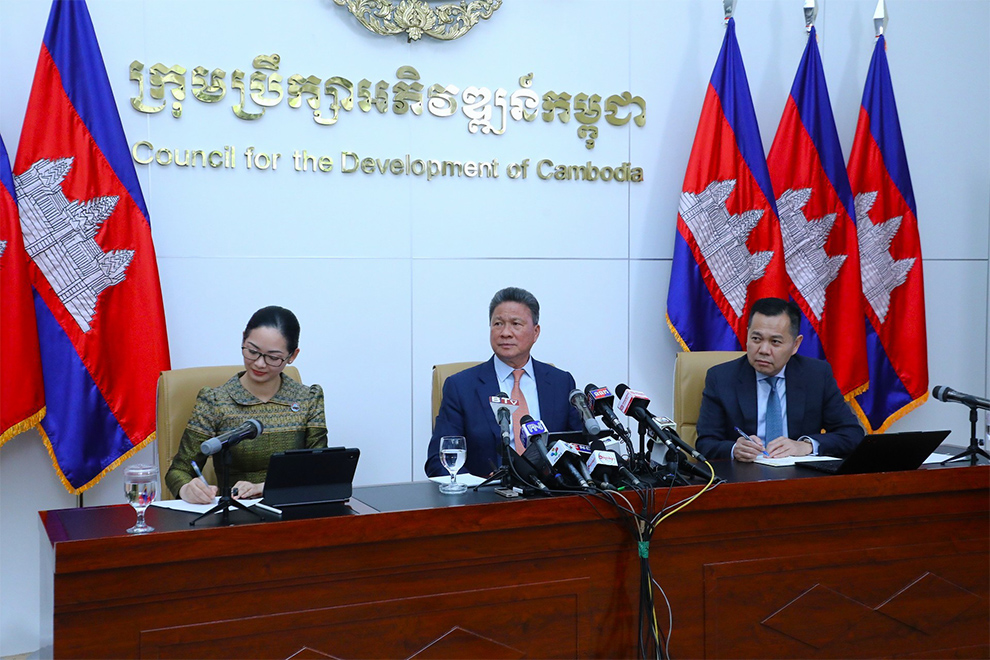
A senior Cambodian government official has called on all investors to remain patient and allow working groups to continue reciprocal tariff negotiations with the United States. His call followed the lowering of proposed US tariffs on Cambodian imports from 49% to 36%. The latest tariffs, announced by the administration of President Donald Trump, are set to take effect on August 1.
Sun Chanthol, first vice-president of the Council for the Development of Cambodia (CDC), made the appeal during a July 8 press conference, held at the CDC headquarters.
He urged all factory/business owners and investors in Cambodia to remain calm and trust the Royal Government as it seeks further solutions regarding the newly adjusted US tariffs.
“I want to take this opportunity to call on companies with factories in Cambodia to stay calm. The government of Cambodia has all the capabilities to protect employers, employees and our national interests,” he said.
According to Chanthol, the 36% tariff rate will officially take effect on August 1, unless further negotiations with the US are held. However, Cambodia is already prepared, whether to negotiate directly in the US or online, to try to further reduce the rate below 36% and expand trade opportunities between the two countries.
According to the General Department of Customs and Excise (GDCE), in the first five months of 2025, Cambodia-US trade reached $4.48 billion, a 27% increase, with exports from Cambodia valued at $4.35 billion (up 27%) and US imports at $120 million (up 25.6%).
In 2024, Cambodia-US trade totalled $10.18 billion, up 11.2%, with Cambodian exports to the US at $9.9 billion (up 11.4%) and US imports at $264.14 million (up 2.7%).
Chanthol noted that despite rising tariffs from the US government against many countries globally, Cambodia continues to attract growing foreign investment. From January to July 4, the CDC approved 396 investment projects with a total value of approximately $6 billion, creating about 271,000 jobs. This figure is close to the 414 investment projects approved in 2024.
He emphasised that Cambodia still has opportunities to attract more direct investment.
Lim Heng, vice-president of the Cambodia Chamber of Commerce, told The Post on July 9 that the US government’s decision to reduce reciprocal tariffs from 49% to 36% represents a major diplomatic success for Cambodia. He noted that while most other countries saw only minor improvements or even increases in tariffs, Cambodia achieved a significant reduction.
“This is a great achievement for Cambodia. While many Asian countries face similar or even higher tariffs, the US tariff increases will make goods in the US market more expensive. This could impact American consumers and potentially open more room for further negotiations,” he said.
“Although the tariff hikes will impact Cambodia, the country also has strong export markets in Europe, the UK, the Middle East and RCEP countries,” he added.
On Vietnam’s 20% tariff rate, Heng acknowledged that the lower rate benefits Vietnam, but he believes it will not significantly harm Cambodia’s export sector, especially in garments and textiles. In fact, in the past 2–3 years, some Vietnamese factories have relocated to Cambodia due to rising labour costs in Vietnam. At the same time, Vietnam’s industry is shifting from textiles to mid-tier industries like electronics and component manufacturing.
“Therefore, Vietnam’s lower tariff rate won’t have a major negative impact on Cambodia’s exports (especially garments) to the US,” he said.
With extensive experience in agricultural investment, Heng added that Vietnam’s low tariffs could actually boost demand for raw materials and semi-finished products from Cambodia, particularly agricultural goods, which Vietnamese companies could process further for re-export to the US.
Lor Vichet, vice-president of the Cambodia Chinese Commerce Association (CCCA), said that despite the recent success in negotiating a tariff cut with the US, the Cambodian government remains committed to further discussions to gain additional benefits.
“Cambodia still has around three weeks left to negotiate further with the US — this could include easing import conditions, increasing purchase orders or facilitating American businesses wishing to operate in Cambodia — before the 36% tariff officially takes effect on August 1,” he noted.
