



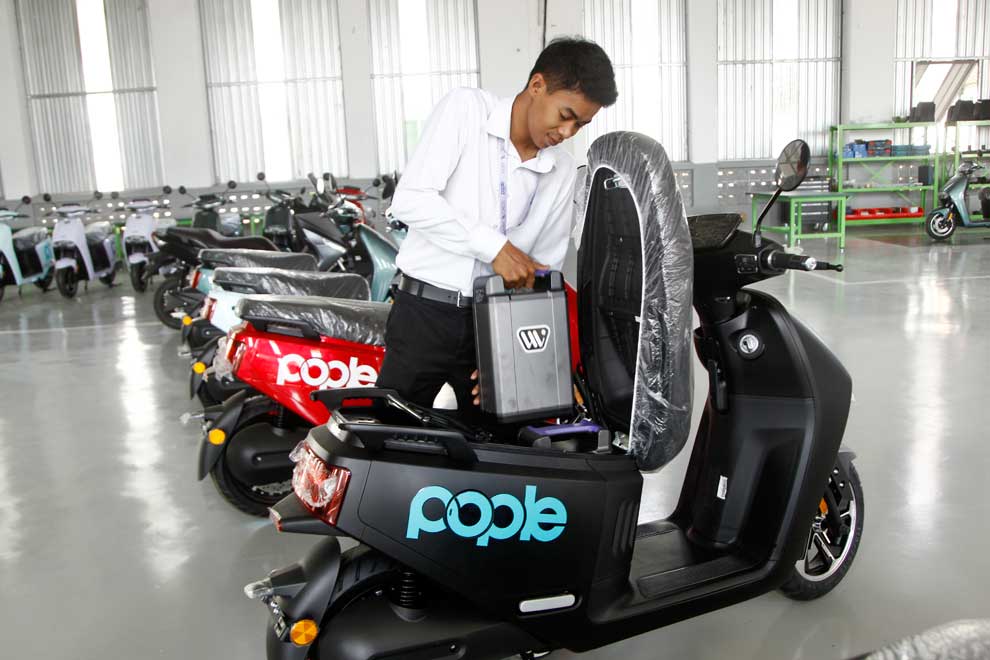
The Council for the Development of Cambodia (CDC) approved 27 private investment projects outside of the Kingdom’s special economic zones (SEZ) in the first quarter (Q1) of the year worth a total of $193 million, down 90.9 per cent from $2.1 billion – through 40 ventures – in the same time of 2022, according to the finance ministry’s latest Socio-Economic Trends report.
Although no concrete figures were given, the provided graph shows that industry accounted for virtually, if not all, of the nearly $200 million in cumulative investment capital, with the agricultural, energy, services and tourism sectors essentially at nil.
For comparison, the ministry’s first-quarter economic and financial statistics bulletin indicated that a total of 39 private investment projects were approved in the January-March quarter worth a total of $294.03 million, down 88.3 per cent from $2.521 billion – through 47 ventures – in the year-ago period.
“For 2023, although the effects of the [Ukraine] war, combined with the scars left over from the Covid-19 crisis, will continue to have an impact on Cambodia’s socio-economic landscape, the Cambodian economy is expected to continue the path to growth,” the report said.
“In addition, the path to growth is driven by China’s economic recovery. However, the regional economy could be affected by slow global economic growth, rising commodity prices and tightening financial conditions in response to long-term inflation.
“This is due to the achievement of community resilience as well as adaptation to the new normal path of the general population as well as businesses, despite some risks.
“In addition, the Royal Government has been implementing policy intervention measures, especially the introduction of intervention packages for vulnerable families due to rising inflation, which will reduce the impact on people’s livelihoods as well as support economic growth for the year,” it added.
Speaking to The Post on July 2, Royal Academy of Cambodia economist Hong Vanak asserted that no country in the world has seen a full recovery in investment levels, despite the fact that the current state of the world economy has improved since Covid-19 times.
Vanak likewise cited the Russo-Ukrainian conflict as the primary cause of the current investment hesitancy, pointing out that several major powers are involved in the quagmire.
In Cambodia, most investment projects now are funded by local or regional investors, he said, calling this time “an opportunity for each country to strengthen and build its domestic production capacity”.
In a previous interview, Federation of Associations for Small and Medium Enterprises of Cambodia (FASMEC) president Te Taingpor argued that the investment allure of the Kingdom could be even more potent if electricity prices were brought down to or below the levels offered in nearby countries.
Lower electricity prices generally mean lower production costs for energy-intensive businesses, which would give them an edge to successfully compete on the international stage, he said.
“Prices for fuel and electricity are key aspects of the appeal to investors, as these are important inputs for manufacturing, along with raw materials and labour. When these rates are stable and low, investors will see opportunities,” Taingpor said.
An earlier Socio-Economic Trends report noted that the CDC in 2022 approved 132 private investment projects outside of the Kingdom’s SEZs worth a total of $3.23 billion, up 87.9 per cent from $1.719 billion – through 108 ventures – a year earlier.
Although the report did not provide concrete figures, a pixel count of the supplied graph suggested that services accounted for the lion’s share of the $3.23 billion in cumulative investment capital, at roughly 43-47 per cent, followed by industry (23-27%), tourism (14-17%), energy (10-13%), and agriculture (1-3%).
According to the National Bank of Cambodia (NBC), foreign direct investment (FDI) inflows into the Kingdom between August 5, 1994, when the old Law on Investment was enacted, and December 31, 2021 totalled 168.8 trillion riel ($41.0 billion), rising by 11.2 per cent from the nearly 152 trillion riel recorded by end-2020.
The Greater China region was the largest investor in the Kingdom with $18.0 billion, or a 43.9 per cent market share, followed by South Korea ($4.9B; 11.9%), Singapore ($2.7B; 6.5%), Vietnam ($2.5B; 6.1%), Japan ($2.4B; 5.9%) and Malaysia ($1.9B; 4.6%). The Greater China region encompasses mainland China, Hong Kong, Macau and Taiwan.
Broken down by sector, finance accounted for the lion’s share at $9.4 billion or 22.9 per cent, followed by manufacturing ($8.5 billion; 20.8%), real estate ($4.9 billion; 12%), hotels and restaurants ($4.4 billion; 10.7%), agriculture ($4.2 billion; 10.3%), electricity ($2.6 billion; 6.2%) and construction ($1.6 billion; 4.1%), while other sectors comprised $5.3 billion, or 13 per cent.
