



The president of Xingtai Shunhe Biotechnology Co., Ltd., a company which operates over 70 private fuel stations in China, has expressed interest in investing and strengthening cooperation in the energy sector—specifically ethanol-based fuel—with Cambodia.
Xingtai president Li Jie met with Chea Vuthy, secretary-general of the Cambodian Investment Board (CIB) under the Council for the Development of Cambodia (CDC), at the CDC headquarters on July 23.
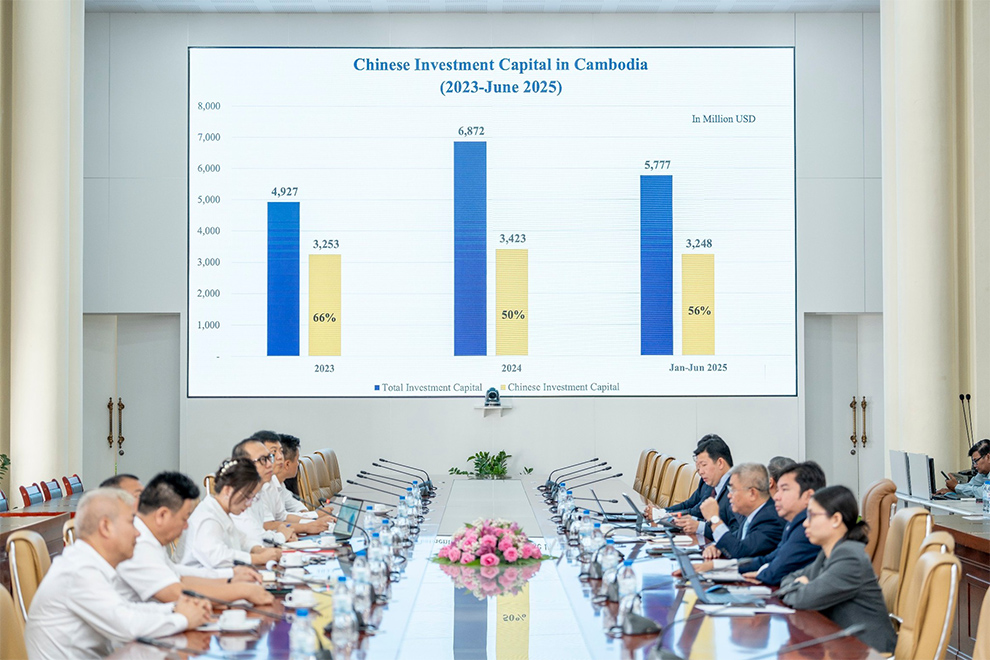
Vuthy welcomed the Chinese delegation, noting that their visit came at an opportune time, as Cambodia is currently considered one of the best destinations for investment. He also highlighted that Chinese investment in Cambodia continues to grow.
“China has consistently ranked as either the number one or number two source of foreign direct investment into Cambodia over the past decade,” he noted.
Vuthy explained that due to the large volume of Chinese investment and imports from China, Cambodia regularly urges Chinese delegations to consider maximising the use of locally produced materials or semi-finished products instead of imports. This is aimed at increasing domestic value creation and securing local supply chains.
Jie informed him that Xingtai is a leading supplier of ethanol fuel products in China, which are used for cars, boats, ships, airplanes and even food processing.
She said the discussions encouraged her company’s interest in investing and strengthening collaboration in Cambodia’s energy sector and contributing to the country’s energy development in the future.
“Through this visit, our company leadership intends to invest in Cambodia’s clean and renewable energy sector, with a focus on enhancing energy security and reducing environmental impact in the Kingdom of Cambodia,” she added.
Lim Heng, vice-president of the Cambodia Chamber of Commerce, told The Post that the long-standing diplomatic and trade relations between Cambodia and China have become a key factor in encouraging Chinese investment. Additionally, Cambodia’s internal advantages — such as its strategic location, investment-friendly legal framework, abundant young labour force, good transportation infrastructure and access to international markets — make the country attractive to investors.
“Currently, Chinese investments cover almost every sector and region in Cambodia. In addition to direct investment, Chinese investors also import large quantities of raw materials from China to support export manufacturing in Cambodia,” he said.
According to the General Department of Customs and Excise of Cambodia (GDCE), in the first half of 2025, trade between Cambodia and China reached a total value of $9.28 billion, an increase of 26.9% compared to the same period in 2024. Of this amount, Cambodia exported goods worth $750.62 million to China — a decline of 7.9% — while Chinese imports totalled $8.53 billion, up 31.2%.
The trade deficit with China was $7.78 billion in this period, up from $5.68 billion during the same period in 2024.
Bilateral trade between Cambodia and China in the first half of 2025 accounted for 30.34% of Cambodia’s total international trade volume.
