



The Ministry of Commerce is currently drafting a Digital trade Strategy, as part of its plans to contribute to building a stronger economic foundation for Cambodia.
In addition, it is implementing a variety of essential public services online and through automated platforms. It is projected that Cambodia’s electronic commerce will reach $1.1 billion by 2025.
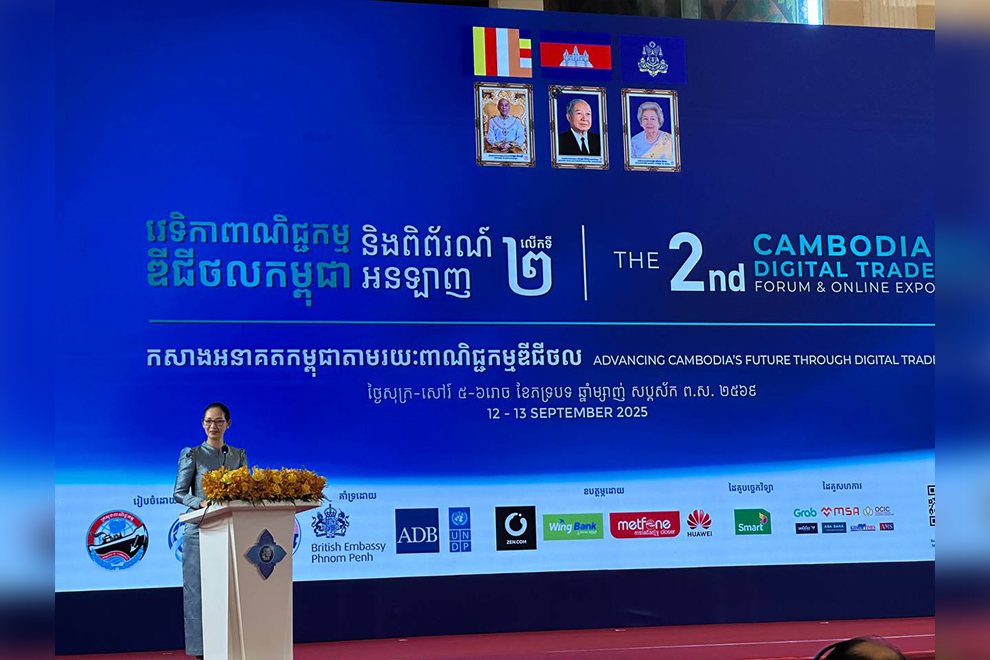
Commerce minister Cham Nimul addressed the September 12 opening ceremony of the 2nd Digital Trade Forum (DTF) in Phnom Penh. Themed “Advancing Cambodia’s Future through Digital Trade”, the forum aims to foster the development of digital trade in Cambodia.
Also in attendance were Dominic William, British ambassador to Cambodia, Carolyn Florey, ADB Bank representative, Shakeel Ahmad, UNDP representative in Cambodia and many senior officials from both the public and private sectors.
Nimul explained that the DTF was organised with the purpose of promoting the development of digital trade in Cambodia, in alignment with the phase one of the government’s Pentagon Strategy, and the Kingdom’s long-term vision of becoming an upper-middle-income country by 2030 and a high-income country by 2050.
This vision is being pursued through support for digital infrastructure and skills, awareness of policy frameworks, promotion of Cambodian products in new markets and the advancement of e-commerce.
She added that over the past decade, Cambodia has observed significant changes in the way business is conducted and how consumers behave. E-commerce activity in the country is growing rapidly.
“Electronic commerce has played a significant role in economic growth and value addition. It serves as a platform that connects Cambodia to the global market,” she noted.
“We have seen the resilience and adaptability of Cambodians in this sector. By the end of 2025, e-commerce revenue is expected to reach $1.1 billion, and by 2029, it is projected to reach $1.8 billion,” she added.
According to her, these figures are not merely economic indicators — they also reflect the vitality of sectors across Cambodian society. For instance, farmers in rural areas can now sell their products online to global markets.
“E-commerce has changed the way we work, trade, and live. It has become a lifeline for many, especially after the Covid-19 pandemic, during which digital networks proved essential for maintaining business operations,” she said.
Nimul also highlighted how the commerce ministry is currently drafting the Digital Trade Strategy, which is expected to be finalised soon.
It aims to create a highly competitive digital trade environment and foster international integration through the development of robust digital infrastructure, efficient cross-border mechanisms and a trusted ecosystem. This will enable businesses, merchants and consumers to adapt, innovate and enhance competitiveness both regionally and globally.
“These efforts are intended to build trust among all stakeholders in fair business practices and to strengthen the regulatory framework for e-commerce in Cambodia. This reflects our commitment to building a resilient, inclusive, and adaptive economy and trade sector,” noted the minister.
Currently, Cambodia’s digital marketplace is growing exponentially, with platforms such as foodpanda, Grab, E-gets, WowNow and J&T providing a wide variety of services, including consumer goods, food, clothing and delivery.
