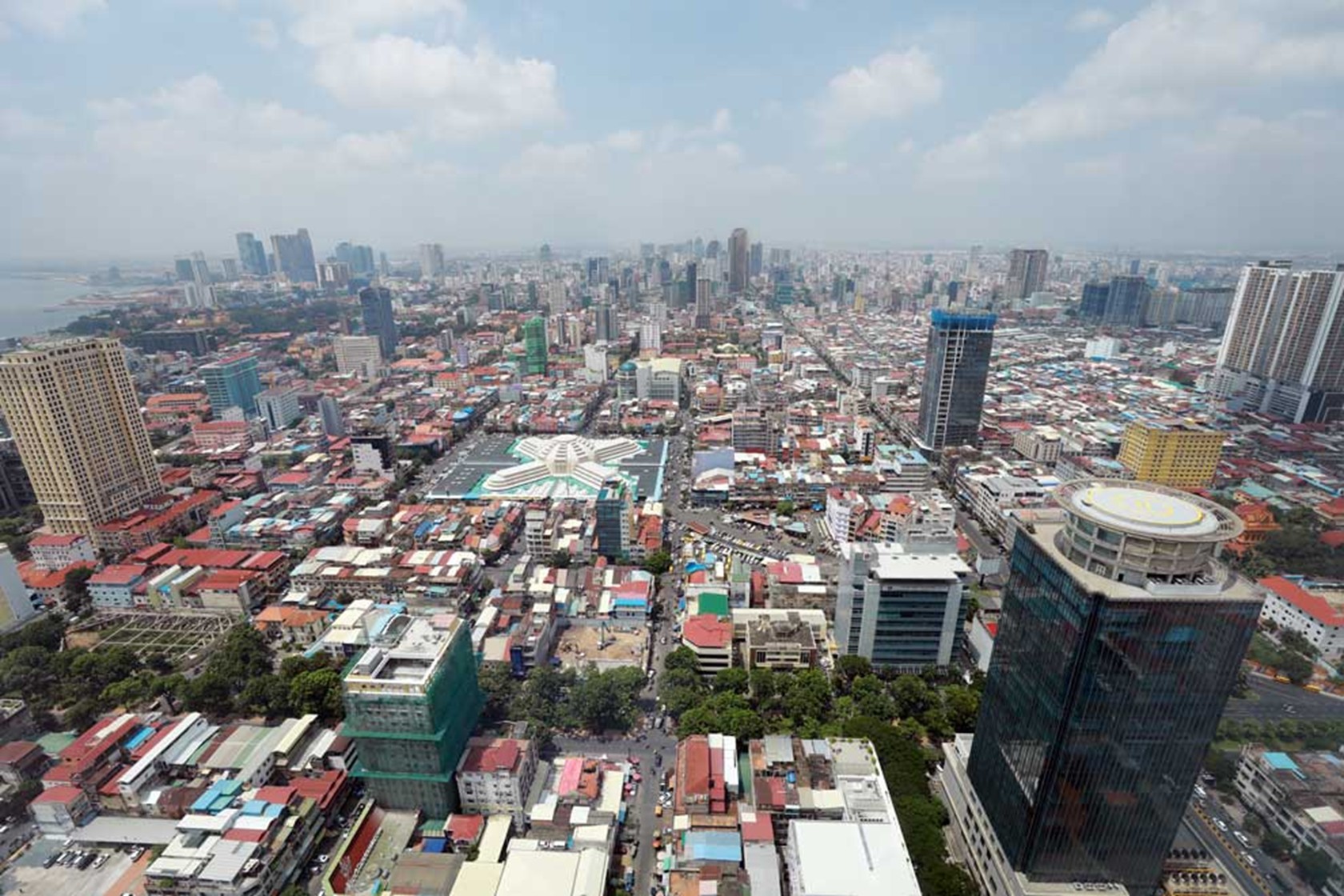
Uncertainty in global economic growth, protectionist policies by major powers and Thailand’s cross-border military aggression all played a major role in the disappointing recovery of Cambodia’s construction and real estate sectors in 2025, according to the National Bank of Cambodia (NBC).
According to the bank, the Kingdom’s construction sector grew by an estimated 0.4% from 2024, while in 2024 the sector grew by about 1.2% from the previous year. The low growth was also attributed to weak demand and an oversupply in the market.
At the same time, foreign direct investment (FDI) into construction was estimated to have fallen by 7.7%, though at a slower rate than the 25.8% drop recorded in 2024. Credit to the construction sector increased at the slower pace of 7% as of November 2025 (compared to 15.4% during the same period last year).
The bank suggested that the two rounds of armed clashes between Cambodia and Thailand had only a minor impact on investor confidence.
The NBC noted that despite weak demand, new construction supply continues to enter the market through newly approved projects and increased imports of construction materials and equipment, which rose by 40.1% in 2025, compared to the 33.2% growth recorded in 2024.
The real estate sector was estimated to have grown just 0.5%, compared to the 0.9% recorded in 2024.
The sector has been supported by increased home sales and the supply of more affordable condominiums, particularly in Phnom Penh, although overall property prices have declined.
Home sales increased by 30.5% in 2025 (after declining by 18% in 2024), driven by demand for affordable properties and more flexible down payment options. However, condominium sales dropped by 19.6%, compared to a 35.6% increase the previous year.
Soknoeun Sam, chair of the SAM SN Group and a real estate specialist, told The Post on February 26 that after experiencing strong momentum for more than a decade, Cambodia’s construction and real estate sectors began to slow down, especially from 2019 to 2025. During this period, the sectors faced consecutive challenges stemming from the Covid-19 crisis, global economic uncertainty, and most recently, Thailand’s invasion of Cambodian territory.
“Despite these challenges, up to now the sector has survived, demonstrating its maturity and resilience,” he said.
He noted that although some construction projects have stalled, the government has been actively addressing policy implementation issues and taking measures aimed at restoring positive momentum in the sector.
Dith Channa, chairman of Lucky Realty, said that the situation of the construction and real estate sectors over the past two to three years has not changed significantly.
“The sector needs more time to recover, as it has experienced a sharp decline since the outbreak of Covid-19,” he warned.
The slowdown in global economic growth over the past few years has significantly affected Cambodia’s construction and real estate sectors, particularly in Preah Sihanouk Province.
To help address these challenges, the government introduced the “Special Program to Promote Investment in Preah Sihanouk Province”. In 2024–25, the working group, in principle, approved incentives, concessions, procedural facilitation and dispute resolution support for 412 projects, representing approximately $7.97 billion in investment capital and the potential to create around 52,000 jobs.