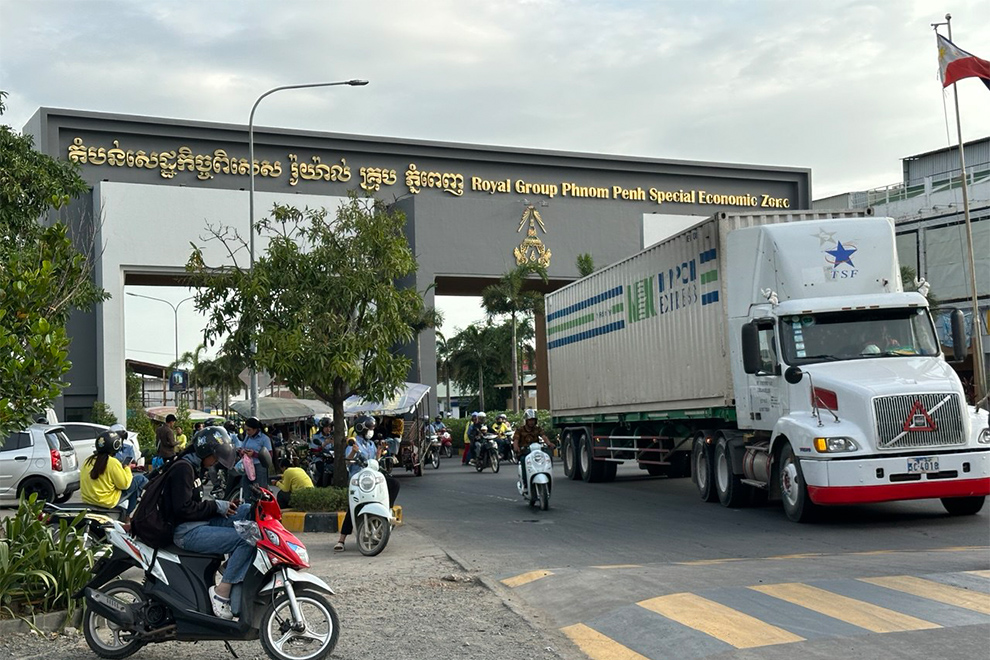
Cambodia is currently implementing a total of 11 bilateral and multilateral free trade agreements (FTAs). They play an increasingly important role in accelerating the Kingdom’s economic integration into international markets as they contribute to the growth of international trade, as well as rising levels of foreign direct investment (FDI).
However, their implementation also resulted in Cambodia losing over $400 million in customs revenue in 2024, noted the leadership of the General Department of Customs and Excise (GDCE).
Cambodian trade on the world stage
Chan Sopheap, deputy director-general of the GDCE, addressed the “Implementation of Free Trade Agreements and International Customs Agreements” seminar, held from August 21–22, He told the assembled audience of customs officials how Cambodia is actively pursuing economic integration into regional and global markets.
This integration is happening through its memberships and participation in ASEAN, the World Customs Organization (WCO), the World Trade Organization (WTO), and various other regional and global agreements such as the ASEAN Agreement on Customs, Trade Facilitation Agreements, and international conventions on customs simplification and harmonisation.
These efforts support reforms and the modernisation of Cambodia’s customs operations, especially through simplifying and digitising procedures. This in turn strengthens the core roles of the customs administration: revenue collection, trade facilitation and ensuring national security.
He added that this integration has brought many positive outcomes through bilateral and multilateral cooperation, the establishment of new FTAs and the effective use of existing FTAs, all aimed at promoting sustainable, resilient and inclusive development.
“This growth shows that the implementation of FTAs in Cambodia is becoming broader, driven by increased awareness of the benefits of preferential import regimes,” said Sopheap.
He listed the 11 bilateral and multilateral FTAs of which Cambodia is a part.
They include the multilateral ASEAN Trade in Goods Agreement (ATIGA), ASEAN-China FTA, ASEAN-Korea FTA, ASEAN-India FTA, ASEAN-Japan FTA, ASEAN-Australia/New Zealand FTA, ASEAN-Hong Kong FTA and the Regional Comprehensive Economic Partnership (RCEP), as well as the bilateral Cambodia-China FTA, Cambodia-South Korea FTA and Cambodia-United Arab Emirates FTA.
Many benefits; reduced customs revenue
Sopheap outlined how, despite the benefits, these FTAs have also led to a drop in annual customs revenue due to various preferential tariff rates.
“Annual losses in customs revenue due to FTAs are increasing. Specifically, in 2023, about $384.59 million was lost, and in 2024, this figure rose to $415.82 million,” he said.
FTAs drive overall trade volume growth
Diplomatic relations, economic integration and FTAs are all contributing to the steady growth of Cambodia’s international trade.
Data from the GDCE showed that in 2024, Cambodia’s total trade with international partners reached $54.74 billion, a 16.9% increase compared to 2023. Exports accounted for $26.2 billion, up 15.7%, while imports reached $28.54 billion, up 18%. Cambodia’s top five trading partners in 2024 were China, the US, Vietnam, Thailand and Japan.
Key exports included garments and textile-related products, fruit and nuts, machinery and electrical equipment, footwear and rubber products.
Major imports included machinery, vehicles, iron and steel products, plastic goods and chemicals.
According to the latest data from GDCE, between January and July 2025, Cambodia’s total trade with international partners reached $36.32 billion, a 16.5% increase over the same period in 2024. Exports amounted to $17.16 billion (up 16.2%), and imports to $19.16 billion (up 16.7%).
FTAs also boosting foreign direct investment
Lim Heng, vice-president of the Cambodia Chamber of Commerce (CCC), told The Post on August 25 that bilateral and multilateral FTAs provide strong momentum for economic growth by attracting foreign investors, especially large international corporations.
Cambodia’s political stability, investment-friendly laws and competitive labour costs make it an appealing destination for FDI. Additionally, FTAs help increase international demand for Cambodian goods.
“Whether bilateral or multilateral, FTAs bring mutual benefits to trading partners by opening larger markets and attracting more direct investment,” he said.
However, he acknowledged that market liberalisation can impact local producers, as some imported goods may be cheaper than domestic alternatives.
“There are certainly some negative effects, but these can also motivate local producers to enhance their capacity and competitiveness,” he added.
An economist’s view: Customs revenue loss not always bad sign
Hong Vanak, an economist at the Royal Academy of Cambodia, noted that although the country loses some customs revenue from FTAs, it compensates through increased Value Added Tax (VAT) revenue and the economic development fuelled by FDI and human capital growth.
“In some cases, a drop in customs revenue isn’t entirely negative. It could reflect growing domestic production that meets internal demand,” he explained.
“And as Cambodia signs more FTAs, its attractiveness for foreign direct investment continues to rise,” he added.