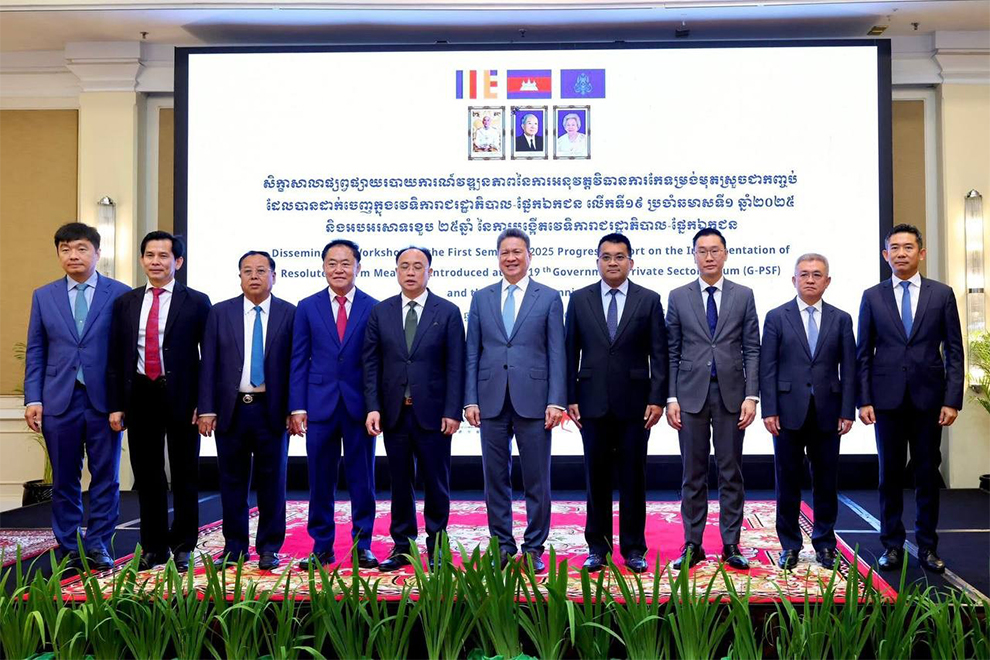
Council for the Development of Cambodia (CDC), supported by Australia, hosting a meeting to disseminate the 2025 Progress Report on the first semester of the Implementation of Resolute Reforrn Measures introduced at the 19th Government-Private Sector Forum (G-PSF).
The event was also a celebration, as the year 2025 marks the 25th anniversary of the creation of Cambodia’s highest-level platform for dialogue between the Royal Government and the private sector.
The event was held at the Raffles Hotel on November 27, with participation from Sun Chanthol, first vice-chairman of the CDC, and chairman of the Coordinating Committee for the G-PSF Mechanism; Peng Ponea, Minister of Public Works and Transport; Chea Vuthy, secretary-general of the Cambodian Investment Board; Derek Yip, Australian ambassador to Cambodia; as well as representatives from ministries, institutions, embassies, the Cambodia Chamber of Commerce, international chambers of commerce, business associations and development partners.
The G-PSF was established in 1999 under the initiative of former Prime Minister Hun Sen, to promote private sector development, economic recovery and to enable the private sector to become an engine of economic growth. It remains Cambodia’s top platform for dialogue between the public and private sectors.
According to a CDC press release, the report detailed progress across priority reform areas, including trade, tourism, infrastructure, taxation, customs, agriculture and regulatory streamlining.
It also provides an overview of the implementation progress of the reform measures introduced at the 19th G-PSF across relevant ministries, institutions and working groups. With 93% of the measures completed and the remaining 7% in progress, the implementation is advancing steadily towards the 20th G-PSF Plenary, anticipated for 2026. The report also highlighted the progress made in resolving issues raised across the 16 Working Groups.
“As we celebrate 25 years of the G-PSF, this mechanism is more important than ever. In the face of new regional challenges, including shifts in global trade – it helps to strengthen institutions and support the private sector to reach its potential as Cambodia’s engine of growth. We look forward to continuing to develop the G-PSF and ensuring productive G-PSF Working Group dialogues,” said Chanthol.
The Australian ambassador also lauded the initiative.
“Australia supports robust, evidence-based policy making and inclusive dialogue. We appreciate the efforts of the CDC and the Cambodian Chamber of Commerce (CCC) to engage constructively in this vital forum that facilitates policy dialogue to drive Cambodia’s economic development,” he said.
Australia began its engagement with the G-PSF in 2002, providing institutional assistance to the G-PSF Secretariat alongside the International Finance Corporation. Australia renewed this partnership in 2023 through the Cambodia Australia Partnership for Resilient Economic Development (CAPRED). This support extends to the CDC, CCC and the 16 G-PSF Working Groups and focuses on enhancing the capacity of relevant G-PSF stakeholders to deliver timely and accountable reform.
CCC president Kith Meng emphasised how the G-PSF is a unique and innovative mechanism that has become one of Cambodia’s greatest success models for government-private sector cooperation. Over the past 25 years, G-PSF has resolved more than 4,000 private-sector concerns. Through this mechanism, major reforms in customs, taxation, trade facilitation, logistics, SME development and investment policy have been developed and implemented. He stressed that when the government and the private sector work together, Cambodia achieves success.