



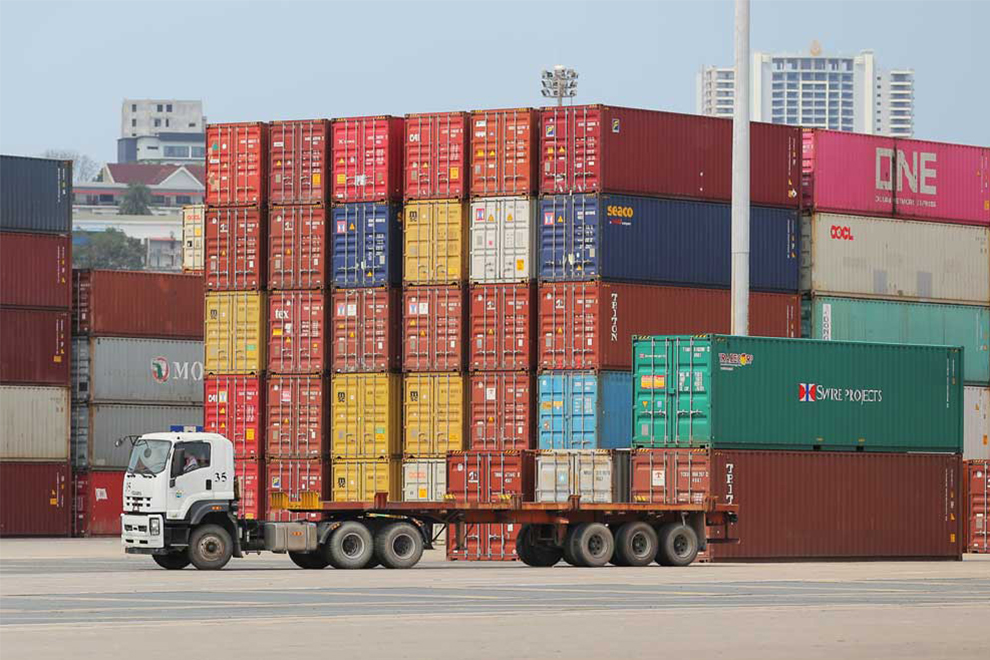
Despite an increasingly unstable global situation and the fact that economic growth in 2025 has not been particularly robust, Cambodian international trade has shown no signs of decline. Instead, it reached a total value of more than $65 billion, increasing by nearly 20% over 2024.
The General Department of Customs and Excise (GDCE) reported that total exports and imports between Cambodia and all international partners in 2025 amounted to $65.25 billion, up 17.66% from the $55.45 billion recorded in 2024.
Exports were valued at $31.28 billion, up 16.95% from $26.75 billion, while imports reached $33.96 billion, up 18.32% from $28.7 billion. Cambodia’s main trading partners include China, ASEAN countries, the US, the EU, Japan, Canada, the UK, South Korea, Australia, India and the United Arab Emirates.
During a January 8 conference held to summarise trade performance for 2025 and outline trade directions for 2026, Penn Sovicheat, Ministry of Commerce secretary of state, noted that Cambodian international trade has performed well. He believed this reflected the Kingdom’s ability to maintain its key markets, ensure supply chains and pricing stability, and sustain confidence among buyers in all target markets.
He explained that key export products included automobile tires, electronic components, automotive parts, garments, footwear, travel goods and agricultural products.
“Cambodian products continue to maintain their competitive advantages in international markets. This is a source of pride and reflects the direct contribution and active implementation of the ministry in export markets through deeper integration into regional and global markets,” he said.
He further noted that these positive trade results are also driven by the effective implementation of several trade agreements, including the Cambodia–China Free Trade Agreement, the Cambodia–South Korea Free Trade Agreement, the Regional Comprehensive Economic Partnership (RCEP) and the Cambodia–United Arab Emirates Free Trade Agreement, among others.
Hong Vanak, an economist from the Royal Academy of Cambodia, told The Post on January 8 that although global economic growth has not yet fully recovered and despite armed clashes along the Cambodia–Thailand border, trade activities with international partners have not declined.
He added that international trade is expected to continue growing, as more factories and enterprises are now operating in the country, producing increasing volumes of goods to meet the demands of both domestic and export markets.
He explained that political stability, favourable investment laws, an abundant skilled labour force, improved transport infrastructure, preferential tariff systems, multiple trade agreements and access to many export markets are the main factors helping Cambodia’s international trade continue to grow steadily.
“Improvements in the investment legal framework and infrastructure development are becoming key contributors to reducing production costs in Cambodia. Lower production costs help Cambodian-made goods access more export markets and become more competitively priced,” he said.
