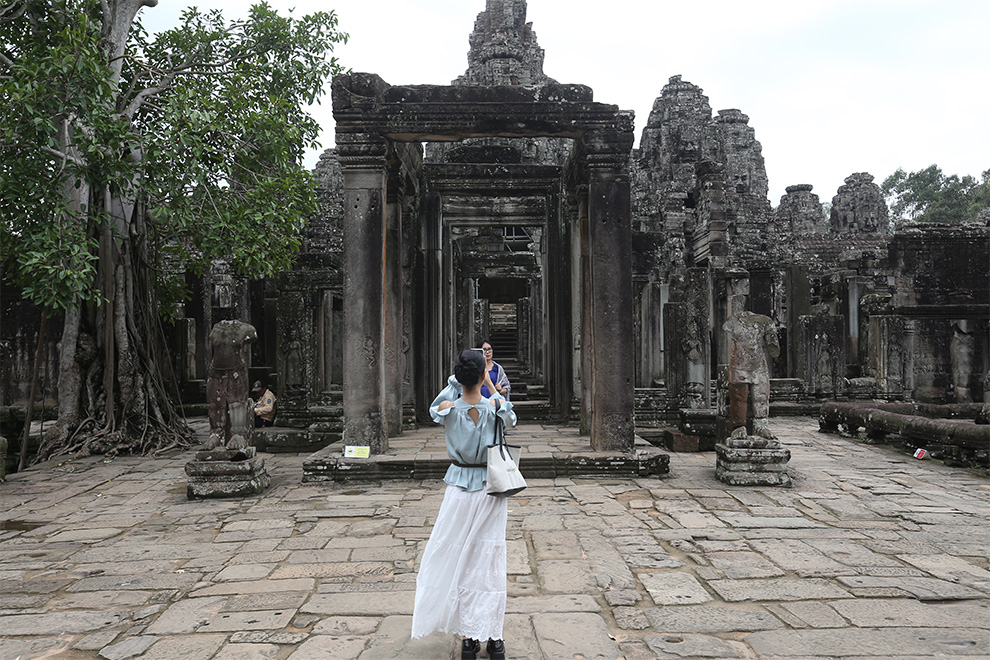
Cambodia recorded a steep decline in visitors from South Korea in October, even as China reclaimed its position as the Kingdom’s top tourism source market, according to the Ministry of Tourism’s latest statistics report for October 2025.
The report showed that only 9,831 South Korean tourists entered Cambodia in October, a sharp 26.3% year-on-year fall from the same month last year.
In contrast, arrivals from China jumped to 111,195, marking a 32.1% increase over October 2024 and making China the largest single source market for the month.
Across the first ten months of 2025, the trend remains consistent. South Korean arrivals fell 12.1% to 138,524, while China climbed 44.6% to just over one million visitors, almost matching pre-pandemic volumes.
The sharp drop in South Korean arrivals appears to be closely tied to heightened fears over scam-related crimes in Cambodia, which have fuelled public anxiety, triggered stricter travel advisories from Seoul and discouraged many Koreans from visiting the Kingdom.
On October 10, the Korean government summoned the Cambodian ambassador in Seoul following reports that a South Korean had died after being tortured at a scam-linked compound in Cambodia. The young man was reportedly lured to the Kingdom to take up a well-paid online sales role.
Subsequently, South Korea raised its travel advisory for the Cambodian capital, Phnom Penh — upgrading it from a “caution” alert to a “special travel advisory”, urging its citizens to avoid non-essential travel to high-risk areas.
“The number of reported kidnappings of South Koreans in Cambodia — historically averaging 10–20 cases per year — reportedly jumped to 220 in 2024, and by August 2025 had reached 330,” according to The Straits Times.
Cambodian ambassador to South Korea, Khuon Phon Rattanak, met Korean lawmaker Hong Keewon at the National Assembly on November 28, renewing Phnom Penh’s appeal for Seoul to ease its tightened travel restrictions to Cambodia.
According to Fresh News, Rattanak thanked Hong for visiting Cambodia twice and for publicly clarifying the situation in parliamentary debates and media interviews following the death of the Korean youth, a case that fuelled public fear and contributed to Seoul’s stricter advisories.
The ambassador stressed that the restrictions have severely affected the livelihoods of people in both countries and urged Hong to push for their relaxation.
“Hong emphasised that the Korean public should also recognise the factual circumstances of the case and the broader reality that Cambodia remains safe for general tourists, noting the Cambodian government’s cooperation on the issue,” said the media.
The government’s recent approval of a trial visa exemption scheme for Chinese tourists, announced on December 2, is expected to accelerate the momentum of the tourist industry’s post-Covid-19 recovery.
Under the measure, Chinese nationals travelling from China will be eligible for visa-free entry for 14 days during the four-month period from June 15 to October 15, 2026.
No visa application or fee will be required, although travellers must complete an electronic arrival card.
“During the implementation period, Chinese visitors may enter Cambodia multiple times,” the Council of Ministers stated.
The scheme also authorises the Ministry of Foreign Affairs and International Cooperation to negotiate with China to simplify procedures for Cambodian travellers, with the long-term goal of achieving reciprocal visa-free travel.
Private sector operators have been encouraged to actively promote the initiative.
With China already surpassing one million arrivals in the first ten months of 2025 and growing rapidly, tourism experts believe the visa-free trial is likely to solidify China’s position as Cambodia’s dominant market in 2026.