



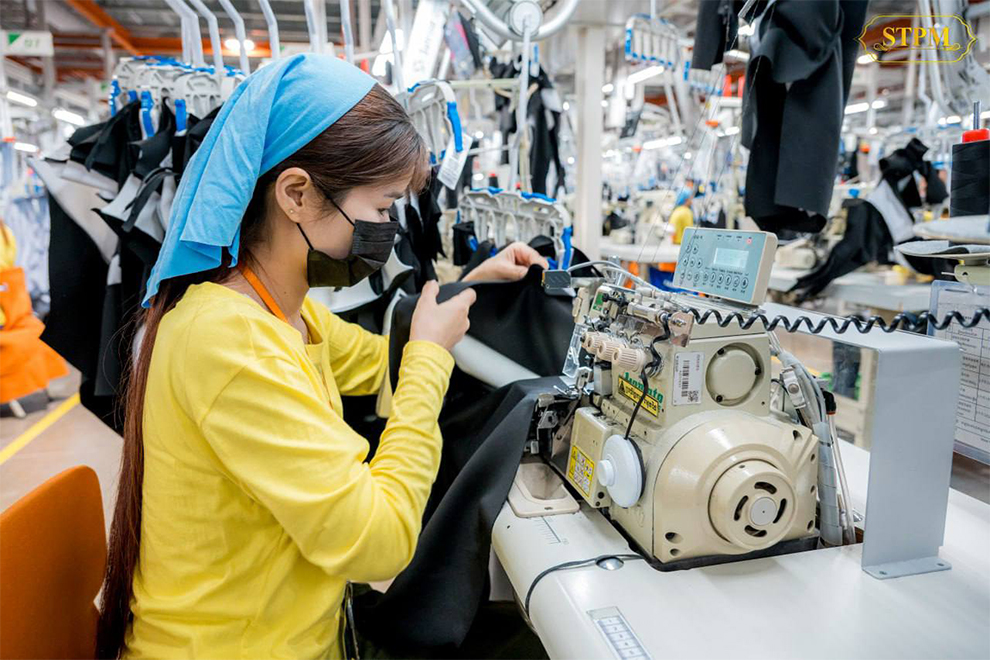
Increased demand for raw materials and components for factories which produce export goods has driven a rise in Chinese imports, leading to a one-sided trade imbalance.
In the first half of 2025, Cambodia imported more than $8.5 billion worth of goods from China, accounting for over half of the Kingdom’s imports, while exporting just $750 million worth in return.
Economists have urged Cambodia to step up efforts to narrow this trade deficit by expanding the domestic production of raw materials, encouraging more local investment and diversifying exports.
According to the General Department of Customs and Excise, during the first half of 2025, Chinese imports totalled $8.53 billion, a 31.2% increase over the $6.5 billion imported in the same period last year. This represents 52.38% of Cambodia’s total import expenditure, which was approximately $16.28 billion.
Exports to China reached only $750.62 million, a 7.9% decline from the $814.83 million recorded in the first half of 2024.
Total trade volume between Cambodia and China in the first half of 2025 reached $9.28 billion, an increase of 26.9% over the same period last year. This means Cambodia recorded a trade deficit with China of $7.77 billion, up from $5.68 billion in the first half of 2024.
Lor Vichet, vice-president of the Cambodia-China Commerce Association (CCCA), told The Post on July 11 that the main driver for the significant trade imbalance is that most Chinese imports are raw materials or parts for the processing and manufacture of export goods.
He explained that Chinese raw materials are favoured due to their high quality, reasonable prices, wide variety, ease of transportation and the large number of Chinese businesses and factories operating in Cambodia. These businesses also bring knowledge and technology transfer to the Cambodian workforce.
“The volume of goods imported from China will continue to rise in the future. Furthermore, the Cambodia-Thailand border dispute, where Thailand unilaterally closed some border points, is another factor contributing to the increased flow of goods from China,” he said.
He noted that in addition to trade relations, Cambodia and China maintain strong ties in tourism, arts and culture, markets, and construction.
Vichet urged the government and private sector to work together to prepare for Cambodia’s graduation from the Least Developed Countries (LDC) group by the end of 2029. Upon graduation, some preferential treatments will be withdrawn. For example, currently Cambodia can export goods internationally with only 30% local content, but after LDC graduation, a minimum of 60% local content will be required.
The latest data from the Ministry of Tourism showed that in the first five months of 2025, 488,973 Chinese tourists visited Cambodia, representing a 16.6% increase compared to the same period in 2024.
To further boost bilateral business and trade cooperation, Cambodia and China held the first meeting of the Cambodia-China Investment and Economic Cooperation Working Group on July 9, in Preah Sihanouk Province. Attendees included Chea Vuthy, secretary-general of the Council for the Development of Cambodia (CDC), Ling Ji, vice-minister of China’s Ministry of Commerce, Wang Wenbin, Chinese ambassador to Cambodia, and numerous other local and Chinese officials and business leaders.
According to the CDC, the meeting was held under the framework of the memorandum of understanding (MoU) signed in late 2021 between the CDC and China’s commerce ministry, which aimed to promote China’s “Belt and Road Initiative” and Cambodia’s “Industrial Development Policy 2015–2025”, as well as enhance bilateral economic and trade relations and strengthen investment.
During the first meeting, key topics discussed included strengthening production and supply chain cooperation, the impact of origin-related regulations, challenges faced by Chinese investors, a proposal to establish special economic zones which focus on processing Cambodian agricultural products and boosting domestic supply chains and industrial clusters.
The meeting concluded with all issues and requests being documented and taken into consideration in a cooperative and responsible manner. According to the CDC, the outcomes of this meeting are expected to have positive impacts on building a shared future community between Cambodia and China in the new era across all seasons.
