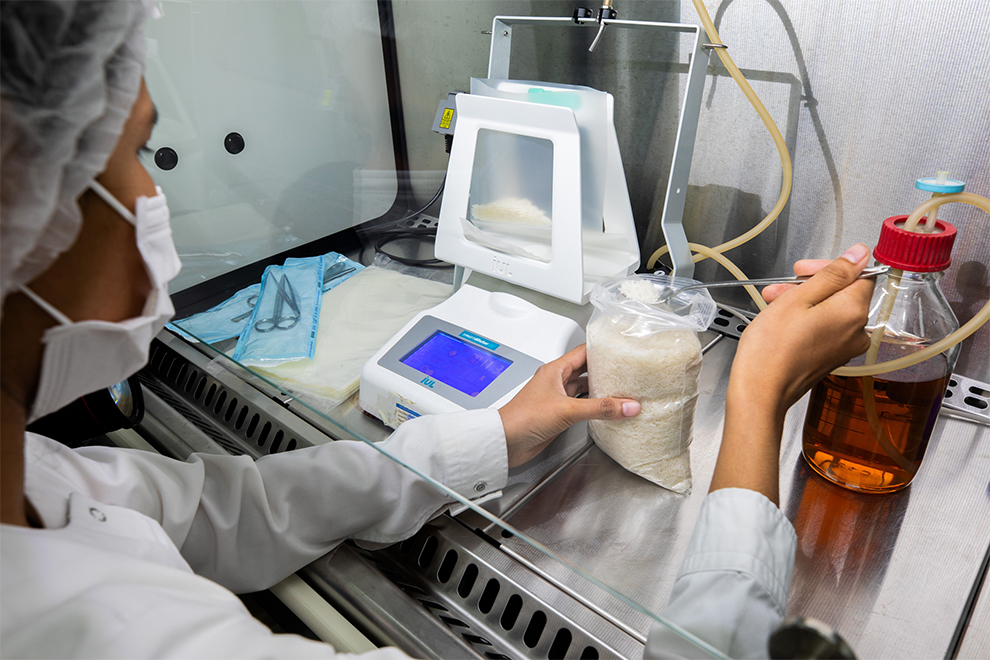
The export of Cambodian rice and pepper to international markets will become easier following an announcement by the Institut Pasteur du Cambodge (IPC), with support from the Australian government, that it is now offering new testing services for heavy metals in water and pesticide residues in rice and pepper.
This milestone means that producers of rice and pepper – some of Cambodia’s most important agri-food exports – now have the option to complete ISO/IEC 17025:2017-accredited tests in-country, reducing costs and turnaround times, and lowering contamination risks.
IPC is the first laboratory in Cambodia to install two state-of-the-art instruments for pesticide residue testing: the Agilent 6495D Triple Quadrupole LC/MS and the Agilent 7010C Triple Quadrupole GC/MS. Their ultra-high sensitivity and accuracy enable testing aligned with Australian, EU and US standards.
As a result, IPC now serves as a one-stop testing provider for exporters seeking to meet the requirements of many major international markets.
“This achievement reflects our strong commitment to delivering high-quality laboratory testing services. It strengthens our capacity to protect public health, enhance food safety and support Cambodia’s agri-food sector in complying with both national and international standards, ultimately benefiting local producers and consumers,” said IPC director Professor André Spiegel.
He expressed his appreciation for the financial and technical assistance provided by the Australian government, through the Cambodia Australia Partnership for Resilient Economic Development.
Australian ambassador Derek Yip lauded the new facilities.
“The expansion of IPC’s laboratory accreditation scope strengthens Cambodia’s food safety control system and enhances competitiveness for agri-food businesses. Australia is pleased to support initiatives that encourage export growth, further develop Cambodia’s high-potential agro-processing sector and deepen the country’s integration into regional and global value chains,” he said.
Reaksmey Run, quality, health & safety, environment supervisor at FEDRICE, a recent IPC client, explained how the new lab equipment is a game changer for the Kingdom’s agriculture sector.
“This is great news for Cambodian agri-food exporters. Previously, I often needed to send samples abroad for testing to meet international market requirements. Now that more services are available in Cambodia, we will be able to export more efficiently. I hope that other Cambodian companies will also be able to profit,” he said.
By the end of 2025, IPC’s Laboratory of Environment and Food Safety had been accredited under ISO/IEC 17025:2017 by the International Accreditation Service for: (1) microbiological testing in food and water (2) heavy metal testing in water and (3) pesticide residues testing in food such as pepper and rice.
An expansion of pesticide testing services to include cashew, fruit and other crops is planned for late this year.