



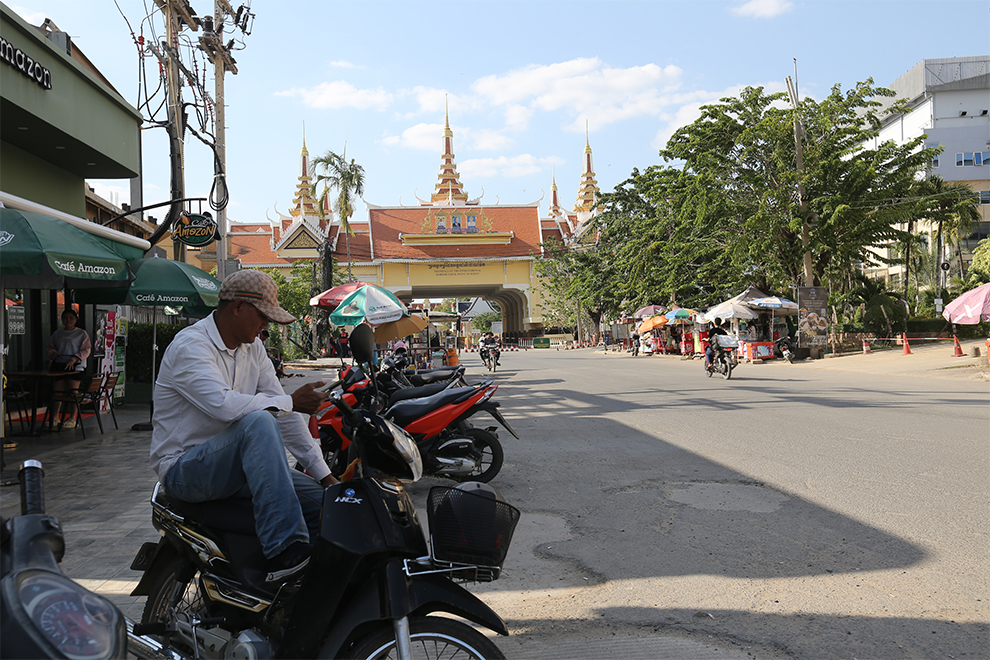
Poipet city, a bustling commercial hub on Cambodia’s northwestern frontier, continues to operate at near-normal levels despite the unilateral closure of the Thai border and recent armed aggression by Thai forces that has unsettled surrounding areas.
Home to residents from 69 nationalities and long considered a second home by many Thais, the city’s civilian economy has remained resilient, even as cross-border movement is disrupted and the security situation remains fragile.
“Poipet is a large commercial centre, with many nationalities living here, working and doing business here,” said Pankhem Bunthan, deputy director of the Prime Minister’s Office and deputy chairman of the Royal Government Working Group in Banteay Meanchey province.
“Poipet is not a military base, not a battlefield, but a commercial centre that is trusted by many countries around the world,” he added.
Situated closest to the Thai border, Poipet has historically relied on strong economic and social ties with its neighbour. Thai-language signage is common throughout the city, the Thai baht remains widely used in daily transactions and many businesses – particularly in retail, services and food – are operated by Thais or cater primarily to Thai customers.
The Poipet night market, one of the city’s main commercial arteries, continues to draw steady crowds, with vendors serving food under bright lights and shoppers moving actively between stalls.
Despite recent aggressive attacks by the Thai military in areas near Poipet, the city’s economic activity has not come to a halt. While shelling has been reported on the outskirts, Poipet itself has not been directly targeted.
Bunthan said that as of January 5 conditions in the city had improved significantly compared to the height of the attacks.
“Poipet is in a better condition than during the armed attack by the Thai army,” he said, noting that traffic remained busy and business operations were nearly 100 per cent normal.
He confirmed that the Thai army had dropped several bombs on areas surrounding the city, but attributed Poipet’s avoidance of direct attacks to its civilian and commercial identity. The city’s role as a hub for legal businesses operated by foreigners, he said, further highlighted its non-military status.
Bunthan added that maintaining stability in Poipet required restraint and flexibility from local authorities, particularly the avoidance of retaliatory actions that could threaten civilians and disrupt legitimate economic activity.
“Resisting the use of pretexts is not easy,” he said, emphasising that Poipet’s protection depends on its clear separation from any military engagement.
During periods of repeated shelling near the city, residents of villages such as Tumnop Ka 5, Prey Preich, Prey Kup and O’Lhong were evacuated to safer areas. Authorities later allowed them to return once conditions stabilised, aiming to minimise civilian risk while keeping the city’s essential functions running.
Speaking to reporters in front of a restaurant that remained open throughout the shelling, Bunthan underlined that Poipet is home primarily to civilians, legal workers and legitimate businesses.
“Some residents decided to leave during the shelling, while most others stayed, including foreigners – especially Thais,” he said.
He also issued a direct appeal to investors and business owners, urging them to maintain confidence in the city.
“Please continue to trust the Royal Government of Cambodia and the Cambodian leadership,” Bunthan said. “We will always be there for them. We will not cause any inconvenience and will continue to guarantee the work they are doing here.”
While the conflict has impacted the town’s long-term development plans, Bunthan acknowledged that progress is continuing, albeit at a slower pace.
“Some work has been hampered and the pace has slowed down, but development is still moving forward,” he said.
On the ground, vendors and small business owners share a similar account of disruption followed by a cautious return to normalcy.
Seav E, a street vendor from Takeo province who has sold milk corn sweets at the Poipet night market for six years, said he temporarily left the city on December 20 amid heavy shelling and sought shelter in Serei Saophoan. He returned on December 26 after determining that conditions had stabilised.
“I left because I was worried about the safety of my younger siblings,” Seav E said. “The loud noise of gunfire made them panic.”
Now back at his stall, he noted business has resumed, with customers gradually returning, though activity has yet to return to pre-conflict levels.
“Because I chatted with my friends here and the shelling situation calmed down, I decided to go back,” he said.
He added that some goods had been stored instead of sold during his absence, due to fears they could be damaged.
Despite the tension, Seav E continues to serve all customers without discrimination, including Thai patrons.
“When they come to buy, they are my guests,” he said. “The service I provide is normal. They talk to me like normal.”
At the same time, he expressed solidarity with fellow Cambodians affected by the conflict and the perceived discrimination against Khmer people. In response, he has begun adjusting his supply chain.
“I decided not to use their products anymore,” he said, explaining that around 70 to 80 per cent of what he now sells comes from Cambodian suppliers, though some items remain unavailable locally.
Seav E called for lasting peace, saying that stability would allow evacuees to return home and resume their lives.
“I want complete peace,” he said. “So people can go back to their homes, do their work and face no more aggression.”
As the Thai border remains closed and tensions continue, Poipet’s experience reflects a wider truth: while conflict has disrupted movement and shaken confidence, the city’s civilian economy – built on multinational trust and everyday commerce – continues to endure.
