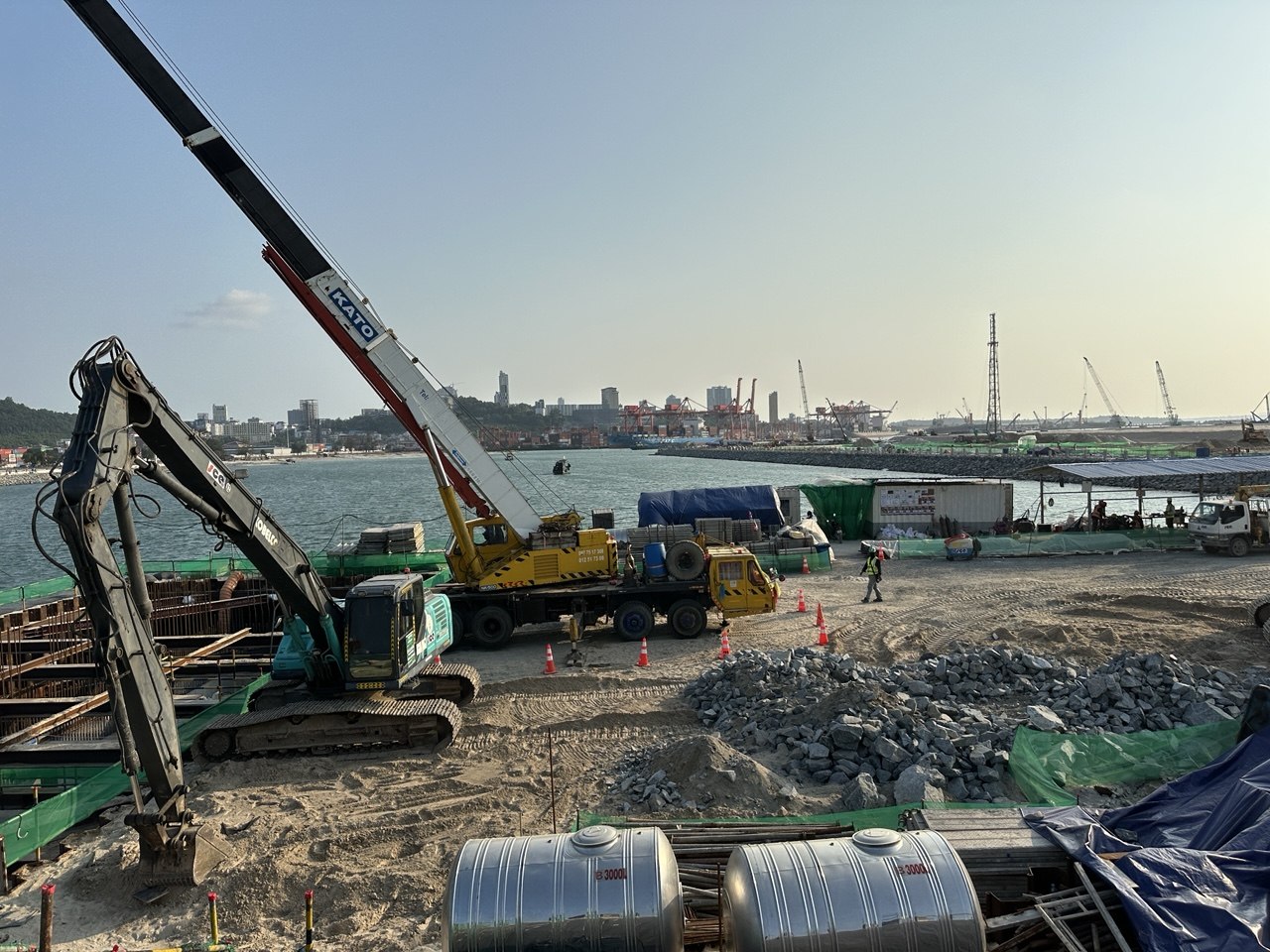
The Sihanoukville Autonomous Port (PAS) will be able accommodate larger vessels and significantly expand its container storage and transshipment capacity starting from the end of the first quarter of 2027, as construction of the Phase 1 New Container Terminal has now surpassed 60% completion.
Japan has played a crucial role in supporting the development of the port since 1996.
Established in 1956 with an initial depth of 8–9 metres and officially commencing operations in 1960, PAS has undergone multiple stages of development.
By 2024, its depth had been increased to 10.5 metres, with an annual handling capacity of approximately 1 million TEUs (twenty-foot equivalent units). However, this capacity has struggled to keep pace with Cambodia’s rapidly growing international maritime trade. In 2025 alone, container throughput reached 1.35 million TEUs.
To support national economic growth and rising trade flows, Cambodia has continuously developed the port since 1996, in cooperation with the Government of Japan through the Japan International Cooperation Agency.
Hamamoto Jumpei of TOA Corporation, project manager for the Phase 1 New Container Terminal, told journalists during a March 23 site visit that construction is progressing according to plan. The project, which began in April 2024, is scheduled for completion by March 31, 2027.
He added that the project will include a 57,000-square-metre container yard, significantly reducing congestion at PAS. The port’s depth will also be increased to 14.5 meters.
According to PAS’s development master plan, efforts to improve service quality and expand operational capacity aim to accelerate Cambodia’s economic growth. These improvements will facilitate greater foreign direct investment and enhance import-export activities.
PAS data shows that as of 2024, the port could handle approximately 1 million TEUs annually. This capacity is projected to rise to 1.45 million TEUs by 2027, 2.02 million by 2029, and 6.84 million by 2050. By 2030, the port’s depth is expected to reach 18.5 metres, enabling safe docking of large vessels from around the world.
PAS chairman & CEO Lou Kimchhun explained that the port plays an increasingly vital role in Cambodia’s economic growth. A modern deep-sea port with improved services and the ability to accommodate larger vessels will enhance the competitiveness of Cambodian goods in international markets. Once the Phase 1 New Container Terminal becomes operational, it is also expected to reduce shipping costs at PAS to some extent.
He noted that improved logistics efficiency and lower transportation costs will attract more international companies to invest directly in Cambodia.
Currently, due to capacity limitations, Cambodia still relies on transshipment through ports in neighbouring countries for large or long-distance shipments
“Through this development plan, PAS is committed to improving service quality by increasing digitalisation and strengthening connectivity, transforming itself into a key gateway for international trade and investment in Cambodia. By early 2027, total port capacity will reach 1.45 million TEUs per year, enabling approximately 93% of large container vessels in the Asia-Pacific region to dock and reducing maritime shipping costs by around $200 per TEU,” he said.
He also expressed his gratitude for Japan’s role as an indispensable partner in the development of the port, noting that 2026 marks almost 30 years of strong cooperation.