



Cambodia’s business climate is facing mounting pressure as escalating border tensions with Thailand, steep US tariffs and shifting regional trade dynamics shake investor confidence and threaten long-standing economic ties.
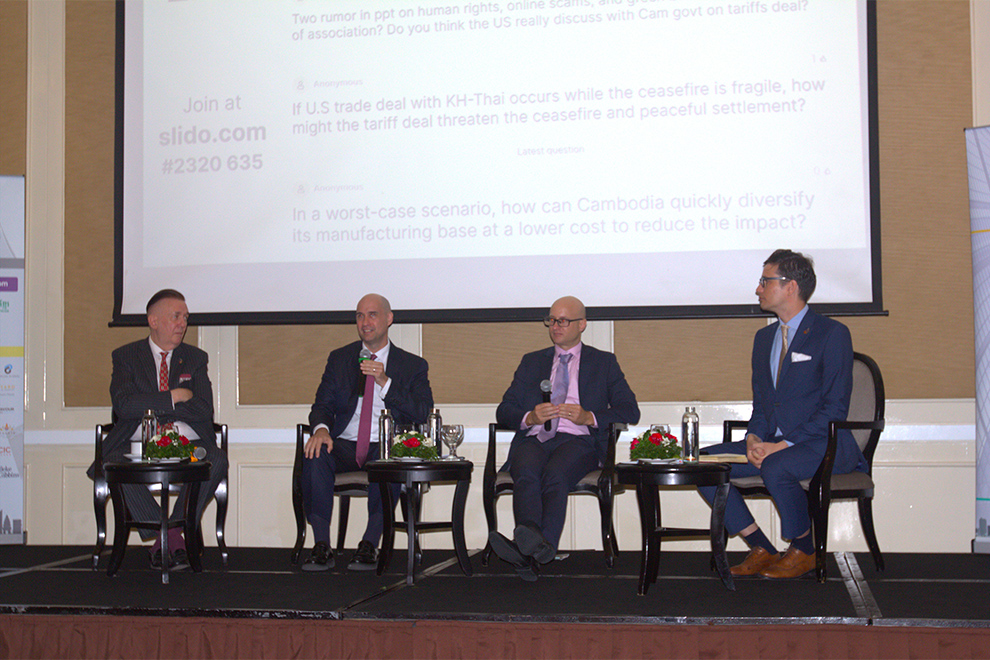
At a business forum organised by the American Chamber of Commerce in Cambodia (AmCham), today, July 31, leading business figures painted a complex picture of the country’s economic future — one caught between geopolitical stress, lost investor sentiment and unrealised opportunity.
“The intention to invest in Cambodia has dropped significantly,” warned AmCham president Casey Barnett.
“From February to July 2025, we saw a drop from 67% to just 51% of companies saying they plan to increase investment. And this was before the armed escalation on the Thai-Cambodian border,” he noted.
The backdrop of deteriorating sentiment is a sharp 36% US tariff imposed on Cambodian imports in early July — down from 49%, but still too high to sustain many factory operations.
“If the rate is 36%, factories tell us they’re not going to stay,” Barnett said bluntly.
“A number have told me that 25% they can survive. But 36%? That’s not viable,” he added.
The recent conflict has already begun reshaping Cambodia and Thailand supply chains. Many businesses are rerouting logistics from Thailand via Laos and Singapore, driving up costs and delaying shipments.
“The supply chain with Thailand is being maintained, but it’s become a lot longer and more expensive,” said Barnett adding he congratulated the completion of the latest trade deal with the US, even though the details have not been revealed.
This shift is being compounded by deteriorating border cooperation. In mid-July, Cambodia banned the import of Thai petroleum, removing more than $1 billion in annual Thai exports.
Despite early fears, Cambodia has avoided a domestic fuel price surge, signalling resilience in its emergency supply chain reconfiguration.
Tourism collapse, trade barriers and the tariff tug-of-war
But resilience doesn’t mean immunity. Tourism, one of Cambodia’s key revenue streams, has taken a hit. Thai visitor arrivals, which surged to two million in 2024, have plummeted.
Companies in industries like hospitality and transport were especially hurt.
“If you have two million people not coming to your country, it’s going to have a significant economic impact — even if they’re just coming across the border to consume services in a resort or casino,” Barnett said.
“In June alone, Thai purchases of Angkor Wat tickets dropped by two-thirds,” he continued.
Moreover, barriers to trade remain deeply entrenched in Cambodia itself. Licensing requirements for goods such as cosmetics, electronics and agricultural products often serve as costly, bureaucratic bottlenecks.
“These licenses really are not adding value,” Barnett emphasised.
“The consumer is not being protected. It’s just a barrier preventing American products from coming into Cambodia,” he noted.
He also cited the excise tax system — levied even on goods Cambodia does not produce, such as petroleum — as a de facto customs duty.
“Cambodia doesn’t have refineries, so an excise tax on gasoline is essentially another tariff,” he explained.
Despite these hurdles, Barnett said that Cambodia’s trade negotiators have made progress.
He credited Prime Minister Hun Manet and Deputy Prime Minister Sun Chanthol with achieving the drop from 49% to 36% in US tariffs, through their active and flexible diplomacy.
Still, Barnett warned that Cambodia’s high duties on US goods, especially vehicles and energy products, leave it vulnerable to retaliation.
“The taxes paid for some American goods are almost double. So it’s reasonable for the US to ask for fair treatment,” he added.
The regional race for investment
Cambodia’s challenges are magnified by fierce regional competition. Vietnam and Indonesia, with 20% and 19% US tariff rates respectively, are drawing attention from multinational manufacturers.
“The main competitor for Cambodia is Indonesia,” Barnett noted.
“They have the labour force, existing capacity, and it’s relatively easy to move large orders there,” he added.
A July survey conducted by AmCham showed that 33% of factories are considering relocating production to Vietnam.
Buyers are watching the region closely, with Bangladesh also seen as a potential competitor — despite facing its own tariff difficulties.
Lucas Moro, vice-chair of AmCham’s Tax Committee, emphasised the long-term risk.
“Much of Cambodia’s growth in the last decade came from exports and Chinese investment, including real estate and tourism — which may never return. This is going to be a challenge for diversification,” he said.
Moro saw energy reform and deregulation as Cambodia’s best bets for creating a manufacturing ecosystem that can rival China’s.
“Once you have three or four factories come, others follow. You keep inventories low, operating costs down — that’s what makes it work,” he explained.
“If Cambodia can create that ecosystem, it won’t just add jobs, it will attract investment,” he added.
Toward a higher-end economy
But diversification is not only about factories. Anthony Galliano, AmCham vice-president, pointed to the bigger picture: Cambodia must leapfrog beyond low-end exports.
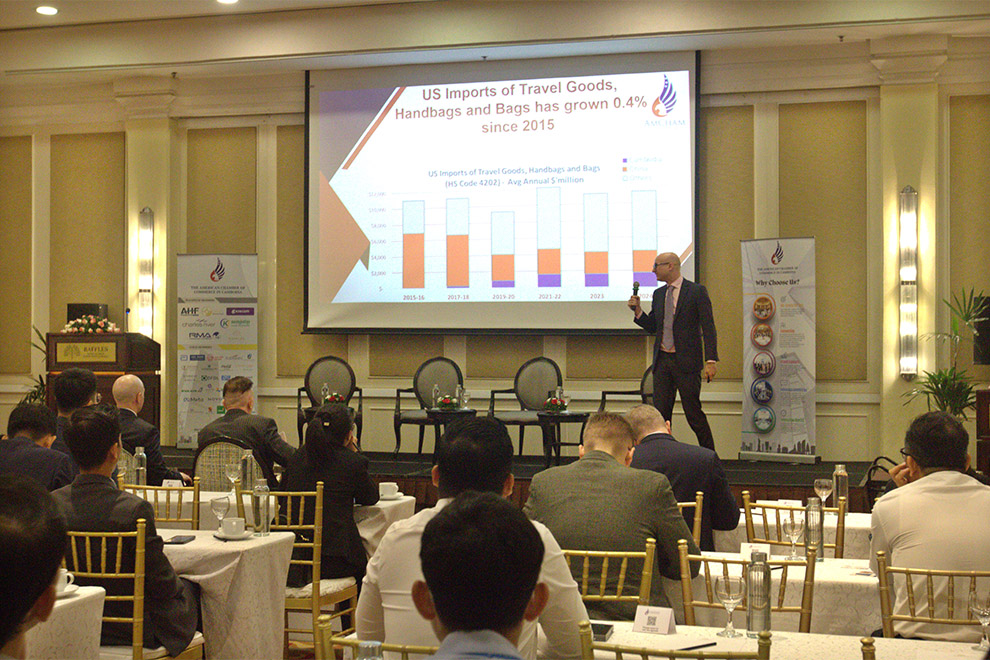
“We’ve got a time frame that allows us to continue at the same thing — shoes, handbags, bicycles — but that’s not our future,” he warned.
“We need to be producing phones, cars, electronics. If not, we’re going to be sitting with Bangladesh and African countries as basic export economies,” he noted.
He urged the Cambodian government to focus on upskilling the workforce and removing regulations that stifle innovation.
“The US is investing billions into Asia in AI, cloud and digital transformation. If you want US dollars, this is what it’s chasing,” Galliano said.
Barnett echoed the call for a more open and digitally ready economy.
“Technology is where we’re going to see the big jumps in productivity,” he said.
“The government should make it easy to bring in electronics, license internet providers, lay fibre optics — it all drives growth,” he added.
A moment of reckoning
As the border crisis lingers and US tariff negotiations continue, the speakers warned that time is running short. Cambodia must reform to remain competitive.
“This is a great opportunity to tell the world the good news story about Cambodia,” Moro urged.
“Right now, it’s apparel and chocolate. But it could be phones, toys, AI. That’s the future,” he continued.
The speakers noted that the path forward will depend not just on geopolitics — but on whether Cambodia can rise to the moment with bold reforms.
“Serious decisions need to be made to return to a higher level of growth,” Barnett noted.
“Because if we just keep merging with the global economy at this slow rate, Cambodia is going to stay poor for a lot longer,” he continued.
