



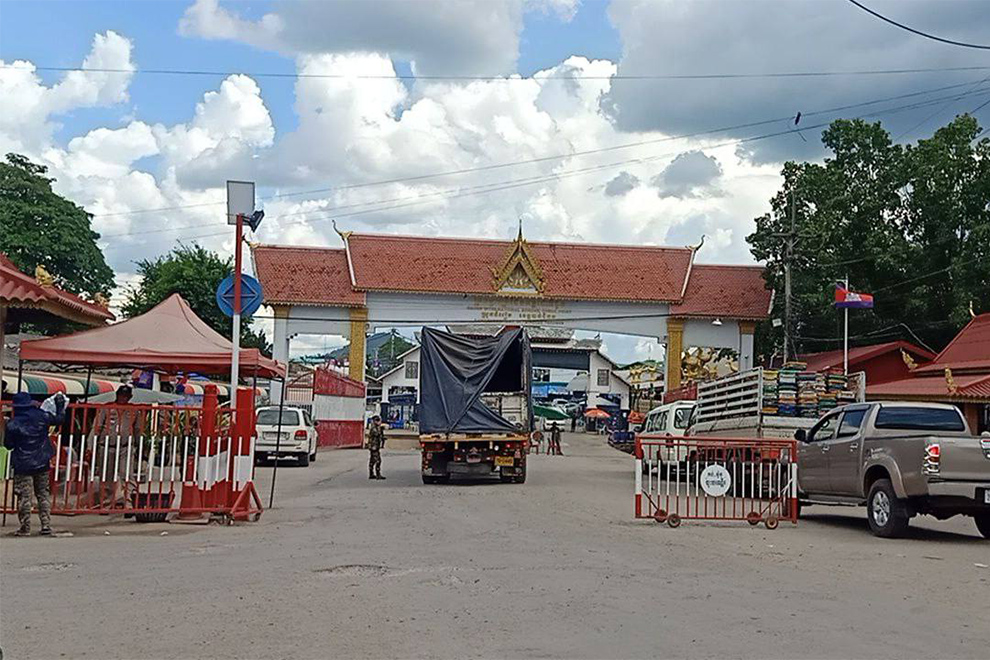
The effects of the recent armed conflict and Thailand’s unilateral border closures have continued to cause major disruptions to the flow of goods between the two countries over the past three months.
In August, the total trade volume between Cambodia and Thailand — who share over 800km of land border —was just $260 million, a drop of almost a third on the same month last year.
However, the figure represented a 25% rise over July, when tensions were at their highest, culminating in the heavy fighting of July 24-28.
According to the General Department of Customs and Excise (GDCE), total trade between Cambodia and Thailand in August 2025 reached $260.03 million, down 30.44% compared to the $373.83 million recorded in August 2024. Of this, Cambodia exported $46.16 million worth of goods to Thailand (down 36.2%), while imports amounted to $213.87 million (down 29.1%).
This resulted in a trade deficit of $167.71 million for Cambodia.
In July 2025, total trade between the two was just $206.88 million, a 42% drop from July 2024, with exports at $40.69 million and imports at $166.19 million.
The GDCE noted that in the first eight months of 2025, Cambodian-Thai trade reached $2.66 billion, down 4.6% compared to the same period in 2024. Total exports were $534.9 million (down 6.4%), while imports totalled $2.12 billion (down 4.1%), leaving a trade deficit of approximately $1.59 billion.
Chea Chandara, president of the Logistics and Supply Chain Business Association in Cambodia (Loscba), told The Post on September 10 that the recent armed conflict — sparked by the Thai side — led many Cambodians to reduce or even boycott the use of Thai products. He added that currently, land transport across the Cambodia-Thailand border is non-operational, with all goods being rerouted through Laos, waterways or by air, contributing to the decline in trade volume in recent months.
He added that trade between the two nations is likely to continue declining for some time, as Thai military aggression has boosted national sentiment in Cambodia, with calls to support local products and look for alternative imports from other countries instead of relying on Thai goods.
“I believe the armed conflict and unilateral border closures by Thailand are even more serious than the Preah Vihear Temple dispute from 2008–2011. Therefore, Cambodian public support for Thai products won’t recover easily, while support for local and alternative imported products continues to grow,” he said.
Cambodian economist Hong Vanak from the Royal Academy of Cambodia noted that although Cambodia and Thailand have agreed to cease hostilities, diplomatic and trade relations remain strained. He suggested that Thailand’s aggressive actions have prompted Cambodian producers to reflect on expanding local production capacity, while public support for domestic products is also surging.
“I believe that the increase in local production capacity and the rising trend of public support for local products will result in a decline in imports of Thai goods into Cambodia,” he said.
In 2024, total bilateral trade between Cambodia and Thailand reached $4.29 billion, an increase of 15.5% over 2023. Exports were $844.9 million (up 3.3%), while imports were $3.44 billion (up 18.9%), according to the GDCE.
