



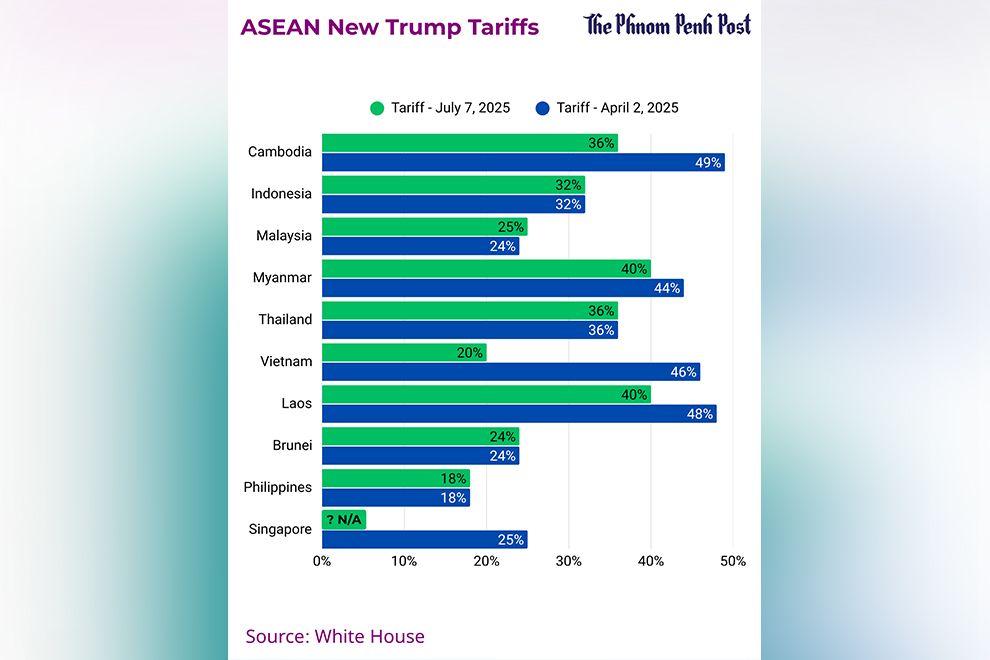
The US government has reduced the reciprocal tariff rate for Cambodian goods from 49% to 36%, marking the second-largest cut among ASEAN countries after Vietnam. The new tariff rate will take effect on August 1, barring further negotiations. Although reduced, the rate remains high compared to those imposed on many other nations.
In a series of July 7 letters, addressed to 14 separate nations including Cambodia, US President Donald Trump urged all countries to increase direct investment in the US and open up their markets further to American goods in order to achieve mutual long-term economic gains.
Based on the new tariff schedule, Tariffs on Cambodian goods fall from 49% to 36%, while Laos falls from 48% to 40%, Vietnam from 46% to 20%, Myanmar from 44% to 40% and Malaysia increases from 24% to 25%.
Thailand remains at 36%, Indonesia remains at 32%, Brunei remains at 24% and the Philippines remains at 18%. No new rate was announced for Singapore, previously at 25%,
Lor Vichet, vice-president of the Cambodia Chinese Commerce Association (CCCA), told The Post on July 8 that although Cambodia’s new tariff rate of 36% is still considered high compared to its regional neighbours, this alone does not mean Cambodia’s export potential will be negatively affected.
He emphasised that it’s important to consider the types of goods being exported by each country. For example, Cambodia primarily exports textiles and garments, while other countries may focus on different products, meaning the impact of tariffs will vary.
He added that Cambodia’s main exports to the US currently include garments and apparel, footwear, travel goods, bicycles and car tyres.
“Cambodia still has around three weeks to engage in further negotiations with the US. These talks could aim to relax import conditions for American goods, increase purchases or ease certain requirements for US companies interested in investing in Cambodia, before the new 36% tariff comes into effect on August 1,” he said.
According to USImportData.com, the top countries exporting textiles to the US in 2024 were China, at $36.1 billion, Vietnam, at $15.5 billion, India, at $9.71 billion, Bangladesh, at $7.49 billion, Mexico, at $5.53 billion, Indonesia, at $4 billion, and Cambodia, at $3.8 billion, making the Kingdom the seventh largest source of textile imports to the US.
Addressing public concerns that some factories or enterprises might relocate from Cambodia to neighbouring countries, Vichet claimed he was not worried. Even though other countries may have lower tariff rates, they rarely allow 100% foreign ownership of businesses like Cambodia does. Furthermore, one must also consider geographic location, labour force, costs and shipping times.
According to the General Department of Customs and Excise (GDCE), in the first five months of 2025, Cambodia-US trade reached $4.48 billion, a 27% increase, with exports from Cambodia valued at $4.35 billion (up 27%) and US imports at $120 million (up 25.6%).
In 2024, Cambodia-US trade totalled $10.18 billion, up 11.2%, with Cambodian exports to the US at $9.9 billion (up 11.4%) and US imports at $264.14 million (up 2.7%)
