



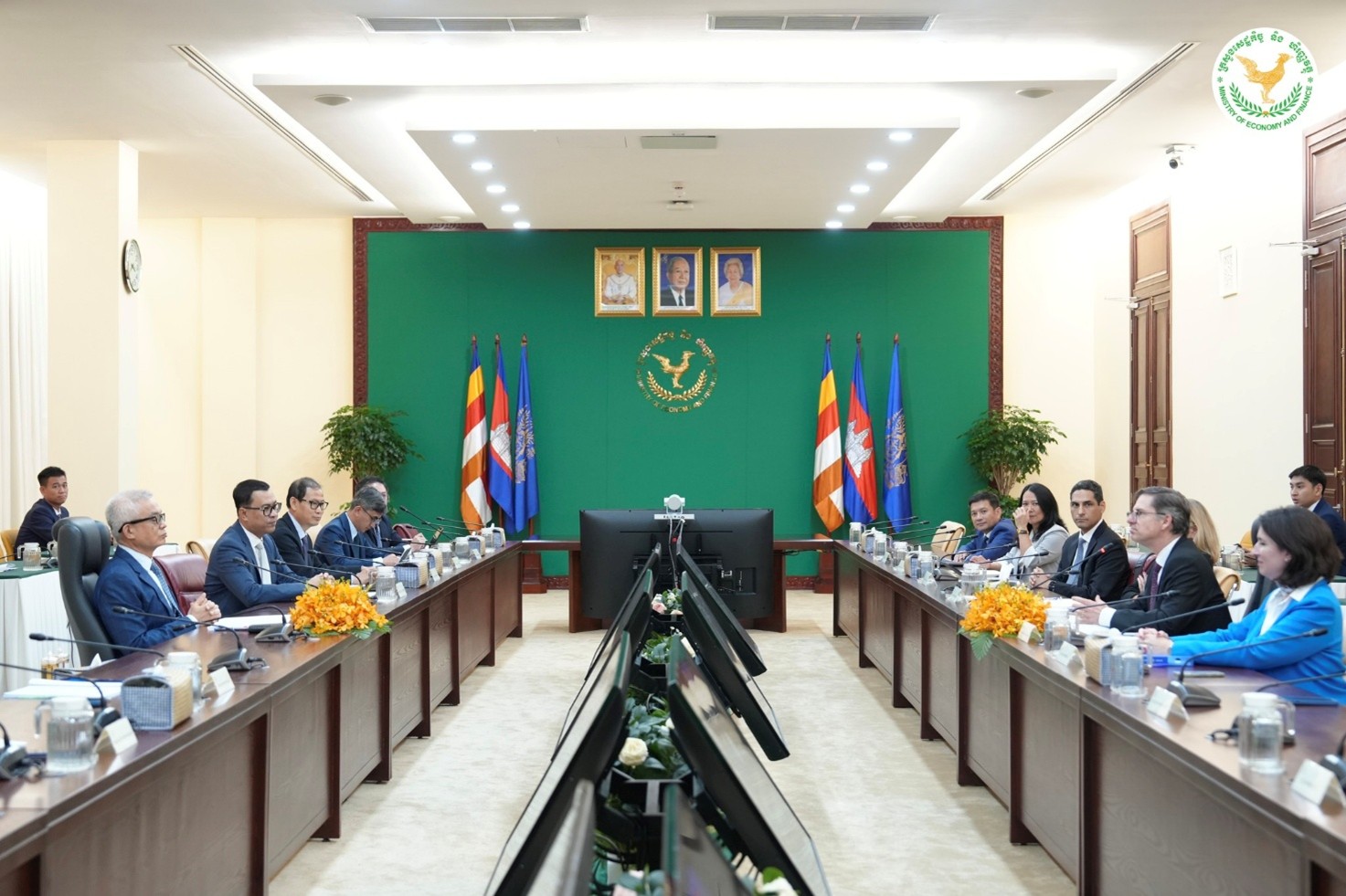
A representative of the World Bank (WB) declared that his institution intends to continue providing technical assistance and sharing its international experience to help Cambodia achieve its vision of becoming a high-income country by 2050.
Carlos Felipe Jaramillo, WB vice-president for East Asia and the Pacific, met with Minister of Economy and Finance Aun Pornmoniroth at the finance ministry on March 16.
Jaramillo informed the ministry leadership that the bank is strongly committed to continuing its cooperation and support for Cambodia’s journey toward achieving its 2050 vision.
This will be implemented through the new Country Partnership Framework (CPF 2025–2029) between the Royal Government of Cambodia and the Bank. The cooperation focuses on human capital development, enhancing competitiveness for better jobs, and strengthening resilience for vulnerable populations.
He explained that following close collaboration with Cambodia’s ministries and institutions, as well as other stakeholders, the CPF 2025–2029 was approved by the bank’s Board of Executive Directors. The framework aligns with phase one of the seventh-mandate government’s Pentagonal Strategy, the National Strategic Development Plan, and Cambodia’s priority needs.
Jaramillo also highlighted the International Development Association (IDA21) financing framework, under which the bank will continue supporting Cambodia by maintaining existing financing levels and mobilizing additional resources from other sources.
Pornmoniroth expressed his gratitude for the bank’s contributions to Cambodia’s socio-economic development. He briefed the World Bank delegation on Cambodia’s macroeconomic situation and key challenges, including the negative impacts of global economic uncertainty, changes in trade policies, geopolitical tensions, the Cambodia–Thailand border conflict and rising oil prices due to conflict in the Middle East.
He highlighted the government’s key priority areas, including skills development and education, transport and other priority sectors aimed at improving the investment climate and trade facilitation. These efforts are intended to enhance productivity, strengthen competitiveness, diversify the economy and maximise the benefits from the free trade agreements Cambodia has signed in recent years.
