



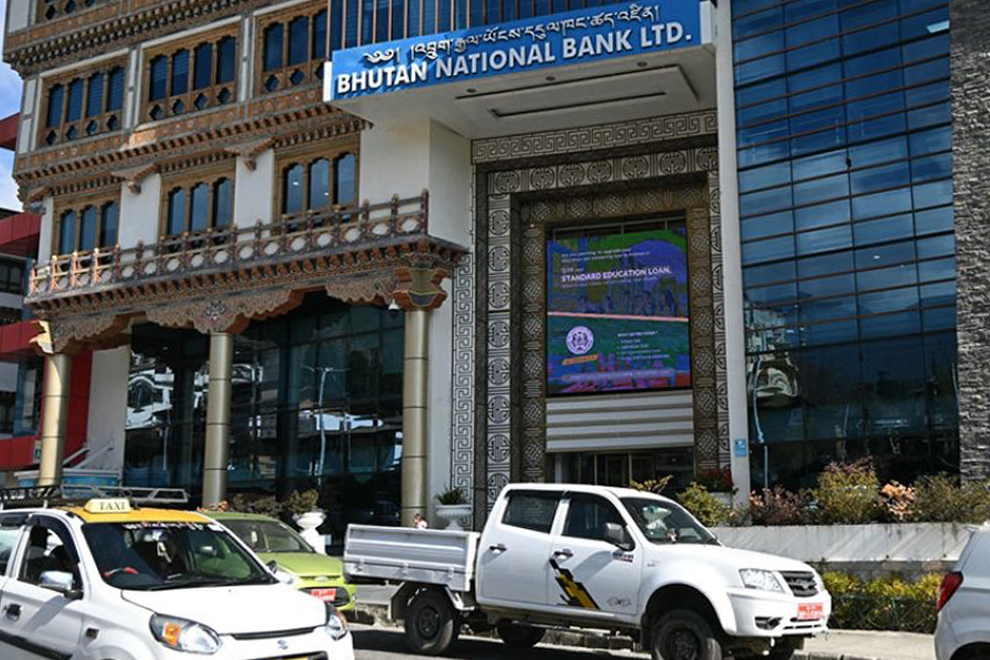
THIMPHU – Financial institutions in the country have introduced a range of deposit schemes offering higher interest rates to Bhutanese living abroad, part of a broader strategy to attract foreign currency inflows into the domestic banking system and bolster foreign currency reserves.
While deposit interest rates for residents within Bhutan are modest, financial products tailored for Bhutanese abroad provide noticeably higher returns.
The banks generally offer around 4.5 percent interest annually for savings accounts for Bhutanese within the country. The rates have remained largely stable across financial institutions, with slight variations.
The Bhutan Development Bank Limited (BDBL) offers 4.75 percent interest, while T-Bank provides up to 5.5 percent for certain account tiers.
Fixed and recurring deposits provide somewhat higher returns depending on maturity periods. For resident Bhutanese, fixed deposit rates typically range between 6.5 percent and 9.1 percent. Bhutan National Bank Limited (BNBL) offers rates up to about 8.5 percent for longer tenures, while T-Bank and BDBL offer 8.5 to 9.1 percent for deposits exceeding seven to 10 years.
In contrast, remittance-linked deposit schemes designed specifically for Bhutanese living abroad can offer yields approaching 9 to 9.5 percent, depending on the tenure and product structure.
T-Bank clearly states on its website that Bhutanese living abroad are entitled to a 0.50 percent higher interest rate than the standard fixed deposit rate while Bank of Bhutan offers 0.25 interest higher than the normal fixed deposit.
According to the central bank, Royal Monetary Authority (RMA), these differentiated rates reflect the strategic importance of foreign currency inflows for Bhutan’s economy.
“The difference exists because Bhutanese living abroad bring foreign currency into Bhutan, while residents generally operate within the domestic Ngultrum-based economy,” an RMA official said.
Bhutan relies heavily on imports for many essential goods and services, which require payments in foreign currency. Encouraging overseas Bhutanese to deposit their savings in domestic financial institutions therefore, helps reinforce the country’s external financial position.
Financial institutions have increasingly introduced products aimed at the diaspora, including remittance-linked deposits, foreign currency accounts, and specialised investment products. These financial instruments allow overseas Bhutanese to channel their earnings back into Bhutan’s banking system.
According to the central bank, such deposits strengthen liquidity within financial institutions while also supporting the country’s foreign exchange reserves.
“These inflows improve the balance of payments, strengthen foreign currency reserves, and support domestic investment,” the RMA official said.
Deposits from overseas earners can also expand banks’ lending capacity, enabling credit growth that supports economic activity.
Preferential lending rates also exist in certain sectors. Housing loans offered to Bhutanese living abroad typically carry lower interest rates than those available to residents. For example, BNBL offers a 0.5 percent reduction in housing loan interest rates for Bhutanese living abroad.
Housing loans for Bhutanese abroad generally carry rates of around 8.5 percent. By comparison, residential housing loans for residents usually range between 8.28 percent and 9.75 percent, while loans for commercial housing projects, such as apartment developments, can reach up to 10.75 percent depending on the bank and project structure.
In 2016, the RMA introduced the Minimum Lending Rate (MLR) framework following a comprehensive review of the country’s interest-rate policies. As of March 2026, the system-wide MLR remains at 5.72 percent.
Under this system, banks calculate their minimum lending rates based on factors including the cost of funds, operational expenses, and negative carry charges associated with the cash reserve ratio. The RMA then establishes an average benchmark rate below which banks are not permitted to lend.
Loan pricing follows a cost-plus model, allowing banks to add margins based on credit risk, loan tenure, and business strategies. The framework aims to ensure transparency and consistency in lending practices across the financial sector.
Despite the economic logic behind the policy, the gap between domestic and diaspora-focused financial products is noticeable. For young Bhutanese weighing opportunities abroad, financial incentives can become one of several factors shaping migration decisions.
The RMA, however, said that these policies are not intended to encourage outward migration.
“There are no major financial incentives currently provided to Bhutanese living abroad that are not available to resident Bhutanese,” the central bank said, noting that certain concessions are tied specifically to the foreign currency brought into the country.
According to the RMA, the Bhutanese Living Abroad Investment Product accounted for about 10 percent of the country’s total inward remittances in 2024.
ANN/Kuensel
