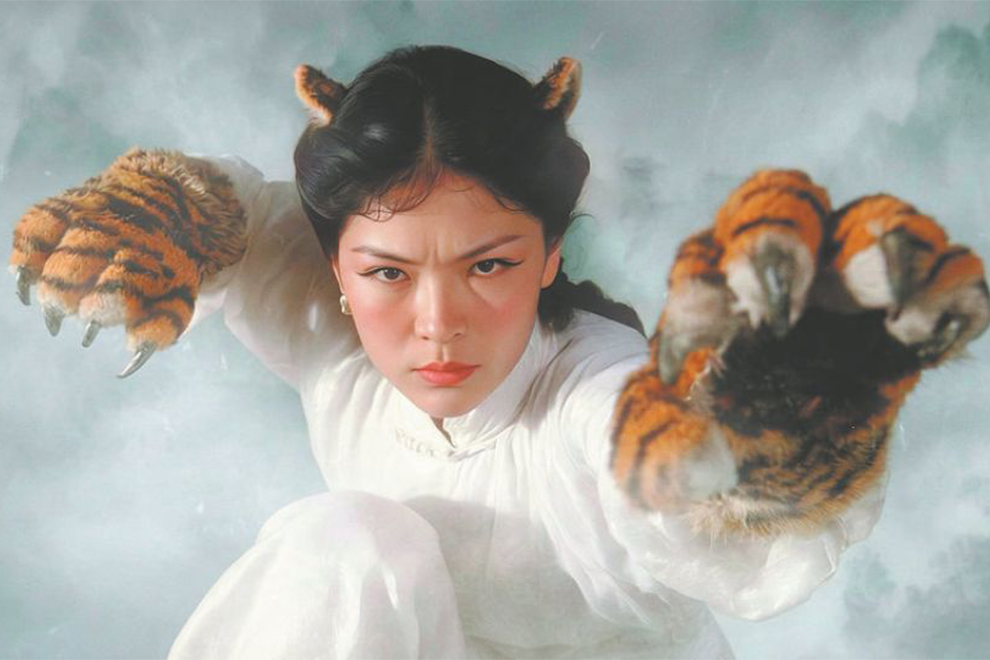
BEIJING – Wu Aihua’s appearance is not typical of virtual performers built for 2026. Her face carries the sharp, resolute features of a classic wuxia (martial arts and chivalry) heroine from 1960s-80s Hong Kong cinema. Her posture is upright, restrained, almost austere.
There is no cyberpunk gloss, no exaggerated sweetness, nor futuristic excess. Instead, she appears as if she has stepped out of a studio-bound martial arts film: grainy, soft-lit, and steeped in nostalgia.
That distinctive aesthetic is precisely what captured the public’s attention in an endless feed of content.
Last month, Warner Music China officially announced its collaboration with director and new media artist Wu Zhiqi (also known as Wu Zhi-Chi), the creator behind Wu Aihua, an AI character and social media music sensation.
“We plan to leverage our global resources and industry expertise to systematically advance Wu Aihua’s multilingual music creation, international distribution, and cross-cultural collaborations,” the company says in its press release. “With audiovisual language as the medium and the spirit of wuxia at its core, the initiative aims to deepen her artistic and cultural exploration, expand the boundaries of her creative expression, and help her build a distinctive aesthetic and value system within global youth culture.”
On Jan 12, the music video Wu AI-HUA was officially released, subsequently amassing over 10 million views across all platforms. Simultaneously, the audio debuted on major global streaming platforms, with comments on NetEase Cloud Music surpassing 999+ on its very first day.
For Wu Zhiqi, it began with Wu Aihua’s unconventional appearance.
“I never wanted her to be soft or conventionally beautiful,” he says. “I don’t like overly submissive femininity. Wu Aihua isn’t a traditional female archetype — she’s rigid, restrained, and tough.”
Wu Aihua’s visual world is deliberately low fidelity. Soft focus, hazy lighting and intentional blank space, or liubai, a core concept in Chinese aesthetics that invokes ambiguity and inspires imagination, dominate the frame.
Hand-drawn mountains and pavilion silhouettes sit beneath a pale-pink dusk sky, re-creating the texture of classic Chinese wuxia films. The stillness between movements matters as much as the movements themselves.
When Wu Aihua begins to sing, the illusion breaks — by design.
She sings in English, over a track that fuses EDM and hip-hop with the austere tension of traditional Chinese instruments. For the director, the choice was non-negotiable.
Her voice is meticulously crafted using synthesizer-based technology and undergoes extensive manual editing and post-processing by a human vocal producer.
“If she sang in Chinese, everything would be too seamless, perhaps even predictable,” Wu Zhiqi explains. “The English vocals provide a sensory counterpoint to the wuxia visuals. I’m looking for that aesthetic friction — a clash between ancient imagery and a modern, global sound — to give the character a more complex, multidimensional texture.”
English, by contrast, creates immediate sensory conflict. “The visual already carries a strong sense of an era,” he says. “If the sound also stays where people expect it to, there’s no contrast. I want the audience to feel the clash between what they see and what they hear.”
That clash became one of the project’s most talked-about elements, forcing viewers to recalibrate their expectations of both wuxia aesthetics and virtual performers.
“I love the visuals, but when she sings in English, it feels random. Wouldn’t an original Chinese song have been more meaningful?” a viewer questioning the linguistic choice and cultural mashup.
“Finally, a virtual artist with character — not the usual cyborg pop doll. She feels like a narrative, not just a gimmick,” shared a viewer impressed by the storytelling.
Wu Aihua was not designed as a quick content experiment. The director initially treated her as a “touchstone”, a 10 — to 20-second test to explore a new idea. But once the demo appeared on RedNote in September last year, messages began flooding in, urging him to expand Wu Aihua’s world.
“I kept revising her,” he says. “She was finished very early, but I kept optimizing. Adding even 30 more seconds is exponentially more work than people think.”
At the core of those revisions was character. The director insists his virtual projects must be story-driven, not aesthetic showcases. “I don’t want Wu Aihua’s music videos to belong to a single style,” he says. “They need a world. Who is she? What kind of world does she live in?
“Current AI models still struggle with complex fight choreography,” the director notes, adding that he plans to incorporate more AI-generated characters into the stories of Wu Aihua’s lore. “If you push too hard, the emotion collapses.”
Instead, he turned to pose-based action logic, inspired by Jackie Chan, Donnie Yen, and Bruce Lee films, as well as by Japanese animation such as Dragon Ball. Each strike becomes a pose; each pose, a storyboarded frame. The result is movement that feels continuous without needing hyper-realistic combat.
Wu Zhiqi is careful to demystify AI’s role in the process. “AI isn’t magic,” he says. “It’s difficult. You need judgment, taste, and knowledge. Otherwise, nothing works.”
Trained in graphic design and deeply immersed in different music genres, Wu approaches AI as an extension of his aesthetic judgment. “If I didn’t have my own sense of beauty, I couldn’t have created Wu Aihua,” he says.
He rejects the idea that AI replaces creators. Instead, it forces them to learn more: storytelling, editing, rhythm, and pacing.
“To hold someone’s attention for over three minutes — whether they love it or hate it — you have to understand cinema,” he says, citing Stephen Chow films as a key influence.
Looking ahead, the Wu Aihua sensation is only beginning. The director is currently experimenting with multilingual tracks, including a bold collision of Hakka dialect and Spanish, and even African languages.
Some of these experiments are very challenging. “AI can’t accurately reproduce Hakka,” he says. “I’ve spent over a month trying to re-create its rhythm using English. It’s extremely hard.”
The goal, however, remains constant: to build Wu Aihua not as a gimmick but as a living IP — one that could eventually include friends, enemies and an expanding narrative universe across animation, music and visual storytelling.
“Everyone is making virtual humans now,” he says. “That’s boring. If the world isn’t different, why should anyone care?”
ANN/China Daily