



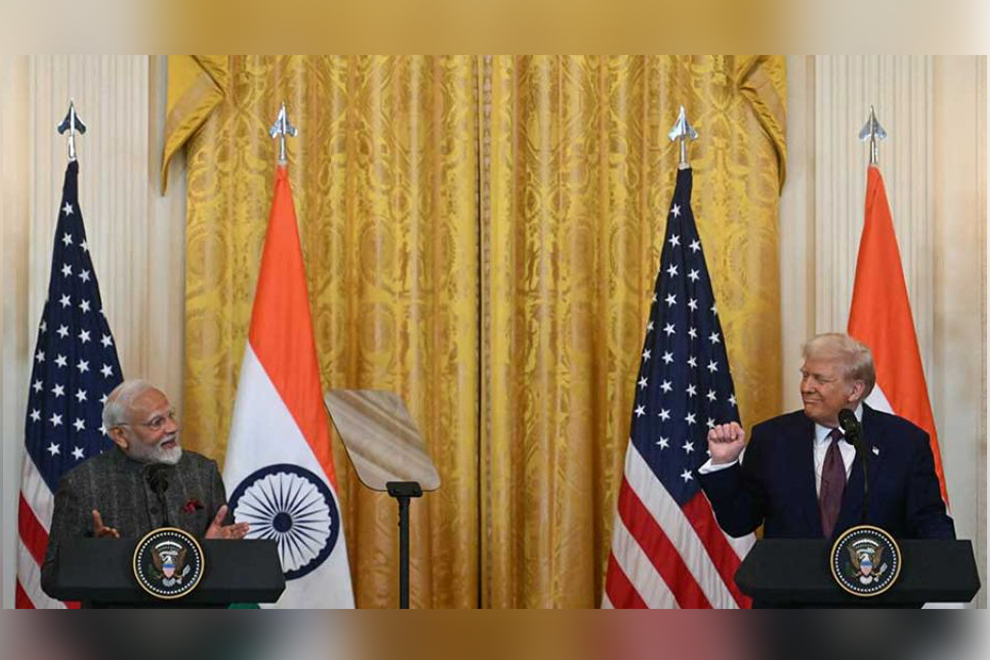
NEW DELHI – The first tranche of the India-US trade deal, announced by US President Donald Trump earlier this, has triggered a major political and strategic debate in New Delhi with the Opposition parties questioning the Narendra Modi government whether Indian interests have been compromised and the country’s position on its strategic autonomy has weakened.
The concerns have particularly been sparked over energy ties with Russia and New Delhi’s market access commitments. Moreover, India’s alleged decision to slash tariffs on a wide range of American goods to near zero in exchange for 18 per cent tariffs on Indian exports to the US has also prompted severe criticism from the Opposition.
With the interim framework of the first tranche of the India-US trade deal already finalised, below are the key sticking points that have led to intense Opposition scrutiny and the government’s stand on it.
‘You are going to talk to us as equals’: LoP Rahul Gandhi’s stern message to Donald Trump amid trade deal row
Trump’s Russian oil claim and strategic autonomy concerns
Concerns on India’s strategic autonomy allegedly being compromised first surfaced after US President Donald Trump, while announcing the interim agreement, claimed that Prime Minister Narendra Modi had agreed to stop purchasing Russian Federation, a remark that set off alarm bells in political circles.
The claim, coupled with the joint statement issued after the deal, prompted Opposition leaders to question whether India’s strategic autonomy on energy sourcing has been compromised.
“No purchase of oil from Russia. No tariffs on American imports. American tariffs on Indian exports 18%. India will buy USD 500 billion worth of energy, technology, agriculture & coal. What the hell happened to India’s strategic autonomy?” Congress MP Manish Tewari asked.
In response to this, the government has maintained that India’s decision to source its energy products, including crude oil, will always be taken in the interests of its 1.4 billion people.
External Affairs Minister S Jaishankar, while speaking at the Munich Security Conference on Saturday, again addressed the issue, saying India is very much wedded to its strategic autonomy.
“We are very much wedded to strategic autonomy because it’s very much a part of our history and our evolution. It’s something which is very deep, and it’s something which cuts across the political spectrum as well,” Jaishankar said.
Addressing the concerns over India cutting its oil imports from Russia, Jaishankar further noted, “As for energy issues, this is a complex market today. Oil companies in India, as in Europe, as probably in other parts of the world, look at availability, look at costs, look at risks and take the decisions that they feel are in their best interest,” he said, adding, “So many things are changing, and so many of us are doing our calculations and recalculations.”
India-US trade deal: Rahul Gandhi accuses Centre of ‘cheating’ cotton farmers, textile exporters
India’s USD 500-billion “purchase” promise and near zero tariffs
Other than the strategic autonomy debate, India’s USD 500-billion “purchase” promise has also come under heavy criticism.
Congress MP Shashi Tharoor criticised the scale of proposed imports. “We have surprisingly promised to buy USD 500 billion dollars worth of American goods over five years. This effectively converts a surplus into a long-term deficit by executive assurance rather than by market demand,” he said.
He further added, “While the US continues to impose import tariffs of up to 18 percent, we have committed ourselves apparently according to this joint statement that I’ve been seeing here, joint US-India statement, to impose tariffs up to 18 percent on Indian exports and we to slash tariffs to near zero levels.”
However, the ruling BJP has countered this claim of Congress leaders, saying that India has only expressed an intention and not committed to this.
BJP leader Anil Baluni said that the older US government fact sheet framed India’s proposed USD 500 billion purchases as a commitment but that language has since been corrected. “The updated position is clear: India has expressed an intention, not a binding obligation, to purchase goods worth up to $500 billion over the coming years,” he said.
Rahul Gandhi claims agreement a trap, will hurt cotton farmers and textile exporters
Leader of Opposition Rahul Gandhi today issued a video statement, accusing the Narendra Modi government of cheating the cotton farmers and the textile exporters, claiming the India-US trade deal would hurt both.
Rahul claimed that the US gave a zero-tariff concession to Bangladesh for textile exports on the condition that the country would import cotton from US farmers.
According to Gandhi, Bangladesh, a large importer of Indian cotton, has hinted at stopping the purchase of cotton from India after its deal with the US.
Shah defends US trade deal, slams Rahul for peddling lies on pact
However, the US has imposed 18 per cent tariffs on Indian textile exports, making it difficult for the exporters to compete with Bangladeshi exporters who will be paying zero tariffs.
He called the agreement a trap designed to push us into a ‘well in front, ditch behind’ situation’.
“If we import American cotton, our own farmers will be ruined. If we don’t import it, our textile industry will lag behind and get destroyed,” he added.
The BJP, however, has maintained that India’s farmers face no threat from the US.
“Commerce minister Shri Piyush Goyal has repeatedly stated that we are not opening up our farming and dairy sector for the USA. The same stance was maintained by the Modi Government during its Free Trade Agreement with the European Union,” Baluni added.
ANN/The Statesman
