



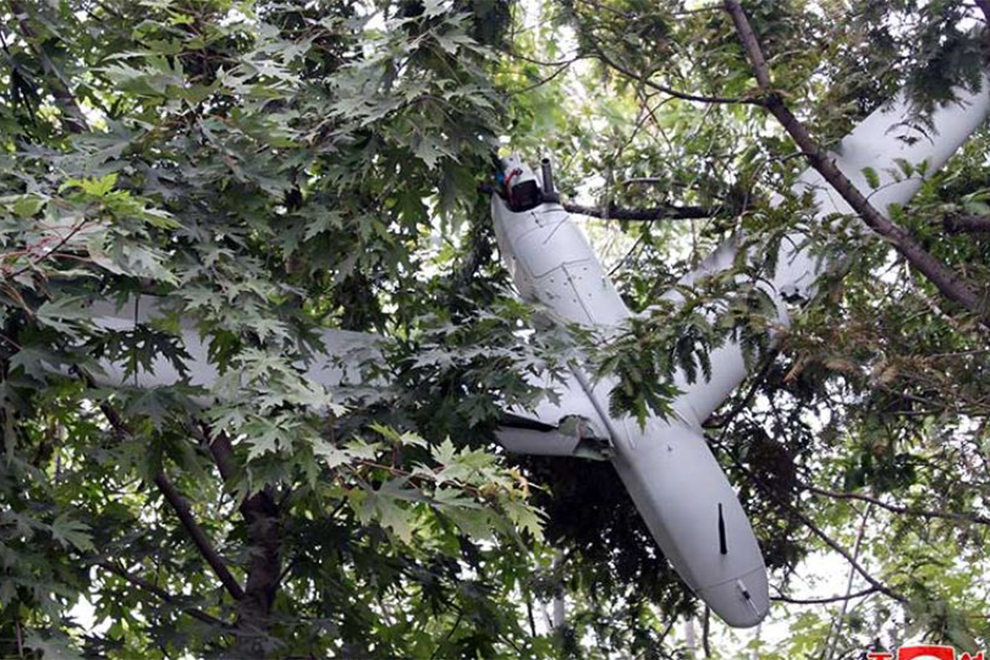
SEOUL – Seoul will pursue a partial reinstatement of the 2018 inter-Korean military agreement, particularly the return of no-fly zones, to prevent a repeat of unauthorized drone flights into North Korea, the unification minister said Wednesday.
Unification Minister Chung Dong-young said he “formally expressed our regret to the North Korean side” over drone flights carried out by South Korean civilians on Jan. 4.
The incident has been under investigation by a joint military-police task force following Pyongyang’s public condemnation of the flights through its state media.
Chung also outlined steps to prevent a recurrence, disclosing that three civilians had sent drones into North Korea on four occasions — not two, as North Korea has said — since the launch of the Lee administration in early June. Chung cited findings from the joint task force launched on Jan. 12.
“We, in cooperation with military authorities, will proactively review and pursue the restoration of the existing Sept. 19 inter-Korean military agreement, including the establishment of no-fly zones, to prevent accidental clashes and build military confidence,” Chung said during a news conference dedicated to the issue on the last day of the Lunar New Year holiday.
The two Koreas had agreed to establish no-fly zones for all aircraft above the Military Demarcation Line effective from November 2018.
Asked whether the restoration of no-fly zones reflects the Unification Ministry’s position or an inter-ministerial consensus, Chung said, “It is the government’s position.” Chung said the Lee Jae Myung administration decided to present that position through a meeting of security-related ministers early in the Lunar New Year holiday, though he did not disclose the date.
Regarding whether the Defense Ministry also agrees to reinstating the no-fly zones, Chung added that “there has been sufficient consultation and coordination among relevant ministries.”
Chung did not confirm whether consultations on restoring the inter-Korean military agreement are already complete and if it is now just a matter of timing the announcement, saying only, “We will speak at an appropriate time.”
Following Chung’s announcement, the Defense Ministry said it “is reviewing a partial restoration of the Sept. 19 military agreement, including the establishment of no-fly zones, in consultation with relevant ministries and the US side.”
The inter-Korean Comprehensive Military Agreement signed on Sept. 19, 2018, was fully suspended by North Korea in November 2023. This followed the Yoon Suk Yeol administration’s decision to suspend implementation of the inter-Korean agreement’s no-fly zone clause in response to the North’s claims of its first-ever successful military spy satellite launch.
Seoul moves to tighten laws
Speaking at the news briefing, Chung underscored that the South Korean government is “thoroughly investigating the truth of the matter and will take corresponding legal measures.”
“The government will handle this issue responsibly, not merely as a case of a legal violation, but from the perspective of blocking artificial acts that escalate tensions between the two Koreas, and hoping to achieve peaceful coexistence on the Korean Peninsula,” Chung told reporters.
To that end, Chung said the Unification Ministry will seek to strengthen penalty provisions under the Aviation Safety Act and pursue amendments to the Inter-Korean Relations Development Act to prohibit unauthorized drone flights into North Korea.
Specifically, the ministry aims to raise the penalty for unauthorized drone flights in restricted airspace, under Article 161 of the Aviation Safety Act, from a fine of up to 5 million won ($3,500) to up to one year in prison or a fine of up to 10 million won.
In addition, the ministry will seek to add a provision to the Inter-Korean Relations Development Act banning acts that heighten military tensions between the two Koreas, such as flying drones into North Korea.
Chung also disclosed the joint military-police task force found that three South Korean civilians carried out four unauthorized drone flights into North Korea — on Sept. 27, 2025; Nov. 16, 2025; Nov. 22, 2025; and Jan. 4, 2026 — launching them from Ganghwa, Incheon.
Two of the drones — those flown on Sept. 27 and Jan. 4 — crashed in North Korean territory, Chung said, citing North Korea’s Jan. 10 press statement. The other two, flown on Nov. 16 and Nov. 22, passed over Kaesong and returned south, landing in Paju near the inter-Korean border in Gyeonggi Province.
Authorities are investigating the three civilians identified by their surnames: Oh, who is suspected of flying the drones; Jang, who runs a drone manufacturing company; and Kim, the firm’s executive in charge of North Korea-related affairs.
Active-duty personnel from the Defense Intelligence Command and a National Intelligence Service employee are also under investigation on suspicion of benefiting the enemy, following search and seizure operations.
Chung’s news conference came after Kim Yo-jong, the sister of North Korean leader Kim Jong-un, issued a statement on Feb. 12 calling on South Korean authorities to prevent similar incidents from recurring and warning of consequences for any future violations.
Kim said she considered Chung’s official expression of regret “fortunate” and described it as “a relatively common-sense response.” Chung had previously expressed “deep regret” to North Korea over what he described as a “reckless drone incursion” on Feb. 10.
Chung’s remarks also came as North Korea prepares to convene its ninth party congress later this month, where domestic and foreign policy direction for the next five years at the congress is expected to be unveiled.
ANN/The Korea Herald
