



SEOUL – South Korea on Monday proposed military talks with North Korea, suggesting that the two sides discuss ways to avoid unnecessary friction along the Demilitarized Zone.
While Seoul cited recent violations of the Military Demarcation Line by the North, the Ministry of National Defense appeared cautious in its wording, hinting at the possibility of the Lee Jae Myung administration laying the groundwork for seeking further engagement.
This is the first time Seoul has proposed talks with Pyongyang since President Lee Jae Myung’s inauguration.
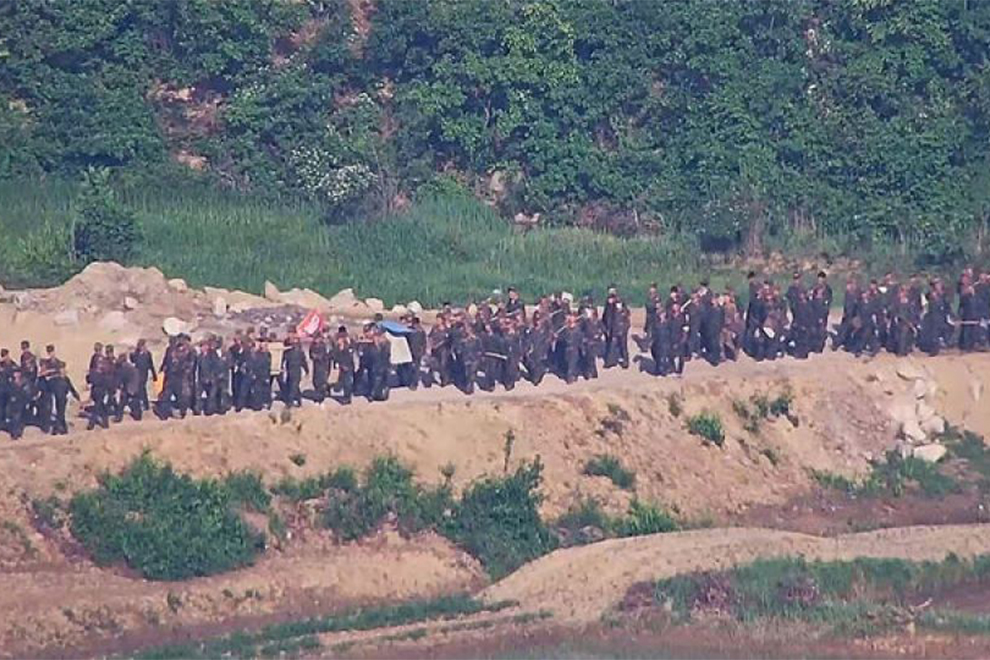
The Defense Ministry said it has officially suggested that the two sides’ military authorities meet to establish a mutually recognized baseline for the MDL, following months of incidents in which North Korean troops crossed into the South’s side of the DMZ while building tactical roads, laying mines and installing new fencing.
“Our forces have responded in accordance with operational procedures, issuing warning broadcasts and firing warning shots to compel North Korean soldiers to return north of the MDL,” the ministry said in a statement.
“Continued MDL violations and our procedure-based responses have raised tensions in the DMZ, increasing concerns that the situation could inadvertently escalate into a military clash.”
To ease tensions and prevent clashes, Seoul proposed holding inter-Korean military talks to discuss ways to reaffirm and standardize the MDL’s baseline. The ministry said the meeting’s schedule and venue could be coordinated in the truce village of Panmunjom.
“We expect a prompt and positive response from the North to this proposal, which aims to reduce tensions on the Korean Peninsula and restore military trust,” the statement said.
Following the announcement, South Korea’s Ministry of Unification called on the North to respond.
“Easing military tensions and preventing incidents are of utmost importance. We hope North Korea will actively respond to our proposal for talks aimed at achieving these goals,” the Unification Ministry said in a statement.
North Korea had not responded as of press time.
According to the Defense Ministry, many recent incidents appear related to North Korea’s work near the front line, combined with differing perceptions of the exact location of the boundary in areas where original MDL marker posts installed under the 1953 Armistice Agreement have been lost over time.
A ministry official, who requested anonymity, told reporters Monday afternoon that most of the 1,292 MDL markers installed in 1953 have been lost over the past 70 years, after maintenance work ceased in 1973 when North Korean troops opened fire on a UN Command repair team. “Only about 200 markers remain clearly identifiable today,” the official said, adding that dense vegetation, rugged terrain and natural deterioration have made many markers impossible to locate.
“With markers missing, the two sides have gradually developed different perceptions of where the MDL actually lies,” the official explained. South Korea uses visible markers when available and falls back on military map coordinates when they are not. But North Korea, relying on its own mapping practices, may believe the MDL sits “slightly farther south” in certain areas, leading its troops to cross the line while conducting border-fortification work.
The official stressed that Seoul has not yet assessed whether the incursions were intentional. “We respond strictly based on observable actions. Determining intent comes afterward,” he said.
The ministry has raised the issue repeatedly through the UN Command–North Korean People’s Army communication channel, but Pyongyang has offered “no response despite multiple attempts,” the official said.
Currently, as inter-Korean military communication lines have been severed, South Korea’s proposals for talks have been conveyed to the North through the aforementioned channel in recent years.
“Today’s proposal is the first official offer of talks,” the official clarified. “Previous UNC-delivered messages were not formal meeting proposals, but efforts to encourage coordination.”
The ministry believes that aligning both sides’ understanding of the MDL is necessary to prevent accidental clashes. “If the current situation continues, tensions will keep rising,” the official said. “Jointly confirming marker locations — or agreeing on a common baseline — can significantly reduce the risk.”
Despite concerns that Seoul appears to be “chasing” Pyongyang for talks, the official defended the move.
“North Korea has crossed the MDL several times recently. This is about preventing unintended conflict,” he said. “If this creates momentum for broader inter-Korean dialogue, we would welcome that.”
The most recent case occurred on Oct. 19, when more than 20 North Korean soldiers crossed the MDL near Paju, Gyeonggi Province, prompting South Korean troops to fire warning shots after multiple verbal warnings went unheeded.
North Korean personnel — some of whom were armed — were believed to be conducting land-clearing and mine-planting operations and appeared to withdraw without reacting to the warning fire. The incident took place on the same day that a North Korean soldier defected across the front line in Cheorwon, Gangwon Province. The military said the two events were unrelated.
The Oct. 19 case is part of a broader pattern of increased North Korean activity near the DMZ following leader Kim Jong-un’s December 2023 order to “cut ties with the South” and reinforce the border.
According to data submitted by the Joint Chiefs of Staff to the National Assembly’s defense committee, North Korean troops have crossed the MDL over 10 times since June 2024 — nearly half of the 25 ground provocations recorded since 2008. All recent cases involved MDL incursions.
Past violations include illegal mine-laying, firing antiaircraft guns near the line and the planting of wooden box mines in Paju in 2015 — acts that violate the Armistice Agreement and threaten stability along the front line.
Inter-Korean military talks — which had included two rounds of defense ministerial talks, 10 rounds of general-level talks and 40 working-level meetings since 2000 — have not been held in more than seven years, with the last session being the 10th general-level talks in October 2018.
ANN/The Korea Herald
