SEOUL – The Seoul Central District Court on Thursday sentenced former President Yoon Suk Yeol to life imprisonment, finding him guilty of leading an insurrection.
“It is recognized that Yoon Suk Yeol acted with the purpose of subverting the Constitution by sending the military to the National Assembly to paralyze or limit its function for a prolonged period,” presiding Judge Ji Gwi-yeon said while delivering the verdict.
The special counsel, which prosecuted the case, on Jan. 13 requested the death penalty, arguing that Yoon had shown no remorse and bore primary responsibility for destabilizing the constitutional order.
“Yoon Suk Yeol and others attempted to monopolize power and extend their rule by using martial law to override the legislative and judicial branches, disregarding the suffering the public would endure,” the special counsel said in closing arguments.
Although the court said there was insufficient evidence to determine that Yoon declared martial law with the explicit aim of extending his term, it ruled that his actions constituted “a violent uprising aimed at excluding state authority” and “disrupting the constitutional order,” meeting the legal definition of insurrection under Korean law.
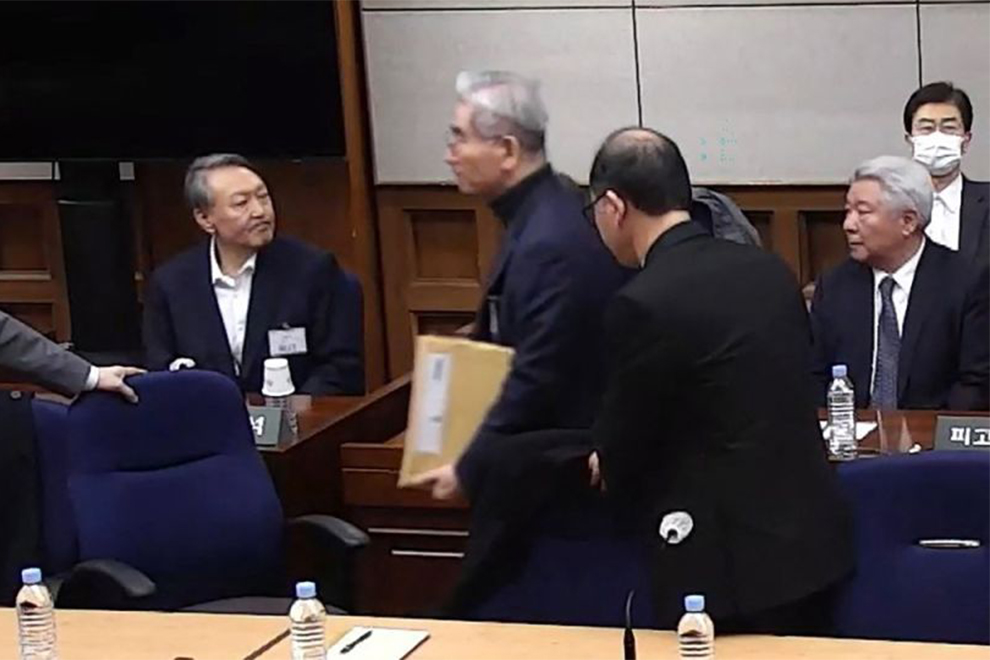
Meanwhile, the court sentenced former Defense Minister Kim Yong-hyun to 30 years in prison on charges including abuse of power and participation in key insurrection activities.
Former National Police Agency Commissioner General Cho Ji-ho received 12 years for aiding the insurrection, while Noh Sang-won, former chief of the Korea Defense Intelligence Command, was sentenced to 18 years.
Former Seoul Police Chief Kim Bong-shik was handed a 10-year prison term, while the chief of the National Assembly Police Security Guard received three years.
Two other defendants were acquitted due to insufficient evidence of criminal intent.
Why Yoon’s martial law decree constituted insurrection
In explaining its legal reasoning, the court invoked the 17th-century trial of King Charles I of England.
“The verdict in that case established that attacking a representative legislative body elected by the people constitutes an insurrection — even when committed by a king,” presiding Judge Ji said. “Based on this historical context and similar cases in other countries, a president may likewise commit insurrection.”
Article 87 of South Korea’s Criminal Act defines insurrection as “violence for the purpose of excluding national power from all or part of the territory of the Republic of Korea or subverting the Constitution.”
“Yoon Suk Yeol and Kim Yong-hyun decided to deploy troops to the National Assembly, using expressions such as ‘to ban the National Assembly and political activities’ in the decree,” Ji said.
The court noted that no withdrawal timeline was established, meaning the Assembly’s functions could have been paralyzed for a prolonged period.
The ruling said actions including deploying troops, crossing the National Assembly fence, sending helicopters and dispatching personnel equipped for arrests collectively constituted “an act of violence.”
At the same time, the court acknowledged that heightened caution is required in evaluating a president’s declaration of martial law.
“Martial law inherently restricts the authority of the legislature and judiciary,” the court said. “Therefore, a declaration of martial law alone cannot automatically be deemed an insurrection.”
The court nonetheless ruled that Yoon’s decree crossed that threshold.
“If the president’s objective in declaring martial law is to achieve outcomes that are impermissible even under martial law, such actions may constitute insurrection,” Ji said.
The court also rejected Yoon’s argument that he invoked martial law to warn the public of what he described as the National Assembly’s “legislative dictatorship.”
“The argument confuses motive with purpose,” the ruling said. “A desire to address a perceived national crisis may explain intent, but does not justify unconstitutional means.”
Those found to have played key roles
The court described insurrection as a collective crime, noting that accomplices must both participate in the uprising and share the objective of subverting the Constitution, including cases involving conditional intent.
The ruling found that former Defense Minister Kim colluded with Yoon from the early stages of the martial law declaration. Kim was found to have discussed potential responses to an “emergency situation” at the National Assembly with military officials and issued direct operational orders on the night of the decree.
The court also cited Kim’s endorsement of election-related conspiracy theories and attempts to involve the military in matters related to the National Election Commission.
Meanwhile, Commissioner General Cho and Seoul Police Chief Kim were found to have been aware of plans to deploy troops and to have been instructed to maintain order during the operation.
Although they did not participate in the initial planning, the court ruled they were aware of the decree’s underlying purpose.
Noh was also found to have actively participated despite recognizing the decree’s underlying intent. The court noted that he had contacted the defense minister after the National Assembly voted to revoke martial law.
The chief of the National Assembly Police Security Guard was also found to have understood the decree’s purpose, having permitted troop entry while restricting lawmakers from entering.
Two National Investigation Office officials were acquitted, however, with the court citing insufficient evidence that they fully understood the decree’s objectives.
In previous rulings, then-Prime Minister Han Duck-soo and then-Interior Minister Lee Sang-min were sentenced to 23 and seven years in prison, respectively, for aiding the insurrection.
Polarization, protest in verdict aftermath
“Due to the defendant’s insurrection, our society has become polarized and mired in conflict. We have gone through another presidential election, and many people are standing trial. Many witnesses have come to court in tears, describing the damage they have suffered,” the court said. “The social costs are immeasurable.”
Yoon supporters shouted in the courtroom after the judge exited the bench.
“Cheer up, Mr. President!” one supporter yelled. Others accused the court of bias, with several using profanity before being removed by security personnel.
Outside the courthouse, about 5,000 people gathered to watch the verdict, with celebrations erupting among opponents of Yoon. Roughly 150 supporters protested nearby, chanting slogans condemning the ruling.
The verdict came 443 days after Yoon’s failed martial law declaration triggered South Korea’s most severe constitutional crisis since democratization.
“We are devastated that we cannot even bring ourselves to say that we respect the judiciary’s decision,” said Yoo Jeong-hwa, one of Yoon’s attorneys.
“Even in this frenzied era marked by falsehoods and incitement, we had hoped that justice — which must never be broken — would prevail. Instead, our judiciary has bowed to inflamed public opinion and political forces seeking to purge their opponents.”
The special counsel also expressed disappointment.
“We thank the court for its hard work,” said special counsel assistant Jang Woo-seong. “It was a meaningful verdict, but there is disappointment regarding certain factual findings and the sentence.”
ANN/The Korea Herald