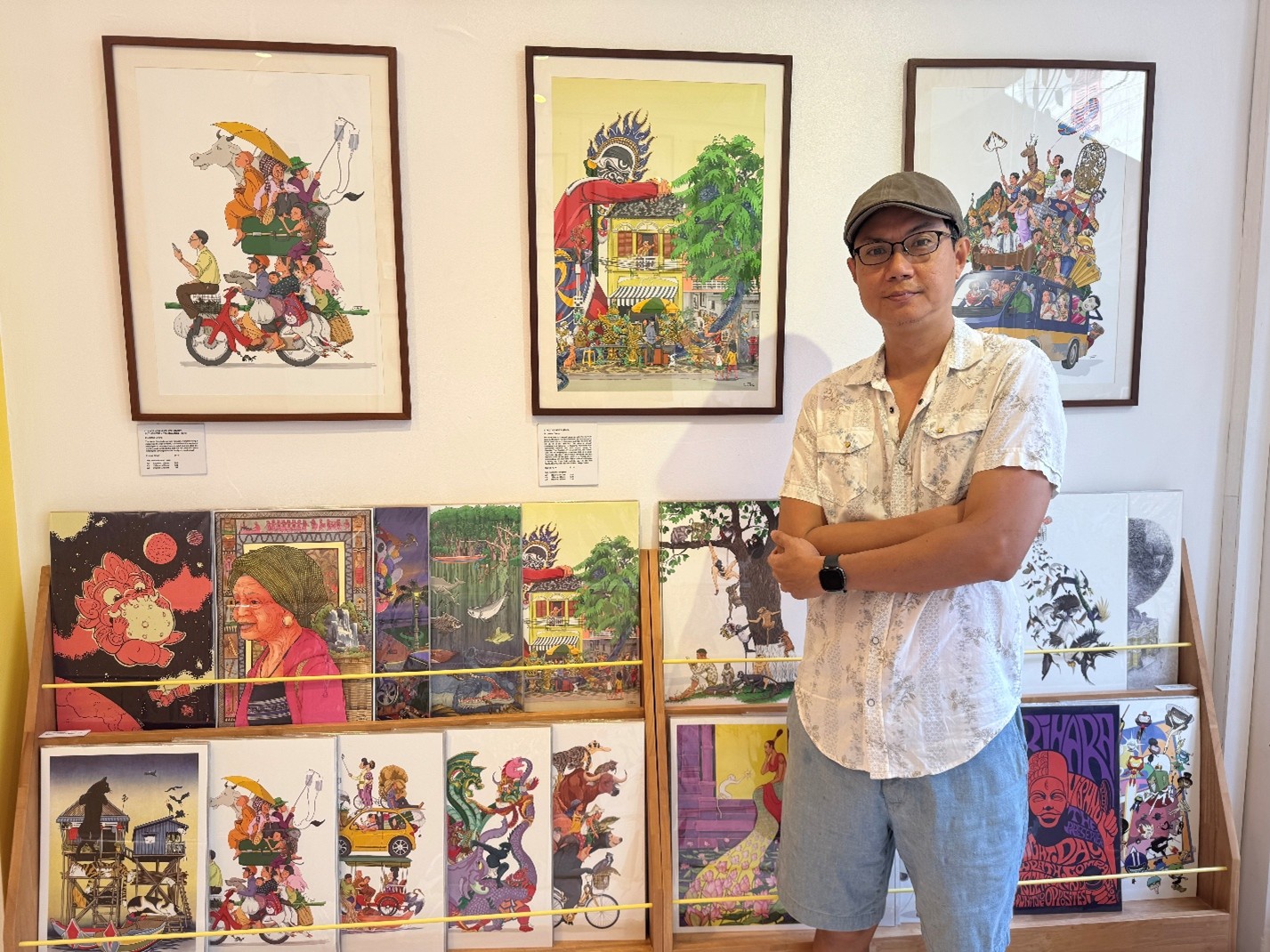
It started with a motorcycle. Not a particularly remarkable one – except that it was piled improbably high with cargo, passengers and chaos, rendered in meticulous ink by a Singaporean illustrator who had recently made Cambodia his home. That single drawing, completed in 2016, would set Joshua Chiang on a decade of artistic exploration that he is now marking with his first solo exhibition.
Makaras and Motordops: Joshua Chiang’s 10-Year Journey opens at Plantation Urban Resort and Spa on March 29 and runs through May 30. Entry is free of charge.
Joshua, who was born in Singapore in 1975, arrived in Cambodia in 2013 after a career that spanned film, animation and illustration. He co-directed a digital feature film that screened at the Shanghai International Film Festival, worked as a storyboard artist and concept designer in Singapore’s animation industry and authored several illustrated books – among them a graphic novel and a comic series.
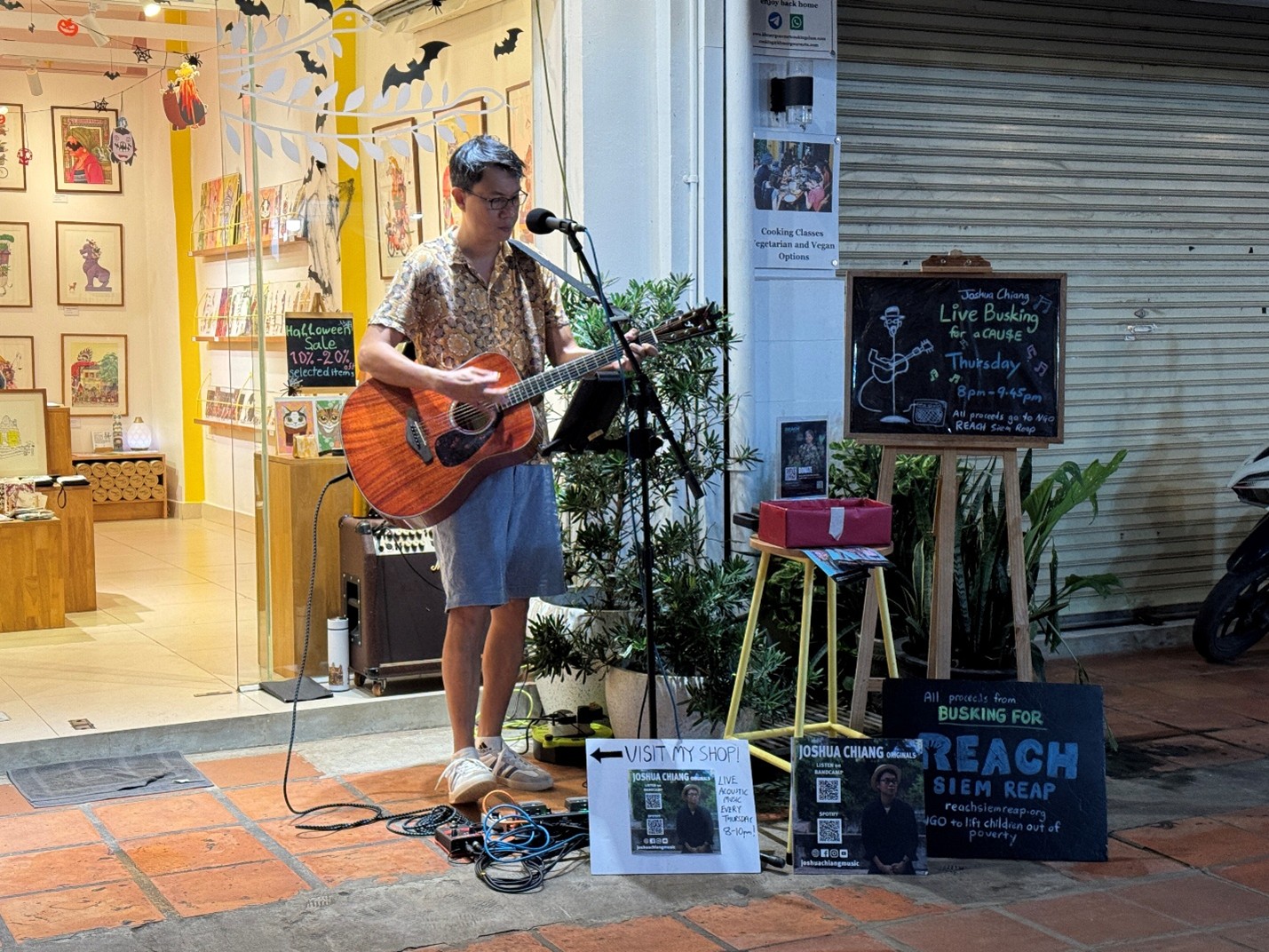
However, it was Cambodia that pulled him back to something more personal. In 2024, he and his wife relocated to Siem Reap province, where they opened CamCam By Joshua Chiang, a shop showcasing his prints and original works, located next to Pub Street. On Thursday evenings, he can be found busking outside, guitar in hand, raising funds for REACH Siem Reap, an NGO supporting underprivileged children through education and nutrition.
What emerged from those years of immersion in Cambodian life is a style he calls “Pile Up” – and the name is deliberately literal. His compositions are dense, maximalist scenes in which overloaded motordops and mythical creatures, ancient temples and contemporary street life, all coexist in a single frame. The effect is somewhere between a visual feast and a puzzle, rewarding close inspection.
“Most artists typically focus on one or two subjects that they paint or draw repeatedly,” Joshua explains. “In contrast, I prefer to explore a wide range of subjects and employ various artistic techniques, often simultaneously. ‘Piling Up’ was my attempt to pack as many of these elements as I wanted into a single piece while still maintaining a sense of coherence and unity.”
The detail is not merely decorative. Joshua, who is partially colourblind, says he compensates through research and precision – studying his subjects carefully before deciding what to include and what to leave out. Every piece, he notes, can take years from conception to completion, even if the actual painting process is a matter of weeks.
Beyond the art itself, the exhibition carries a secondary purpose. Joshua has become a vocal advocate for copyright protection in Cambodia, arguing that a new generation of Cambodian artists – one he describes with genuine excitement – risks being stifled by the unchecked copying of their work.
“In the last few years, I’ve seen an incredible new wave of Cambodian artists with bold ideas and imagination,” he says. “I truly hope this leads to a renaissance for Cambodian art, but copyright infringement risks undermining that momentum.”
The show also coincides with a shift in his own practice. After years of working digitally, Joshua has returned to traditional media – ink, watercolour and the kind of unpredictable results that no undo button can replicate.
“The best artwork is always a delicate dance between skill and happy accidents,” he says. “True creativity involves taking risks.”
Visitors will see works displayed at their original scale, alongside previously unseen sketches, ink drawings and colour studies that offer a window into how these intricate pieces come together. The opening reception on March 29, from 4-7pm, will include live music from The Dropping Shoes and a musical performance by Joshua himself – who, in addition to everything else, is also a musician.
Makaras and Motordops runs at Plantation through May 30 with free admission for the general public.