



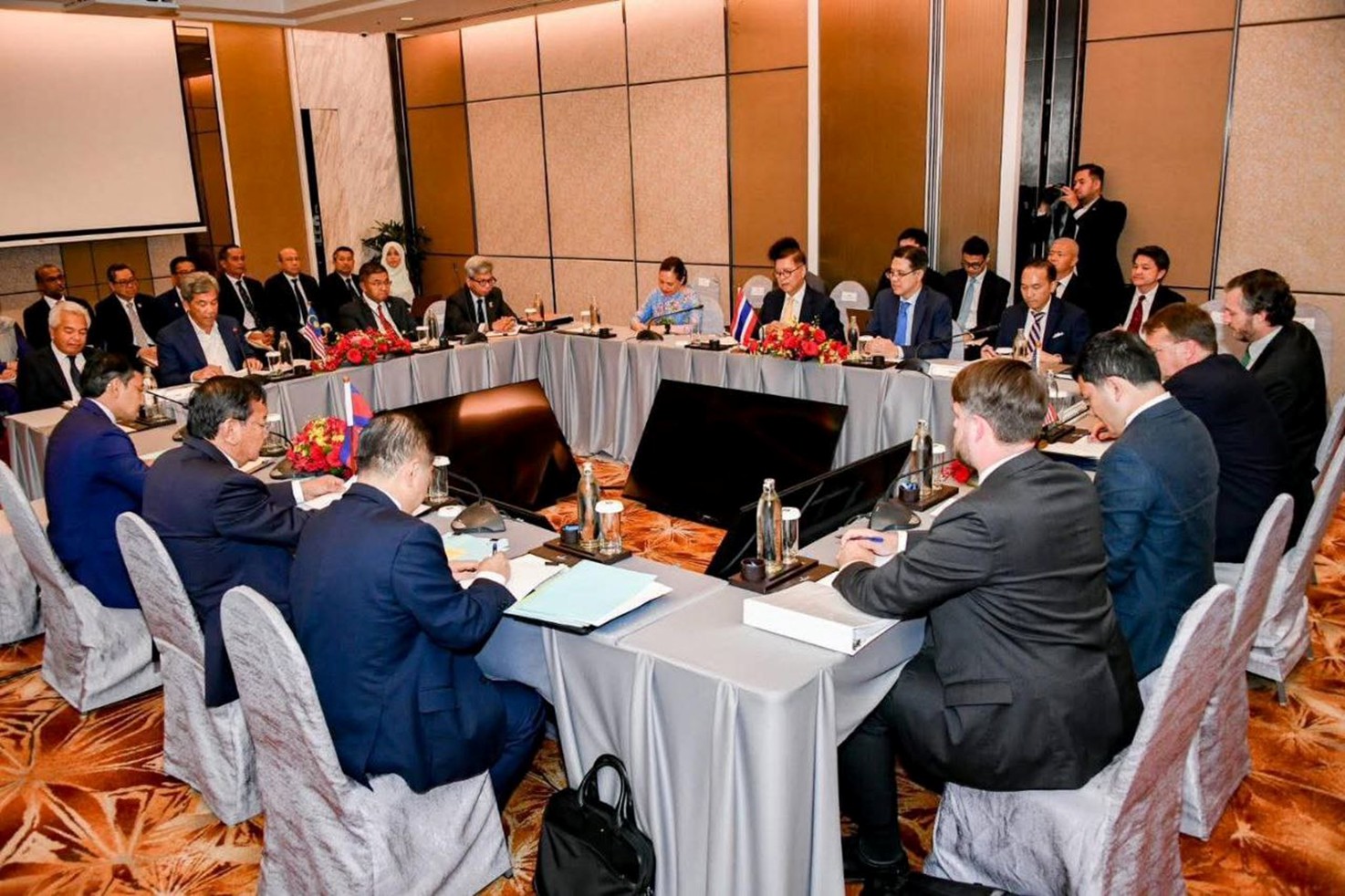
Domestic and international media outlets are paying close attention to the outcome of recent negotiations between Cambodia and Thailand, with hopes high that the peace agreement the two nations will sign on the sidelines of the ASEAN Summit this week will bring an permanent end to the tensions which have simmered since a July 28 ceasefire brought and end to five days of heavy fighting.
Quadrilateral talks, with the US and ASEAN chair Malaysia, culminated in the agreement, which US President Donald Trump will witness personally.
What media now want to know is how the agreement will contribute to resolving ongoing disputes over the sovereignty of the two countries. There are also questions as to whether the Kuala Lumpur Agreement will be implemented effectively, as the Thai military has been widely seen to repeatedly violate the conditions of the July ceasefire.
It is likely that the territorial disputes between the two countries are likely to remain under the jurisdiction of the bilateral mechanisms of the two countries, within the framework of the Joint Boundary Commission (JBC) of the two countries, based on international legal instruments including the 1904-1907 Border Delimitation Agreement and the 1908 Map.
In response to questions by social media users, Cambodian Prime Minister Hun Manet recently made it clear that the peace agreement is not about casualties, or about land gained or lost.
On October 20, he also asked the public to place their trust in the Cambodian armed forces, several of whom sacrificed their lives to defend the Kingdom. He assured the public that his government has taken every possible measure to demand the release of the Cambodian soldiers captured by Thailand, and soon all 18 men will be home.
Minister of Foreign Affairs and International Cooperation Prak Sokhon arrived home from the quadrilateral meetings in Malaysia last Saturday. He described the results of the meeting as “satisfactory”.
Thanks to the efforts of all four parties, including US President Trump and Malaysian Prime Minister Anwar Ibrahim, the ASEAN chair, the unnecessary war was ended, and peace and trust are being rebuilt.
As in the past, I believe the five-day war between Cambodia and Thailand was fuelled by ultranationalist and conservative groups within the Thai political and military spheres, all of whom were influenced by the events that took place in Thailand in the 1930s, 1940s and 1960s, particularly the request for registration of the Preah Vihear Temple as a World Heritage Site in 2008.
A strong Thai nationalist movement in 2025 was also a major driver behind the fighting. This movement fuelled anger over perceived border issues, which should not have happened, as the two countries have clearly drawn international borders since 1904 and 1907.
Nationalist and conservative Thai politicians and military leaders have always been very concerned about the Thaksin family or his group returning to power, with the same elements finding it easier to drag Cambodia into a war rather than launch another coup d’état by the Thai military.
The recent quadrilateral meeting in Kuala Lumpur is likely to lead to a full ceasefire and pave the way for the two countries to begin building better diplomatic relations and trust building for the long-term benefit for the peoples of both countries. This will also strengthen trust in ASEAN and restore its image, which is crucial to regional peace.
The upcoming summit in Kuala Lumpur, with the significant presence of Trump, will bear witness to the indisputable fact that all are aware of the need for a solution.
It is hoped that the Cambodia-Thailand conflict will be resolved at the summit and a new chapter in history will be opened, with both parties agreeing to long-term peace building, which will lead the bloc towards a better, stronger shared future.
Although Thailand is a non-NATO ally of the United States, it is also a member of ASEAN, and in its current Indo-Pacific strategic policy, the US still considers this region in the sense of America First.
Despite this, the presence of trump may prove to be very meaningful as part of his long-term Indo-Pacific vision. Certainly, it was no coincidence that Trump stepped in to end the Cambodia-Thailand war in July.
Trump was seen as a key figure, along with ASEAN chair Ibrahim, in efforts to broker the July ceasefire, with the US administration threatening to impose tariffs on both nations if an agreement could not be reached.
The ceasefire remains fragile, partially to the lack of a strong mechanism to insure its implantation. In addition, Thailand has repeatedly violated the agreement, while Cambodia has remained extremely patient and strictly following the spirit of the ceasefire, to prevent any confrontations and avoid catastrophic impacts on the lives of the people of both countries.
This means that the most important goal of this week’s Kuala Lumpur Agreement must be a long-term peace building agreement that focuses on the withdrawal of heavy weapons from the border area, the clearance of mines in disputed areas and the prevention of cross-border crimes, all necessary measures to pave the way for all parties to the conflict to begin to restore diplomatic relations.
Somewhat contrarily, the agreement is unlikely to delve into the independence, sovereignty and territorial integrity of the two countries. Of course, Cambodia and Thailand have appropriate bilateral mechanisms that should be used to resolve the outstanding issues. They just need to follow the spirit of consensus of the 2000 Memorandum of Understanding on the land border and 2001 on the maritime border.
The question is whether Thailand can be relied upon to do so.
Long Sokun was a researcher on the 1962 Preah Vihear Temple case for the 2007-8 special working group. The views and opinions expressed are his own.
