



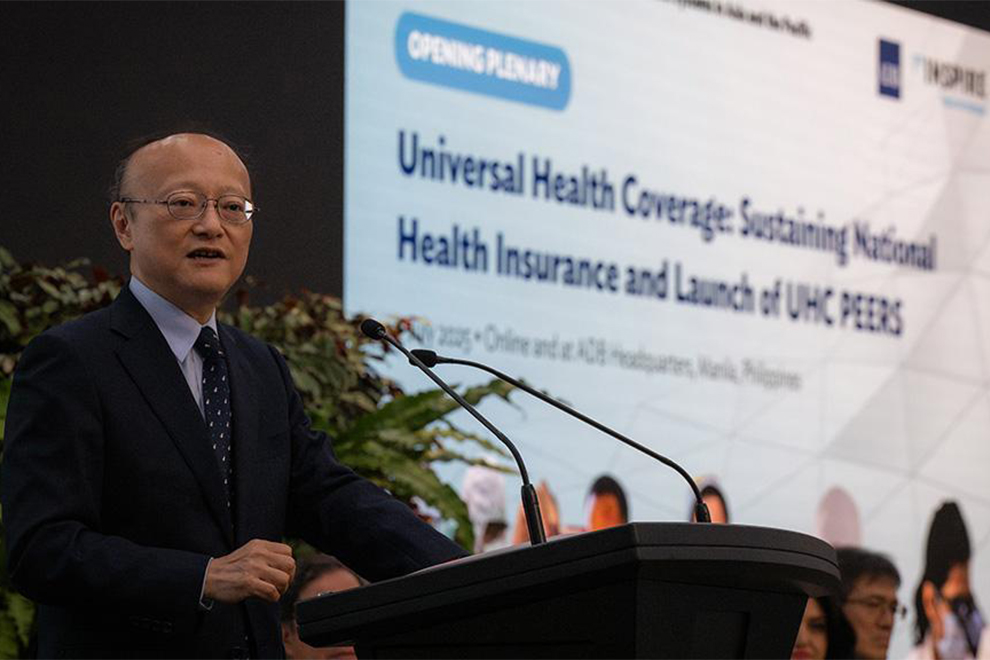
More than a billion people across Asia and the Pacific, including many in Cambodia, still lack access to basic health services — an alarming shortfall spotlighted during the opening of the Asian Development Bank’s (ADB) first INSPIRE Health Forum, held on July 7, at its headquarters in Manila.
ADB president Masato Kanda announced the launch of a new regional initiative, which is aimed at accelerating progress toward Universal Health Coverage, especially in developing member countries.
The newly unveiled UHC PEERS — the Universal Health Coverage Practitioners and Experts Knowledge Exchange and Resources network — will serve as a collaborative learning platform for over 25 countries in the region, allowing policymakers and health experts to exchange strategies, innovations and lessons learned.
The platform complements the Tokyo-based UHC Knowledge Hub and is intended to foster regional solutions to shared health challenges.
“Achieving Universal Health Coverage is not something that we can delay further, and it is within our reach if we work together to build a region where everyone, everywhere, has access to the care they need, without financial hardship,” Kanda declared, in his keynote address.
Kanda explained that at ADB, Universal Health Coverage is seen not only as a health goal but also as a crucial economic and social necessity.
He mentioned that when developing member countries (DMCs) invest in health, they do more than just ensure a healthy population; they also unlock the potential of their people.
Healthy children learn more effectively, healthy workers are more productive and healthy societies are stronger and more prosperous.
“Universal Health Coverage lies at the heart of resilient, sustainable, and inclusive development,” said Kanda, “every $1 invested in primary health care yields up to $10 in economic growth.”
The UHC PEERS network addresses a gap in regional health cooperation by providing a platform for countries to share solutions for extending coverage to underserved populations.
Kanda noted that the memories of the largest pandemic to impact humanity in over a century are still vivid.
He pointed out that the Covid-19 pandemic drove an estimated 78 million people in the region into poverty and revealed weaknesses in health systems.
It served as a harsh reminder that no economy can be truly secure without a robust, inclusive, sustainable and resilient health system.
The launch reflects growing regional consensus on UHC as a development priority, as health systems face pressures from aging populations, rising noncommunicable diseases and persistent infectious diseases.
In many Asian countries, Kanda said, the private sector delivers over 50 per cent of outpatient care and a significant share of inpatient services.
“The private sector is the backbone of medical supply chains, including pharmaceuticals, vaccines and diagnostics,” he said.
“Harnessing the power of the private sector, while ensuring equity, quality and regulation, is essential for achieving Universal Health Coverage in Asia and the Pacific,” he added.
Cambodian Minister of Health Chheang Ra spoke at the inauguration of the Techo Sen Koh Thom Hospital in Kandal province in March last year.
He explained that the ministry, in collaboration with its partners, is working to improve the quality of health services, in order to accomplish the seventh-mandate government and UN goal of providing universal health coverage.
“Primary healthcare through education and consistent disease prevention are essential. We will also strengthen regulations of public and private health facilities to ensure that all people receive quality, safe and effective healthcare, while earning public trust in the government’s healthcare systems,” he said.
Cambodia’s Health System Still Faces Systemic Strains
Cambodia has made significant strides in addressing communicable diseases such as tuberculosis (TB) and malaria, while also confronting the challenges posed by non-communicable diseases.
Cambodia has achieved notable progress in reducing TB rates, with the TB mortality rate dropping from 42 per 100,000 people in 2000 to just 23 in 2022.
This decline follows a 45 per cent reduction in TB infections over the same period. Prime Minister Hun Manet called for renewed efforts on World Tuberculosis Day in 2024, stressing the need for continued progress to meet global sustainable development goals.
Cambodia has made remarkable progress in the fight against malaria, with no malaria-related deaths reported since 2018.
The country also witnessed a 74 per cent decline in malaria cases in 2024, and there have been no reported cases of Plasmodium falciparum malaria since January 2024.
The Cambodian government has set an ambitious goal to eliminate malaria by the end of 2025, integrating this effort into its broader sustainable development framework.
While communicable diseases like TB and malaria are on the decline, Cambodia is facing an increase in non-communicable diseases.
In 2024, over 230,000 new cases of diabetes and more than 30,000 cancer cases were reported, marking a growing public health concern.
