The recent armed conflict along the Cambodia-Thailand border, coupled with external mediation efforts, has exposed deep fissures within the ASEAN, prompting several leading analysts to call for radical reforms to strengthen the bloc’s role beyond rhetoric.
The crisis led to widespread concerns that ASEAN, an organisation founded on the principles of regional peace, is failing its members when internal disputes turn violent.
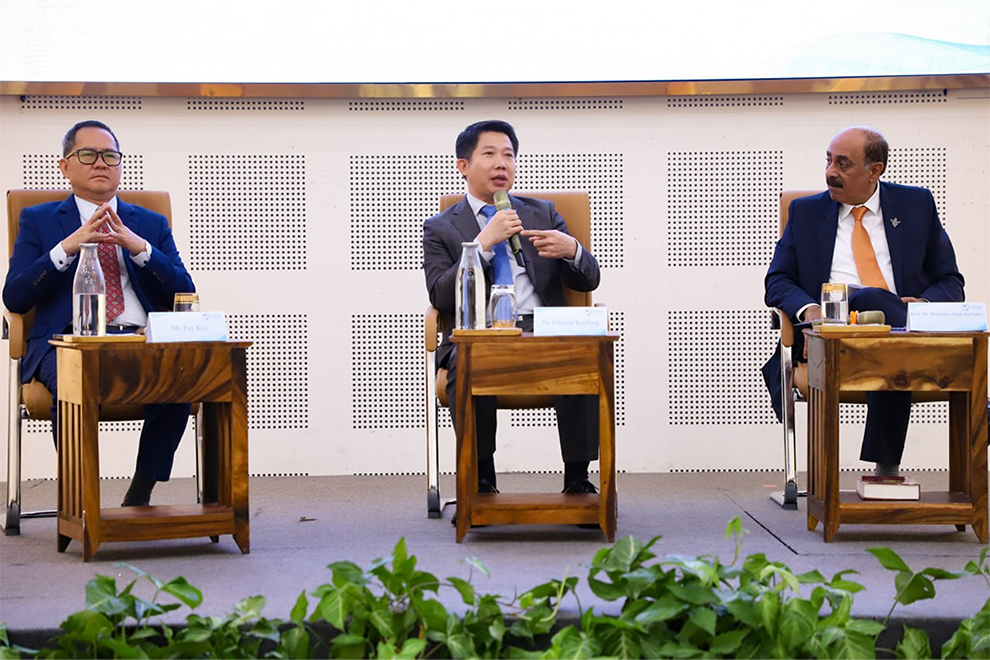
The October 8 Phnom Penh Forum 2025, organised by the Royal Academy of Cambodia’s International Relations Institute, provided an opportunity for the analysts to share and discuss their views.
Chheng Kimlong, president of the Asian Vision Institute (AVI), argued forcefully that the border conflict is not just a bilateral issue, but a crisis for the entire bloc.
“ASEAN cannot claim to be a peaceful region if Thailand and Cambodia are fighting,” Kimlong stated, adding that trade agreements mean the economic cost of conflict is applied to all member nations.
He acknowledged that ASEAN’s role in pausing the five-day armed clashes was an initial success, validating the principle of ASEAN centrality. However, this success was only achieved after the fact and under external pressure, and the ultimate resolution must be internal.
“If Cambodia and Thailand did not reach a peace agreement on July 28, both countries would have faced devastation and the ASEAN bloc may have been divided,” he said.
He stressed that while the resolution itself was an outstanding achievement in facilitating bilateral disputes; the dependency on last-minute interventions or external partners is a sign of underlying weaknesses.
Analysts stressed the need for ASEAN to transition from consensus-based declarations to active enforcement of international law and regional treaties.
Kimlong urged the bloc to go beyond internal strengthening by pressing all members to respect international laws. He suggested the urgent need to establish a robust mechanism to follow up and monitor compliance.
Specifically, he recommended forming a quick-response ASEAN Observer Team (AOT) to monitor situations in both countries, rather than separate, nationally-based teams, warning that the latter could lead to corruption and bias.
Yang Peou, secretary-general of the Royal Academy of Cambodia, echoed this sentiment, emphasising that agreements must be enforced, “not just noted on paper”.
He pointed to a recent instance where Thailand allegedly violated the UN and ASEAN Charters by attempting to compromise Cambodian territorial integrity. He suggested that it illustrated the bloc’s decreasing power when it fails to ensure adherence to foundational rules.
The structural weakness is compounded by changing political realities within member states.
Puy Kea, president of the Club of Cambodian Journalists, argued that younger, potentially weaker leaders in some member states — citing Thailand as an example where military power supersedes elected government — complicate regional efforts.
“When the Thai government attends the ASEAN summit, it may be meaningless” Kea warned, highlighting confusion in the Thai power structure.
“If Donald Trump presides over a peace deal, but the Thai military does not listen and receive commands from the royal palace, we don’t know who to talk to,” he said referring to reports that Trump wishes to preside over a peace deal between Cambodia and Thailand on the sidelines of the ASEAN summit later this month.
Kea warned that this internal instability and lack of unified commitment places the future of ASEAN at a critical crossroad. He cautioned that if the Cambodia-Thailand conflict were to persist until Thailand chairs ASEAN in the next few years, Cambodia may not attend the ASEAN summit. This would establish a dangerous precedent for future division.
To secure its future, the analysts advised ASEAN to adopt a geopolitical strategy. Peou recommended that the bloc maintain its balance among global superpowers, strengthen multilateralism and ensure the region does not become a theatre for geopolitical contests.
By promoting regional resilience and upholding the principle of equal respect for all members — regardless of size or economic strength — ASEAN can begin to rebuild its credibility as an effective and indispensable regional body.