



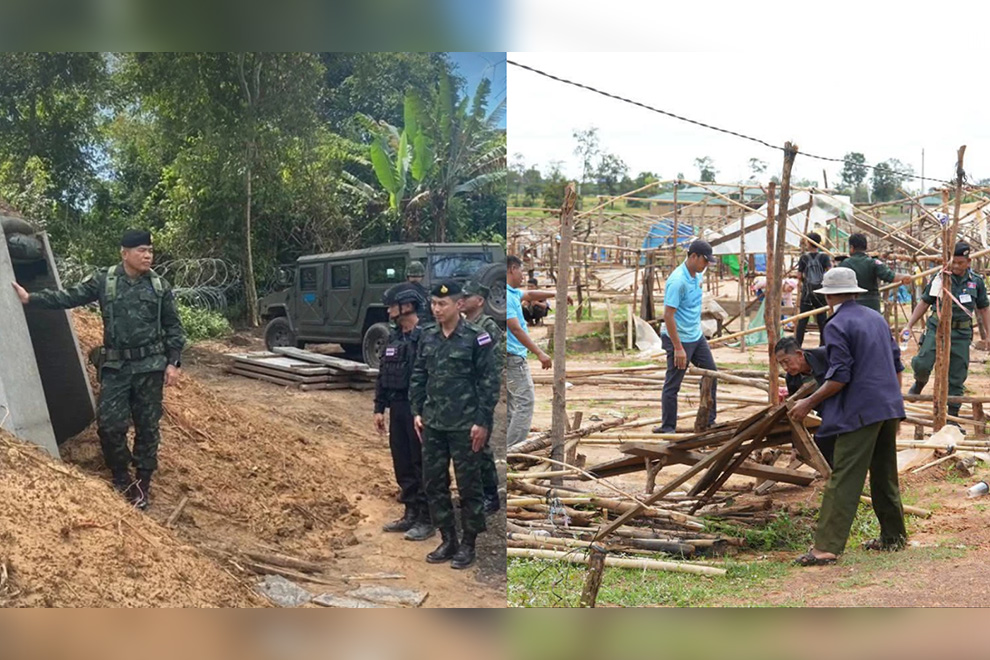
As Cambodia continues to implement the hard-won peace agreement by withdrawing highly destructive heavy weapons and after the displaced population have returned to their homes, Thailand appears to be moving in the opposite direction, digging trenches and announcing that it is preparing to evacuate citizens from areas near the border, traditional a prelude to combat operations.
The Thai cabinet held an emergency meeting today, November 12, following a landmine incident that injured three soldiers, some seriously, near Phnom Trop, not far from Preah Vihear Temple.
Thai Prime Minister Anutin Charnvirakul announced the results of the meeting, with several ministries given specific tasks.
According to a Thai government spokesperson, Anutin ordered the Thai Ministry of Defence to suspend each of the deescalation measures begun under the peace agreement and implement “strict military measures”.
The Ministry of Foreign Affairs was instructed to “register a diplomatic protest and consider cancelling the current peace agreement”. The ministry was also tasked with explaining the Thai position to the international community.
Anutin ordered the Ministry of Interior to “disseminate information and prepare to support citizens in the seven provinces bordering Cambodia, in case of unexpected situations”.
The Ministry of Education will begin conducting emergency drills and prepare an emergency response plan, while the Ministry of Public Health has been told to be ready for a worsening situation, especially in high-risk areas.
These new orders bear a sharp resemblance to the preparations which were made before the heavy clashes which broke out from July 24 to 28.
According to a November 9 report in Thai media outlet The Nation, Thai Princess Chulabhorn has provided funds for the construction of 256 new bunkers for the military and private citizens along the border regions under the control of Thailand’s Second Army Region. This includes the land near the An Ses border crossing, the scene of some of the heaviest fighting.
According to the media, each military trench can accommodate two soldiers, with enough space for them to easily return fire. The civilian trenches are larger and can hold more people.
On the Cambodian side, both the Ministry of National Defence and the Ministry of Foreign Affairs have reiterated their respect for the ceasefire and the peace agreement, which was witnessed by US President Donald Trump and ASEAN chair Anwar Ibrahim.
Cambodia has been withdrawing heavy weapons since November 1, in accordance with the peace agreement. The withdrawal of tanks and artillery has been monitored and confirmed by an ASEAN Observer team (AOT).
The last group of Cambodians displaced by the fighting, from the Wat Po 5000 camp, in Preah Vihear province’s Kulen Tbong commune in Kulen district, returned to their homes on October 30.
Yesterday, November 10, the Preah Vihear provincial administration dismantled the Wat Po 5000 sanctuary, demonstrating their faith that the peace agreement will hold.
