




As the fragile ceasefire holds between Cambodia and Thailand, the human toll of the recent border clashes is starkly visible in temporary displacement camps.
A delegation of diplomats from 11 nations, along with representatives from 15 UN agencies and partner organisations, visited four camps in Oddar Meanchey and Siem Reap province on August 6-7 to witness the humanitarian crisis firsthand.
Their visit offered a glimpse into the pain and uncertainty felt by thousands who fled their homes under heavy fire.
The camp in Soutr Nikom district is one of several makeshift shelters, primarily in pagodas and schools, accommodating families displaced from Banteay Meanchey, Preah Vihear, and Oddar Meanchey provinces since the outbreak of hostilities on July 24.
Kim Vannak, the governor of Soutr Nikom district, reported that his district alone is hosting 652 families, or 2,276 people, including 966 children.

A significant concentration of 1,874 people, with 857 children, is housed at the camp at Wat Prasat Banteay Srei.
The conditions, though managed, are challenging. Shakeel Ahmed, the UNDP Deputy Resident Representative in Cambodia, expressed his sorrow for the displaced.
“We are very sorry to see that people living in these camps, who have been displaced from their homes,” Ahmed said.
“We know that they are going through a lot of pain, but we also have seen that the local administrations, they are helping them a lot,” he added.
Ahmed described the scenes as “very touching” and “heartbreaking”, highlighting the plight of women with young babies and children who are unable to attend school.
He acknowledged that while the basic needs of displaced people were being met, their living conditions could not compare to life in their own homes.

Ahmed expressed hope that the situation would improve, the ceasefire would hold and permanent peace would return to the region, allowing people to go back to their homes in a dignified manner.
“The UN, particularly the UNDP, will assess the conflict’s impact on affected people’s socio-economic conditions and explore how to support them and the government in helping communities return home,” he said.
Local authorities, in cooperation with partner organisations, are working to provide the displaced with basic necessities.
Vannak explained that the immediate needs are food, accommodation, sanitation and healthcare.
“Daily necessities are also essential because when the war broke out, they could not take anything with them,” he said, noting the provision of mosquito nets, blankets and drinking water.
During the visit, Pascal Ringwald, World Health Organization (WHO) representative in Cambodia, noted that the arrangements for the refugees were well-organised, with good healthcare provisions, preparations for hospital transfers for those in need and care for the injured at two hospitals in Siem Reap province.

“The WHO is mobilising medical supplies, and we are working closely with the Ministry of Health and partners to ensure that displaced individuals receive quality healthcare services,” he said.
The UNDP, along with partners like Australia, Luxembourg and New Zealand, is supporting a Mine Action Initiative, providing training on explosive ordnance risk education to prepare communities for a safe return home.
One of the evacuees, Chey Thavy from An Ses village, said she feels safer in the camp than living alone in her village.
Widowed and with her son stationed at the front line as a border police officer, Thavy fled with her younger brother’s family.
While the camp offers free healthcare, food, and basic supplies, she shares a tent with her brother’s family, as she wasn’t given separate shelter.
“I really want to go home, but I’m afraid of the reported toxic smoke, and I’m afraid of the Thai attacks,” Thavy told The Post.
When Thai artillery struck near Ta Mone Thom Temple in Oddar Meanchey on July 24, 10-year-old Thy Kimsort was hit by shrapnel that shattered his hip.

His mother, who fled Kok Mon commune, recalled the terrifying moment: “At first, the doctors said there was little hope because he had lost so much blood. It took four bags of plasma before his condition began to improve,” she said.
After emergency surgery and the insertion of a metal rod, doctors now expect Kimsort to recover fully. First lady Pich Chanmony later visited the boy, pledging continued support to his family.
Alexander Ugolnikov, third secretary at the Russian Embassy in Cambodia, expressed hope for lasting peace following the recent ceasefire.
“Russia welcomes the ceasefire agreement and hopes the conflict will end peacefully,” he said.
“We look forward to seeing all displaced families return safely to their homes, and we encourage both Cambodia and Thailand to continue choosing dialogue over confrontation,” he added.
For many evacuees, the desire to return home is paramount.
To date, 124,940 civilians displaced by border tensions across five Cambodian provinces remain in the crowded, makeshift camps.
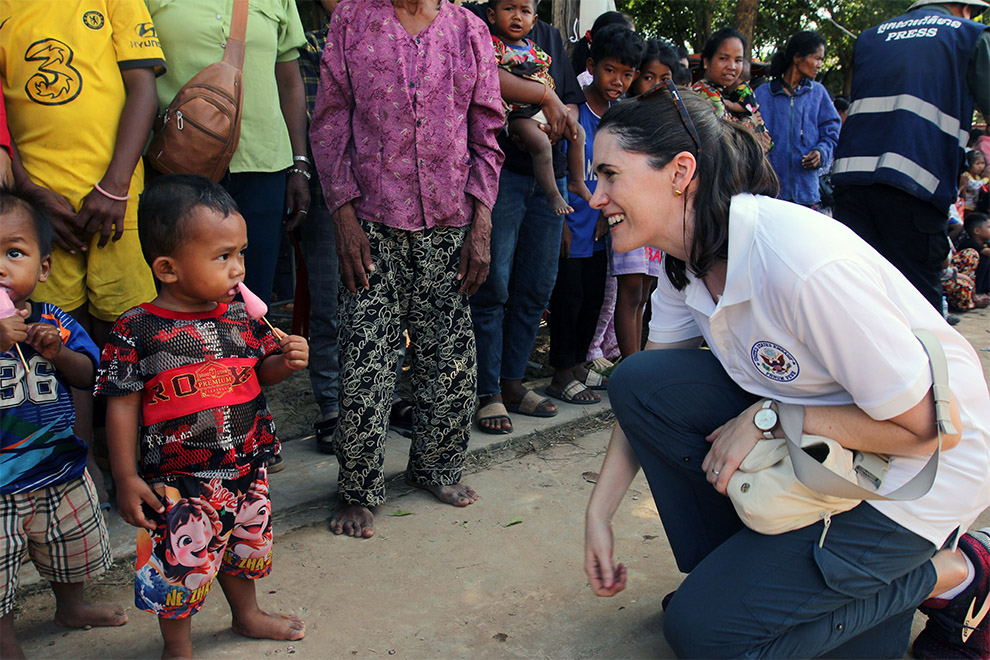
From elderly farmers to young schoolchildren, all share the same heartfelt wish: to return home as soon as possible.
Forced to flee their villages amid rising tensions along the Cambodian-Thai border, families now endure overcrowded shelters, uncertain futures and the emotional toll of separation from loved ones and livelihoods.
Choeun Ratana, who fled her village in Sraem commune, Choam Ksan district, Preah Vihear, spoke her fears.
Her son is a soldier on the front lines, a dangerous place. She has heard no news on the status of her home and livestock.
“When I heard about my son, I wanted him to come and visit me for a while. He said he couldn’t go down because he was always on guard,” Ratana told the delegates.
Sardar Umar Alam, UNESCO representative to Cambodia, walked through the camp, asking the same questions to the displaced: “Do you want to go home soon? What do you need?”
The answer was universal.

Residents of Chambok Senchey village in Sraem commune, which is close to sene of some of the fiercest fighting, described the intense airstrikes and shellings that forced everyone to flee, leaving everything behind. Their collective appeal to the world is for peace.
Mon Ngy Rainsy, deputy governor of Siem Reap, told the international guests that life in the camps is difficult, and support — no matter how generous — cannot replace the comfort and dignity of home.
“They left their homes, their belongings, and in some cases even their children or husbands to watch over the houses. The cows and buffalo are still there. This is not life — it’s survival,”
Her appeal was heartfelt and urgent.
Alam urged Cambodia and Thailand to build on the ceasefire and move toward lasting peace.
“Families are enduring significant hardship and require urgent humanitarian support,” Alam said, after witnessing the conditions faced by those affected by recent border clashes.
He praised the rapid response by local authorities, UN agencies and volunteers, and stressed: “The community called for peace and a safe return to their homes. This is the priority we must all work together to support.”
The ceasefire, which was formalised in a joint statement signed by Thai and Cambodian defence officials, has been extended following last month’s deadly clashes.
Both sides have pledged to freeze troop movements and suspend armed hostilities, according to the extraordinary General Border Committee (GBC) meeting agreement on August 7, 2025.
While the agreement offers a glimmer of hope, the pervasive uncertainty and longing for a return to normalcy underscore the profound human cost of the conflict.
