Cambodia has issued a sharp rebuke to Thailand over its allegations of newly laid landmines along the border. The Kingdom accused Bangkok of misusing the Ottawa Convention’s compliance mechanisms for political purposes, warning that such actions threaten the integrity of one of the world’s most important humanitarian disarmament treaties.
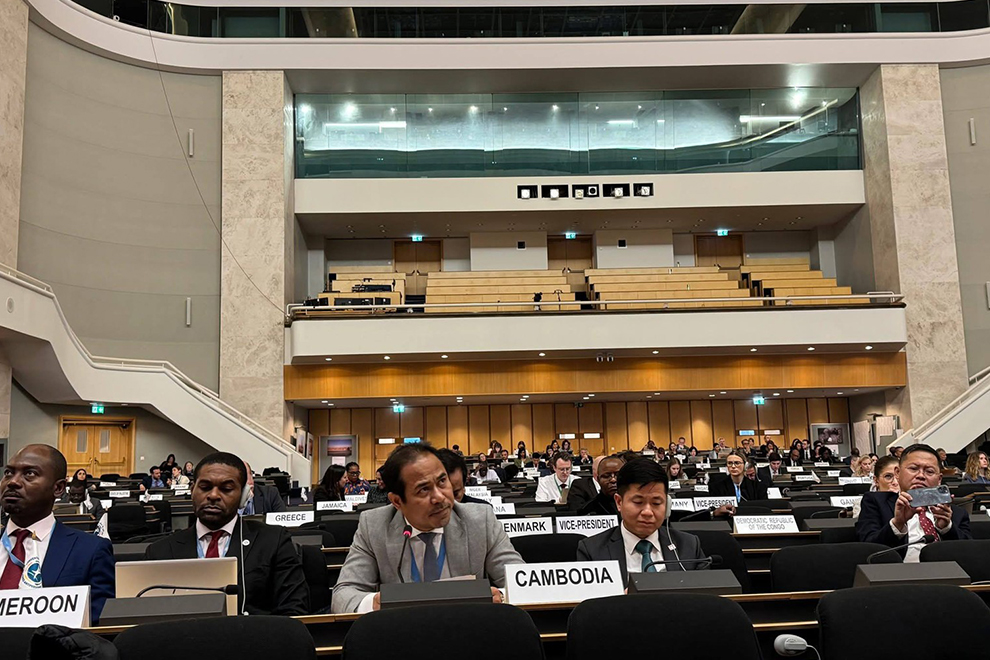
Speaking at the Meeting of States Parties to the Ottawa Convention in Geneva on December 4, ambassador Dara In, Cambodia’s permanent representative to the UN in Geneva, said Thailand’s claims were not only unfounded but “entirely unilateral”, made without independent access to the alleged sites and unsupported by credible, verifiable evidence.
“These principles are not abstractions but lived realities,” he told delegates, noting Cambodia’s long and painful experience with landmines.
He said the country’s commitment to the convention was rooted in both humanitarian conviction and historical responsibility.
“Weapons incapable of distinguishing between combatant and civilian have no place in any rules-based international order,” he added.
The dispute stems from Thailand’s assertion that new mines were emplaced in areas along the border.
Cambodia countered that the incidents occurred on Cambodian territory as defined by maps from the 1904 and 1907 Treaties and reaffirmed in the 2000 Memorandum of Understanding.
Dara said Thailand’s refusal to allow Cambodian or neutral technical experts to inspect the sites “falls far below any standard of scientific credibility or good-faith cooperation”.
“Claims that cannot withstand independent scrutiny cannot credibly form the basis of a compliance allegation under this convention,” he said, stressing that compliance must be grounded in verifiable evidence and cooperative verification — not unilateral accusation.
The Cambodian envoy issued a broader warning to the States Parties, saying Thailand’s move represented a dangerous politicisation of the treaty’s compliance tools, particularly Article 8, which governs how concerns about violations should be addressed.
“Precisely because Cambodia honours its obligations, we must register our profound concern at Thailand’s persistent attempts to politicise the convention’s compliance mechanisms,” he said.
“These mechanisms exist to safeguard the convention, not to be used as levers in bilateral disputes or instruments for strategic messaging.”
He argued that Thailand had bypassed Article 8(1), which requires direct consultation to seek clarification before any formal compliance action under Article 8(2) can be initiated.
Invoking the latter without exhausting the former, he said, amounted to a “deliberate instrumentalisation of the convention’s compliance tools for purposes wholly unrelated to mine action.”
Cambodia has submitted a detailed clarification document to the UN secretary-general, including technical data, historical context and precise geographical information.
Dara said this reaffirmed Cambodia’s record as a “principled, constructive and cooperative State Party”.
He warned that if such misuse of compliance mechanisms goes unchecked, it risks eroding mutual trust among States Parties, weakening the convention’s impartiality and transforming a humanitarian treaty into a forum for strategic manipulation.
“The authority of this Convention rests upon the integrity of its processes, the accuracy of its evidence and the good-faith conduct of its States Parties,” he said.
“We therefore urge all States Parties to defend the Convention against politicisation and uphold the procedural and evidentiary integrity of Article 8.”
Cambodia, he added, remains ready to engage “constructively, transparently and in full conformity” with the Convention’s principles.
The Ottawa Convention, also known as the Mine Ban Treaty, is a landmark humanitarian agreement that prohibits the use, stockpiling, production and transfer of anti-personnel mines and obliges states to clear contaminated areas and assist victims.